Botanical species
Campanula persicifolia
L.
Peach-leaved Bellflower
Description
Morphological description
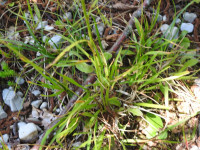
Perennial herbaceous plant belonging to the family Campanulaceae, it has a scapose habit, with erect, robust and striated stems, reaching a height ranging from 40 to 100 cm. The stem is glabrous in the upper part, rarely branched and contains milky latex inside. The base is equipped with a tuberous, fusiform and creeping rhizome, which ensures its perenniality.
The basal leaves are arranged in an irregular rosette and have an oblanceolate or spatulate shape, measuring about 15 x 90 mm, half of which is represented by the petiole. The leaf margin has obtuse teeth and the blade is ciliate on the lower leaves, while it is grooved on the cauline ones. The cauline leaves, progressively smaller towards the top, are lanceolate or almost triangular, with a reduced petiole, 40 to 60 mm long and 7-10 mm wide, with an entire margin. The leaf surface is generally glabrous.
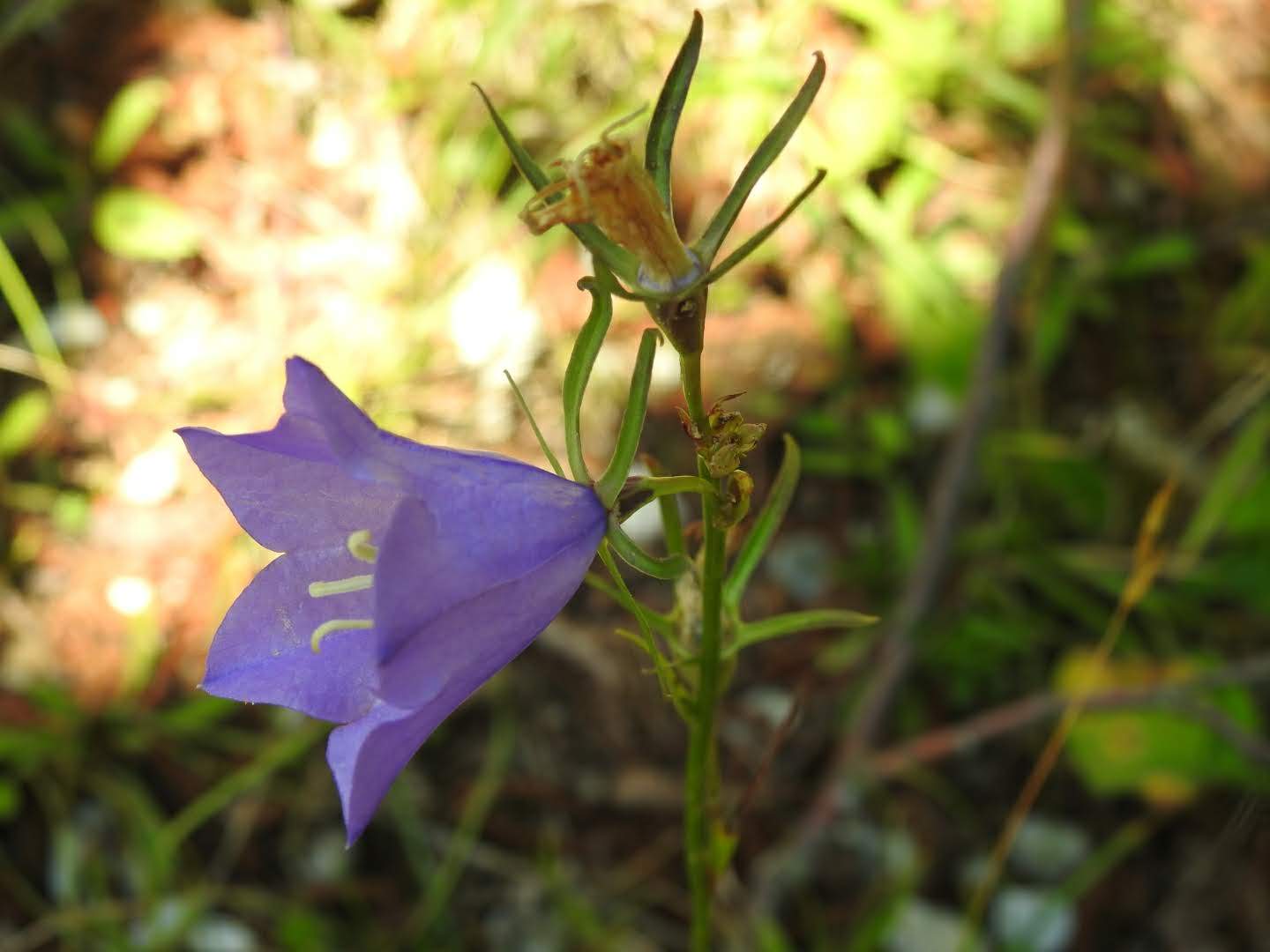
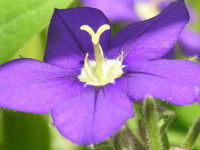
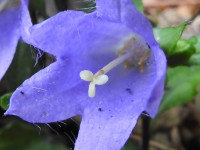
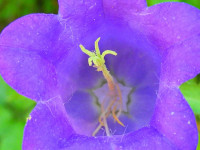
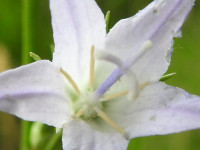
The flowers are gathered in elongated racemes, generally sparse, with inflorescences formed by 3-6 pedicellate flowers. The peduncles are short, 1-2 cm long, and bear two bracts. The corolla, bell-shaped and flared, measures from 2.5 to 4 cm in diameter and is typically blue-violet, rarely whitish. The corolla lobes are wide, obtuse and about one third of the total flower length deep. The calyx is composed of linear-lanceolate, erect-patent lobes, about 14 mm long — half the length of the corolla. The stamens are five, the style can be glabrous or slightly rough; the stigma is trifid and protrudes little or not at all beyond the corolla.
The fruit is an erect, trilocular and dehiscent capsule, containing numerous brownish seeds. The opening occurs through pores located in the apical part beneath the calyx teeth, facilitating seed dispersal.
Habitat and distribution
This species is widespread in Europe and parts of Asia (Eurasian range), from the Alpine and northern Apennine region to the South and Apulia, with reports also in Sardinia (although the latter may be erroneous). In Italy it is present in the Alps, in the northern, central and southern Apennines, up to about 2000 meters of altitude, although it prefers elevations between 100 and 1500 meters.
It grows preferably in light woodland environments, coppice woods, clearings, forest edges, thickets and tall grass pastures. It favors thermophilic and semi-shaded positions, with exposure from hilly to mountainous. The substrate is generally well-drained, typical of forest or pasture soils with a good presence of organic matter.
Flowering period
Flowering mainly occurs between April and August, with a higher concentration in the summer months (May-August). No significant variations in the flowering period are reported in different Italian geographical areas.
Ecology and pollination
The bellflower with peach-like leaves is pollinated by pollinating insects, particularly bees and bumblebees, attracted by the blue-violet color of the flowers and the bell shape which facilitates access to nectar. The arrangement of the flowers in racemes allows good visibility and accessibility. The trifid stigma and the position of the stamens are adapted to favor cross-pollination.
Seed dispersal occurs through the opening of the capsule via pores in the upper part, from which the brownish, light and numerous seeds can fall onto the underlying surfaces and spread thanks to abiotic factors such as wind or water.
Curiosities and traditional uses
The species is frequently cultivated in perennial plant gardens, appreciated for its simple flowers and pleasant blue-violet color, but double-flowered varieties are also known. No specific data are available on traditional medicinal or food uses, but its ornamental cultivation is widespread due to its beauty and ease of cultivation.
Etymology
The genus name Campanula derives from Latin and means "little bell," referring to the characteristic shape of the flower. The specific epithet persicifolia indicates the resemblance of its leaves to those of the peach (Prunus persica), with lanceolate shapes and slightly toothed margins. The Italian common name “Peach-leaved Bellflower” derives directly from this distinctive morphological characteristic.
Sources
- Prof. S. Pignatti, Flora d'Italia
- Acta Plantarum - Flora delle regioni italiane (scheda di Marinella Zepigi)
- World Flora Online (WFO)
Characteristics
Where I found it (5 sightings)
Classification
- Kingdom
- Plantae
- Family
- Campanulaceae
- Full name
- Campanula persicifolia L.
- Life form
- Emicriptofite scapose
Similar species
Search for species with similar characteristicsFurther reading
Noticed an error in the identification? Write to me
Other species of the same family
Campanulaceae
Explore
Other species of Campanulaceae