Botanical species
Jasione montana
L.
Sheep's-bit
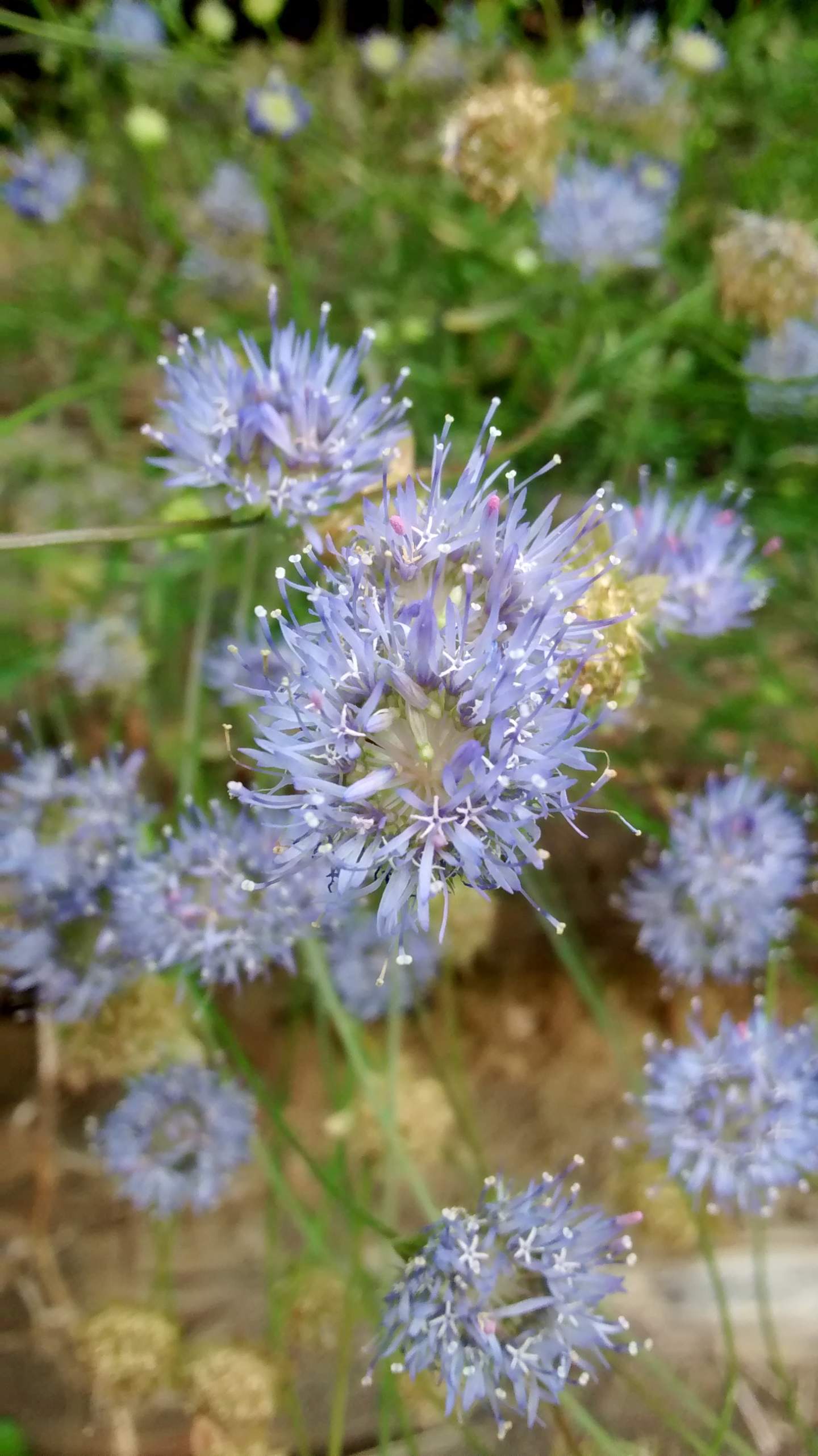
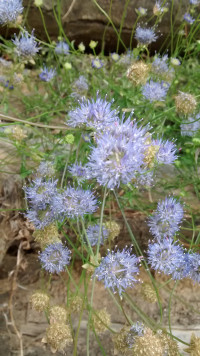
Description
Morphological description
Annual or biennial herbaceous plant, sometimes also perennial, which can reach a height between 10 and 80 cm, with an erect or ascending habit and stems generally branched from the base. The stem is stolon-free, robust in texture and characterized by a villous or tomentose surface, especially at the base, where a rough tomentum is found. The branches can be numerous, giving the plant a bushy appearance.
The leaves are mostly basal, deciduous at flowering time, sessile and slightly decurrent along the stem. The shape varies from linear to oblong, oblanceolate or spatulate, with typical dimensions between 7 and 55 mm in length and 1.5-10 mm in width. The leaf margin is entire or finely crenulate, with wavy edges and herbaceous texture, while the surface presents rough hairiness and ciliate hairs, especially on the edge. The cauline leaves are arranged spirally, more lanceolate or oblong-lanceolate, and decrease in size towards the apex of the stem.
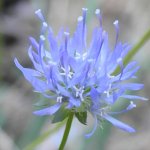
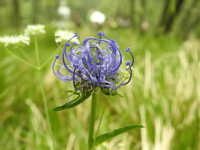
The inflorescence is a globular or subspherical capitulum, with a diameter ranging from 1 to 3 cm, composed of numerous small flowers, from 5 up to 300 per capitulum, gathered in a compact cluster. The capitulum is supported by a long peduncle, smooth or with some scattered hairs on the upper part, which can reach up to 25 cm in length. The involucral bracts, arranged in 1-3 series, are elliptical, ovate-triangular or lanceolate in shape, with entire or slightly denticulate margins, often ciliate and green or lilac in color.
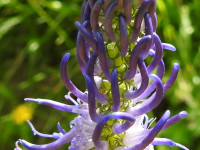
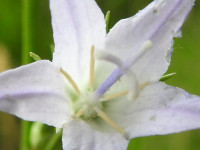
The flowers are blue, blue-violet or lilac in color, sometimes also white, with a corolla length from 3.5 to 15 mm. The corolla is initially tubular, then divides to the base into five linear and thin lobes, which open radially. The style protrudes beyond the petals, with a bifid stigma shaped like a mass. The calyx is glabrous, with linear lobes of length equal to or greater than the calyx tube, without awns.
The fruit is a dehiscent, bivalve capsule, oval, measuring between 2 and 5 mm, containing 6 to 8 brown seeds, elongated and about 0.7 x 0.2 mm.
The root system is taprooted and branched, firmly anchored in the soil, without the presence of stolons.
Habitat and distribution
A species typical of mountainous and hilly environments, the plant prefers sandy, siliceous, poor and well-drained soils, often on acidic or otherwise calcifuge substrates. It is common in rocky environments, uncultivated areas, poor grasslands and dry pastures, up to an altitude that can reach 2000 meters above sea level.
In Italy, it is widespread in many regions, especially in the mountainous and submontane areas of the Alpine arc and the Apennines, but also in lower areas with sandy or siliceous substrates. In the western Mediterranean and Europe it is present in similar habitats, from plains to alpine zones, extending to the Caucasus and North Africa.
The species prefers sunny or partially shaded exposures, with a preference for xerophilous and meso-xerophilous environments, adapting to conditions of low soil fertility.
Flowering period
The flowering generally extends from March to September, with a peak concentration in the summer months, from June to September. In warmer areas or with Mediterranean climates, flowering can start earlier and last longer, while in colder mountainous areas it tends to concentrate in the central summer months.
Ecology and pollination
The plant is pollinated by pollinating insects, particularly bees and other hymenoptera, attracted by the vivid color of the blue-violet corollas and the presence of accessible nectar and pollen. The shape of the corolla, divided into linear lobes, facilitates access to insects with thin legs.
Seed dispersal occurs mainly by natural fall from the dehiscent capsule, but can also be favored by wind or animals that accidentally move the seeds.
The species, although belonging to the Campanulaceae family, presents an inflorescence that can superficially resemble some Asteraceae such as Scabious, but is distinguishable by the structure of the fruit and corolla.
Curiosities and traditional uses
The common name "Sheep's-bit" reflects the often annual or biennial nature of the plant, although perennial populations and morphological variants exist.
In ethnobotany, the plant has traditionally been used in folk medicine for its astringent and vulnerary properties. The dried leaves are used in infusion as a tisane to facilitate the dilution of bronchial catarrh and to treat indigestion and gastrointestinal disorders. However, these applications are traditional in nature and not supported by thorough scientific evidence.
The plant is also appreciated in hay meadows, being favored by livestock, especially ruminants. The leaves, when crushed, emit an unpleasant odor, a characteristic that may help protect it from herbivore predators.
Etymology
The genus name "Jasione" has uncertain origins and several hypotheses have been proposed. One possible derivation is from the Greek "casis", which could refer to medicinal properties attributed to the plant. Another hypothesis links the name to the mythical Jason, famous Argonaut, while Linnaeus may have adopted it without a precise reference to ancient plants.
The epithet "montana" refers to the altitudinal distribution of the species, frequently found in mountainous environments, although the plant is also present in hilly and flat areas with suitable substrates.
The Italian common name "Sheep's-bit" indicates the prevailing biological cycle of the species, distinguishing it from possible varieties or related species with biennial or perennial cycles.
Sources
- Prof. S. Pignatti, "Flora d'Italia"
- Acta Plantarum - Flora delle regioni italiane (scheda di Marinella Zepigi)
- Tela Botanica / H. Coste, "Flore descriptive et illustrée de la France"
- World Flora Online (WFO)
Characteristics
Scheda botanica
| Famiglia | Campanulaceae |
|---|---|
| Fioritura | marzo – settembre |
| Forma biologica | Biennials |
| Habitat | with purple flowers, annual plant, with blue-purple flowers |
Domande frequenti
- Quando fiorisce Sheep's-bit?
- Sheep's-bit fiorisce marzo – settembre.
- Che tipo di pianta è Sheep's-bit?
- Sheep's-bit è una Hemicryptophytes (Biennials) secondo la classificazione di Raunkiaer.
- A quale famiglia appartiene Sheep's-bit?
- Sheep's-bit appartiene alla famiglia botanica Campanulaceae.
Where I found it (7 sightings)
Classification
- Kingdom
- Plantae
- Family
- Campanulaceae
- Full name
- Jasione montana L.
- Synonyms
- Jasione echinata Boiss. & Reut.; Jasione montana L. subsp. echinata (Boiss. & Reut.) Nyman
- Life form
- Hemicryptophytes biennials
Similar species
Search for species with similar characteristicsFurther reading
Noticed an error in the identification? Write to me
Other species of the same family
Campanulaceae
Explore
Other species of Campanulaceae