Botanical species
Legousia speculum-veneris
(L.) Chaix
Large Venus's-looking-glass
Description
Morphological description
Annual herbaceous plant 10 to 40 cm tall, with a well-developed taproot. The stem is erect and branched especially in the upper part, sometimes it can assume a prostrate-ascending habit. The stem surface is generally pubescent, with fine hairs that give a slight fuzziness.
The leaves are sessile and arranged oppositely along the stem. The lower leaves are ovate-spatulate in shape, while the upper ones are lanceolate; both have a slightly rough surface to the touch and wavy or crenulate margins. The size varies from 1 to 3 cm in length.
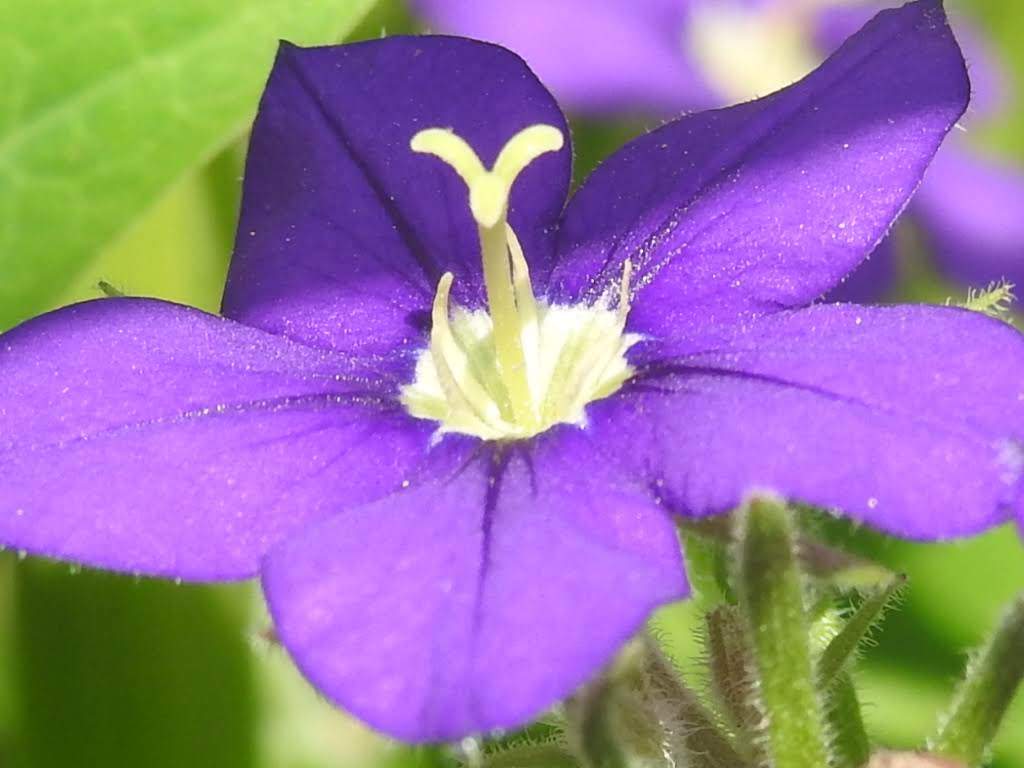
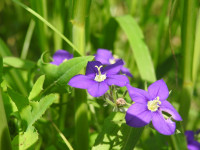
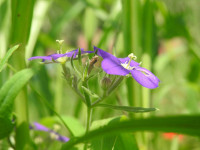
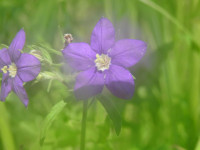
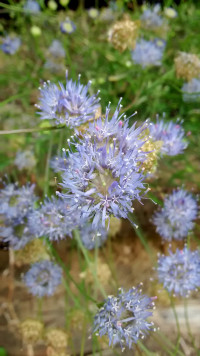
The inflorescence consists of lax racemes or few-flowered panicles, with numerous and subsessile flowers, arranged in small corymbs forming a terminal panicle. The flowers have a rotate corolla, that is with a barely evident basal tube, composed of five petals deeply divided almost to the base; the lobes are rounded-acuminate and bright dark violet in color, sometimes they can also be white, but less frequently. The diameter of the corolla varies from 1.5 to 2.5 cm. At the base of the corolla there is a whitish or light green throat (widened throat). The calyx is formed by five linear, strap-shaped, patent or falcate lobes, of similar length to the petals. Five stamens are present, and the ovary is superior and syncarpous with three carpels.
The fruit is a prismatic or fusiform capsule, angular, 1 to 1.5 cm long, dehiscent into three locules, which opens to release the seeds.
Habitat and distribution
The species is mainly widespread in Mediterranean regions, but its range extends northwards and eastwards into continental Europe and Western Asia, as well as in North Africa. In Italy it is present throughout almost the entire national territory, from the plains up to about 1300 meters altitude, with greater frequency in hilly areas between 500 and 800 meters.
It typically grows in anthropized environments such as cereal fields, vineyards, road edges and ditches, in well-lit areas with generally well-drained soils. Once very common in wheat fields, the species has declined due to intensive use of chemical herbicides and selected seeds, which have limited its spread especially in traditional agricultural environments.
Flowering period
Flowering extends from April to July, with a higher concentration in May and June. In some areas, especially more northern or mountainous ones, flowering may start later or last less, while in Mediterranean areas the period can be earlier and longer-lasting.
Ecology and pollination
The plant has a reproductive strategy typical of scapose therophytes, with an elongated floral axis often leafless. The flowers, with their wide and bright corolla, attract various pollinating insects, including bees and bumblebees, which promote entomogamous pollination. The rotate shape of the corolla facilitates access to nectar and pollen.
Seed dispersal mainly occurs through the dehiscence of the three-loculed capsules, which release the seeds into the surrounding soil. The species is adapted to rapidly colonize disturbed soils, such as agricultural ones, and to exploit traditional cultivation conditions.
Curiosities and traditional uses
The common name "Venus's mirror" refers to the flat and shiny shape of the corolla, which resembles a mirror. In folklore and ethnobotany, this plant is not particularly known for significant medicinal or food uses, probably due to its growth mainly in cultivated fields and relative abundance. However, the beauty of its flowers has made it appreciated in some local cultures as a spontaneous ornamental plant.
Etymology
The genus name, Legousia, is a tribute to the French botanist Legouz de Garland, founder of the botanical garden of Dijon in 1773. The specific epithet speculum-veneris derives from Latin and means "Venus's mirror", a clear reference to the flat, round and shiny shape of the corolla that resembles a mirror. The Italian common name directly reflects this poetic image, evoking the goddess Venus and the brightness of the flower.
Sources
- Acta Plantarum - Flora delle regioni italiane (actaplantarum.org)
- Acta Plantarum - Flora delle regioni italiane (scheda di Mirna Medri)
- Tela Botanica / H. Coste, "Flore descriptive et illustrée de la France"
- World Flora Online (WFO)
Characteristics
Where I found it (6 sightings)
Classification
- Kingdom
- Plantae
- Family
- Campanulaceae
- Full name
- Legousia speculum-veneris (L.) Chaix
- Life form
- Terofite scapose
Similar species
Search for species with similar characteristicsFurther reading
Noticed an error in the identification? Write to me
Other species of the same family
Campanulaceae
Explore
Other species of Campanulaceae