Botanical species
Campanula medium
L.
Canterbury Bells
Description
Morphological description
A robust biennial herbaceous plant, Canterbury Bells reaches a height between 20 and 80 cm. The habit is erect, with simple or slightly branched stems, characterized by an angular cross-section and a surface covered with rough, almost prickly hairs, which give the stem a cobwebby appearance and a reddish-brown coloration. The stem is therefore hairy, cobwebby, and bristly, presenting a fairly rough texture to the touch.
The leaves are alternately arranged along the stem and in a basal rosette, with a marked differentiation between basal and upper leaves. The basal leaves, gathered in a rosette, are oblanceolate or spatulate, petiolate, oval-lanceolate in shape with crenate or dentate margins, and are densely bristly. The upper leaves are smaller, sessile, lanceolate, and almost stem-clasping, with crenate or dentate margins, also covered with rough hairs.
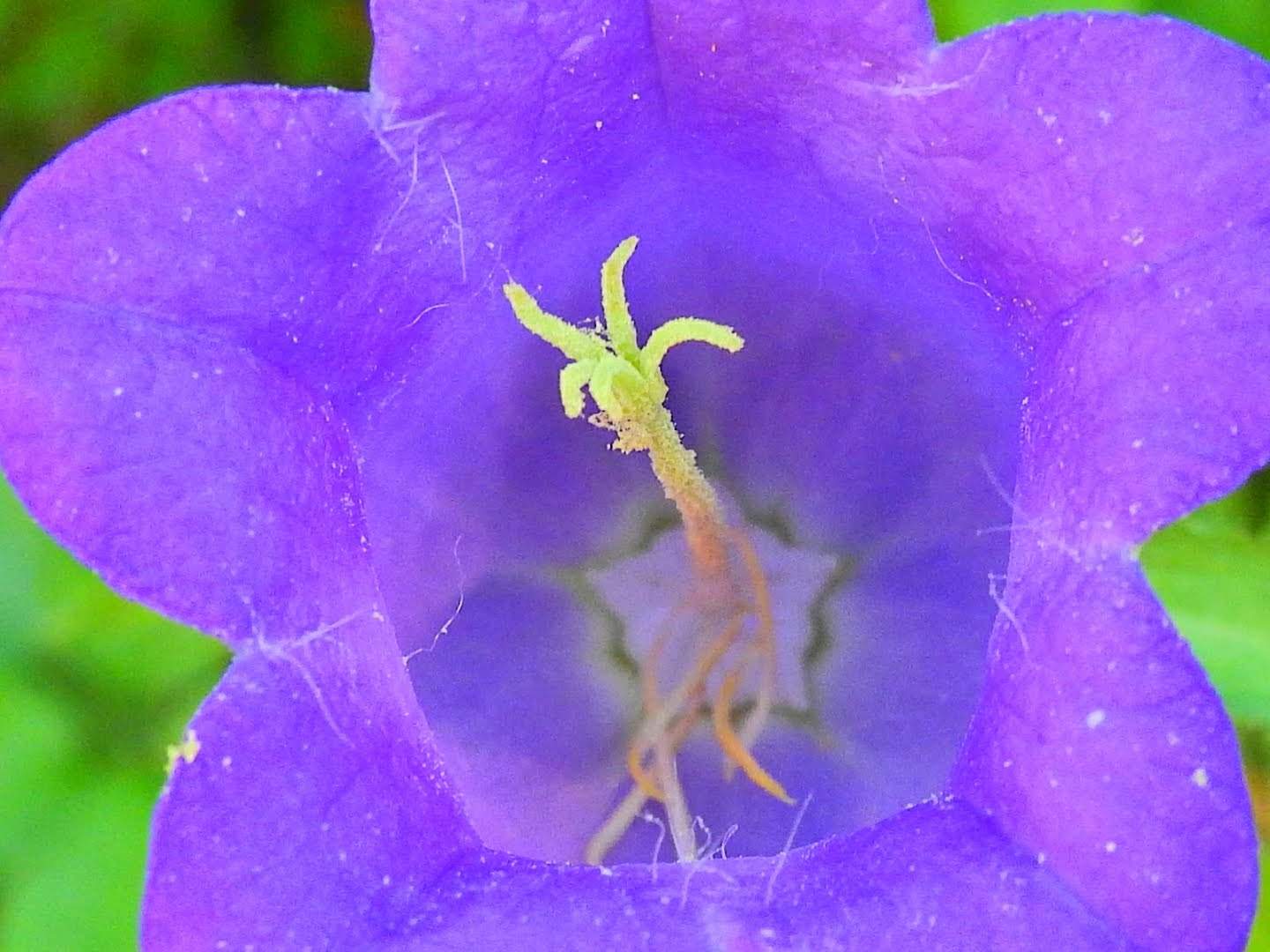
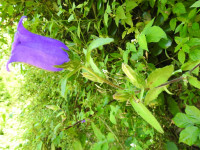
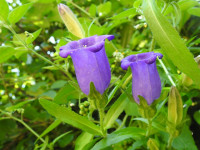
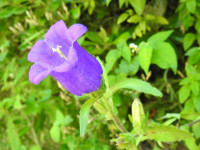
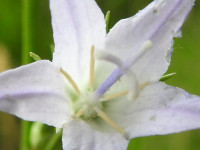
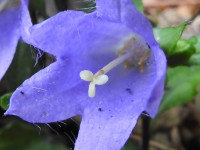
The flowers are of rare beauty, generally intense blue-violet in color, but may show color variations ranging from pale violet to white, although the latter is relatively rare. The flowers are pendulous, solitary or grouped in few-flowered racemes at the apex of the stem, supported by peduncles 2 to 10 cm long, equipped with two leafy bracts. The calyx has a tube of 8-10 mm with five lanceolate-cordate teeth of considerable size (7-9 x 13-17 mm) and folded appendages 8-10 mm long.
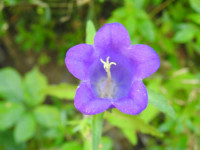
The corolla is bell-shaped with a barrel-shaped or slightly urn-shaped tube, about 4-5 cm long and 1.5 cm wide, with five short lobes and a velvety throat. The androecium consists of five free stamens, with membranous filaments and also free anthers. The stigma is cylindrical and presents five lobes. The fruit is an ovate, poricidal capsule with five locules that opens through five pores, facilitating seed dispersal.
The root system, typical of biennial plants, is well developed but not described in detail in the available sources.
Habitat and distribution
Canterbury Bells is a species typical of the northwestern Mediterranean area, with a distribution extending from central Italy to southern France, particularly in the Gard region. In Italy, its presence extends south to the Tuscan-Emilian Apennines, east to the Romagna Apennines, and north to the Aosta Valley, where it is however very rare.
It prefers habitats characterized by screes, rocky slopes, and shrublands, growing on well-drained soils, often calcareous or stony, at altitudes ranging from sea level up to about 1400 meters. The preferred exposure is sunny or partially shaded, typical of open and dry or semi-arid environments.
Flowering period
The flowering of Canterbury Bells is mainly concentrated in May and June, with a duration that can extend into summer, especially in milder areas. In cultivation, this period can be further prolonged, making the species appreciated for the beauty and longevity of its flowers.
Ecology and pollination
The reproduction of Canterbury Bells occurs mainly through entomogamous pollination, i.e., favored by pollinating insects, but autogamy, or self-pollination, also occurs. Pollination is therefore mixed, with the presence of insects visiting the pendulous flowers, attracted by the color and characteristic shape of the corolla.
Seed dispersal is barochory: seeds are dispersed by direct fall from the capsule that opens with pores, facilitating distribution around the mother plant and colonization of new suitable sites.
Curiosities and traditional uses
This species is particularly appreciated for the beauty of its flowers, which make it common in gardens, where it is cultivated mainly to extend the summer flowering. However, Canterbury Bells is subject to indiscriminate wild collection, threatening its survival, making adequate protection measures necessary.
No significant traditional medicinal or food uses are reported for this species, nor particular references in local folklore. Its importance is mainly ornamental and botanical.
Etymology
The genus name "Campanula" derives from the bell-shaped flowers, which resemble small bells. The specific epithet "medium" indicates an intermediate characteristic, probably referring to the size or morphological features of the plant compared to other species of the genus. The Italian common name "Canterbury Bells" derives directly from the scientific name.
Sources
- Prof. S. Pignatti, "Flora d'Italia"
- Acta Plantarum - Flora delle regioni italiane (scheda di Giuliano Salvai)
Characteristics
Scheda botanica
| Famiglia | Campanulaceae |
|---|---|
| Fioritura | maggio – giugno |
| Forma biologica | Biennials |
| Habitat | with purple flowers, with blue-purple flowers |
Domande frequenti
- Quando fiorisce Canterbury Bells?
- Canterbury Bells fiorisce maggio – giugno.
- Che tipo di pianta è Canterbury Bells?
- Canterbury Bells è una Hemicryptophytes (Biennials) secondo la classificazione di Raunkiaer.
- A quale famiglia appartiene Canterbury Bells?
- Canterbury Bells appartiene alla famiglia botanica Campanulaceae.
Where I found it (9 sightings)
Classification
- Kingdom
- Plantae
- Family
- Campanulaceae
- Full name
- Campanula medium L.
- Life form
- Hemicryptophytes biennials
Similar species
Search for species with similar characteristicsNoticed an error in the identification? Write to me
Other species of the same family
Campanulaceae
Explore
Other species of Campanulaceae