Botanical species
Campanula rapunculus
L.
Rampion Bellflower
Description
Morphological description
Biennial herbaceous plant reaching a height between 30 and 100 cm, with an erect habit and a thin, angular stem, generally glabrous or with slight scattered pubescence, often branched in the upper part. The base is provided with a taproot, tuberous and fleshy, fusiform in shape, whitish, up to about 10 cm long, similar to a small turnip.
The basal leaves are arranged in a rosette and are oblanceolate or oblong-obovate in shape, with a dentate or crenate-dentate margin and light green surface, often wavy. These leaves have a petiole and develop mainly in autumn and spring. The cauline leaves, on the other hand, are very reduced, lanceolate or linear, sessile, alternate and sparse, up to 1.5-2 cm long, with simpler margins compared to the basal ones.
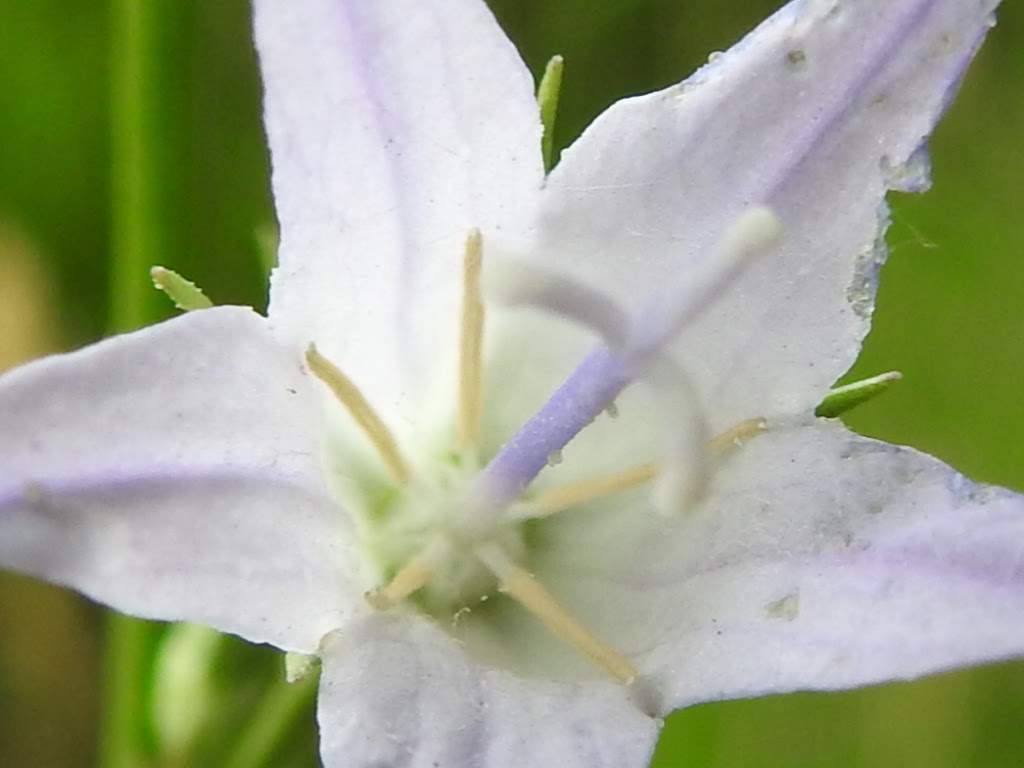
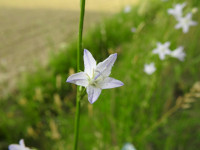
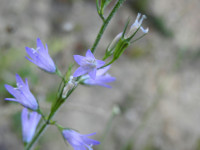
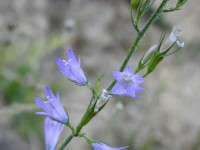
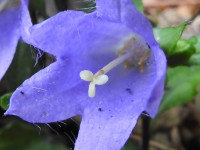
The flowers are grouped in panicles or tight elongated clusters, with small-petioled axillary flowers arranged more or less erect. The calyx is glabrous, formed by five linear teeth, about two-thirds the length of the corolla, often patent or turned backward. The corolla is campanulate, gamopetalous, 1-2 cm long (up to 2.5 cm according to some sources), with a color ranging from pale bluish-lilac to lilac, rarely white or pinkish-violet, with five acute lobes folded outward, reaching about one-third of the total length of the corolla. The corolla dimensions tend to be longer than wide, with a tube length about two-thirds of the flower. The style is simple and hairy, while the stamens are five, free with filaments swollen at the base.
The fruit is a dehiscent capsule, erect and glabrous, containing numerous small seeds.
Habitat and distribution
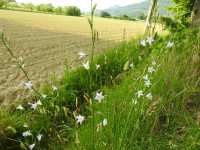
Species widely distributed in the paleotemperate range, found in many regions of Europe, Western Asia, and North Africa. In Italy it is present throughout the territory, preferring environments with calcareous and well-drained soils. It commonly grows in uncultivated places, road edges, fields, dry meadows, olive groves, and coppices, up to an altitude of about 1500 m a.s.l.
It prefers sunny or partially shaded exposures, typical of open woodland environments, clearings, forest edges, and dry grasslands. Its presence is common in Mediterranean and temperate regions, where it adapts well to poor and dry soil conditions.
Flowering period
Flowering generally extends from May to August, with possible variations depending on altitude and latitude. In more temperate or mountainous climates, flowering may start later or be shorter, while in warmer and Mediterranean areas it can begin already in late spring.
Ecology and pollination
The plant is mainly pollinated by pollinating insects attracted by the bluish-lilac color of the flowers, such as bees, bumblebees, and other hymenopterans. The structure of the corolla, with its open lobes and bell-shaped form, facilitates access to nectar and pollen. The presence of a well-developed and toothed calyx helps protect the flowers during development.
The seeds contained in the capsule are small and light, favoring dispersal mainly by falling (barochory), but they can also be transported by insects or small animals that facilitate their spread in the surrounding territory.
Curiosities and traditional uses
The root of this species is edible and appreciated in cuisine for its sweetish taste, due to the presence of inulin, a carbohydrate that does not contain starch and that, when broken down, produces levulose instead of glucose. This makes the consumption of the root suitable also for diabetics. The roots are consumed raw, often in salads, while the basal leaves, with a slightly bitter but pleasant taste, are used to flavor soups, broths, and savory pies.
From a medicinal point of view, the leaves were used in external applications to combat warts, while the flower infusion was employed as a mouthwash for gargling. The plant therefore has a traditional medicinal value, although such uses should be considered for informational purposes only.
The German name Rapunzel-Glockenblume is known thanks to the Brothers Grimm fairy tale "Rampion Bellflower," in which the protagonist is associated with this plant, highlighting its cultural as well as botanical importance.
Etymology
The generic name "Campanula" derives from the bell shape of the flowers typical of the genus. The specific epithet "rapunculus" means "small turnip" in Latin, referring to the shape of the tuberous root, similar to that of a turnip. The Italian common name "Rampion Bellflower" reflects this characteristic, emphasizing the edible root and the popular tradition linked to the plant.
Sources
- Prof. S. Pignatti, "Flora d'Italia"
- Acta Plantarum - Flora delle regioni italiane (scheda di Giuliano Salvai)
- Tela Botanica / H. Coste, "Flore descriptive et illustrée de la France"
- World Flora Online (WFO)
Characteristics
Scheda botanica
| Famiglia | Campanulaceae |
|---|---|
| Fioritura | maggio – agosto |
| Forma biologica | Biennials |
| Habitat | edible plant, with lilac flowers, biennial plant |
| Uso alimentare | Commestibile |
Domande frequenti
- Quando fiorisce Rampion Bellflower?
- Rampion Bellflower fiorisce maggio – agosto.
- È commestibile Rampion Bellflower?
- Rampion Bellflower è considerata commestibile. Verifica sempre le parti eduli e la preparazione corretta prima del consumo.
- Che tipo di pianta è Rampion Bellflower?
- Rampion Bellflower è una Hemicryptophytes (Biennials) secondo la classificazione di Raunkiaer.
- A quale famiglia appartiene Rampion Bellflower?
- Rampion Bellflower appartiene alla famiglia botanica Campanulaceae.
Where I found it (6 sightings)
Classification
- Kingdom
- Plantae
- Family
- Campanulaceae
- Full name
- Campanula rapunculus L.
- Life form
- Hemicryptophytes biennials
Similar species
Search for species with similar characteristicsFurther reading
Noticed an error in the identification? Write to me
Other species of the same family
Campanulaceae
Explore
Other species of Campanulaceae