Botanical species
Phyteuma italicum
Arv.-Touv.
Raponzolo italiano




Description
Morphological description
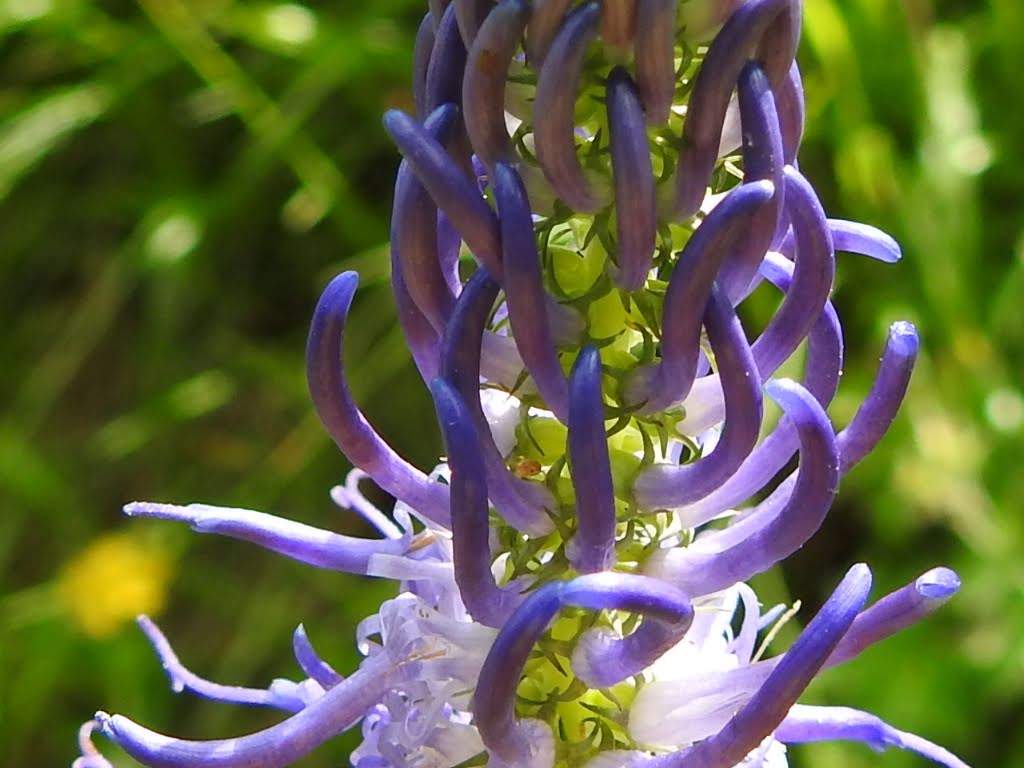
Perennial herbaceous plant, the Italian Raponzolo presents an erect habit and a growth that can reach a height between 70 and 90 cm. The stem is ascending, glabrous and hairless, a characteristic that gives the plant a smooth and shiny appearance.
The leaves show a notable differentiation along the vegetative axis. The basal leaves, which generally disappear at flowering time, are glabrous, narrow and elongated with a blade gradually attenuated into the petiole, without a clear distinction between blade and petiole. These leaves are 8 to 20 times longer than their width and have a serrated margin with more or less spaced teeth. The cauline leaves, on the other hand, are sessile and often have entire margins, showing a progressively lanceolate shape. The lower leaves are distinguished by the serrated edge, while the middle and upper ones tend to have an entire margin.
The inflorescence is an elongated and narrow spike, about 10 cm long, placed at the apex of the flowering stem. It bears numerous flowers with color varying from violet-blue to light purple. The flowers are characterized by a corolla divided into five lobes, fused at the base and apex, resulting fissured on the sides. Each flower has two stigmas and stamens with ciliate filaments, typical elements of Campanulaceae.
The fruit is a poricidal capsule, obovoid or subglobose in shape, 3-4 mm long, which opens laterally through pores (poricidal dehiscence). Inside are numerous ovoid or ellipsoid seeds, about 0.6-0.8 mm long, brown in color, smooth and shiny.
The root system, not described in detail in the sources, can be presumed to be taproot or fasciculate type typical of perennial mountain herbs, suitable to support the plant in often poor and well-drained soils of the habitats frequented.
Habitat and distribution
The Italian Raponzolo is a subendemic species mainly present in the Italian area, with limited crossings into the mountainous areas of Switzerland and France near the western Alps. In Italy its distribution covers the western Alps, from the Lake Como area to Liguria and the northern Apennines, including the Apuan Alps and the Monte Amiata reliefs, where it reaches the southern limit of its distribution.
Growing mainly in mountain environments, this species prefers pastures, grassy slopes and sparse woods, adapting to a wide altitudinal range from the plain up to about 2100 meters above sea level. The soils where it grows are generally well-drained, often calcareous or siliceous, with sunny or partially shaded exposures typical of open or semi-shaded environments.
Flowering period
The flowering of the Italian Raponzolo mainly extends from May to July. This period can vary slightly depending on altitude and latitude: in higher and northern areas flowering tends to shift towards the summer months (June-July), while in lower and southern areas it can start already in May.
Ecology and pollination
The reproductive strategy of the Italian Raponzolo is based on showy flowering with corollas of light violet or violet-blue color, which attracts various pollinating insects. Among the pollinators are probably bees, bumblebees and other typical pollinating insects of pastures and mountain woods, attracted by the color and shape of the flowers, which facilitate the collection of nectar and pollen.
The fruit dehiscence through lateral pores favors seed dispersal, which are numerous, small and shiny, probably dispersed mainly by wind (anemochory) or by falling at short distance from the mother plant. No particular animal dispersal strategies are reported.
Curiosities and traditional uses
No specific traditional, medicinal or food uses are documented for this species. The genus name, of Greek origin, refers to plants to be planted or cultivated, but there is no evidence that the Italian Raponzolo had particular ethnobotanical applications. Its presence in pastures and mountain meadows contributes to the balance of habitats and floristic biodiversity.
Etymology
The generic name “Phyteuma” derives from the Greek φύτευμα (phýteuma), meaning “that which is planted or sown”. This term was used in antiquity by Theophrastus and later by Dioscorides and Pliny to indicate plants with aphrodisiac properties or cultivated, perhaps originally referring to different species but assimilated in the genus.
The specific epithet “italicum” indicates the geographical area of prevalence of the species, namely Italy, emphasizing its mainly Italian distribution, with some presence in neighboring territories.
The Italian common name “Raponzolo italiano” recalls the similarity with other plants of the genus Phyteuma (raponzoli) and specifies the distribution area of the taxon, distinguishing it from other related species.
Sources
- Prof. S. Pignatti, Flora d’Italia
- Acta Plantarum - Flora delle regioni italiane (sheet by Giuliano Salvai)
Characteristics
Scheda botanica
| Famiglia | Campanulaceae |
|---|---|
| Fioritura | maggio – luglio |
| Forma biologica | Scapose |
| Habitat | with purple flowers, plant with dimorphic leaves |
Domande frequenti
- Quando fiorisce Raponzolo italiano?
- Raponzolo italiano fiorisce maggio – luglio.
- Che tipo di pianta è Raponzolo italiano?
- Raponzolo italiano è una Hemicryptophytes (Scapose) secondo la classificazione di Raunkiaer.
- A quale famiglia appartiene Raponzolo italiano?
- Raponzolo italiano appartiene alla famiglia botanica Campanulaceae.
Where I found it (14 sightings)
Classification
- Kingdom
- Plantae
- Family
- Campanulaceae
- Full name
- Phyteuma italicum Arv.-Touv.
- Synonyms
- Phyteuma scorzonerifolium Vill.; Phyteuma scorzonerifolium auct. Fl. Ital.
- Life form
- Hemicryptophytes scapose
Similar species
Search for species with similar characteristicsFurther reading
Noticed an error in the identification? Write to me
Other species of the same family
Campanulaceae




Explore
Other species of Campanulaceae