Botanical family
Campanulaceae
Description
Botanical characteristics
The Campanulaceae include herbaceous, aromatic plants, annual, biennial or perennial, but also include shrubs and rare tree species. The typical habit of the stem is erect, although there are carpet-like, climbing or bushy forms. The roots can be taprooted, tuberous or rhizomatous.
The leaves are arranged spirally in an alternate manner (rarely opposite), without stipules at the base. The basal leaves often differ from the cauline ones, which are generally sessile or clasping and sometimes transformed into bracts near the inflorescence. The blade is almost always entire, broadly lanceolate, with often toothed and slightly milky margins.
The inflorescence is variable: it can consist of a single flower or more complex structures such as racemes, panicles or corymbs. The flowers, sessile or pedunculate, are generally hermaphroditic, actinomorphic and pentamerous, but in some cases can be zygomorphic. They are tetramerous, with calyx, corolla, androecium and gynoecium well distinct.
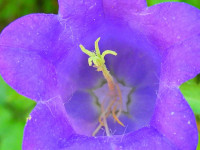
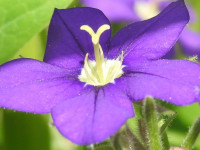
The calyx typically has five teeth, which can be appressed, erect or spreading, sometimes with reflexed appendages. The corolla is predominantly campanulate and gamopetalous; it can be bilabiate or tubular and has an upper opening. The most common colors are blue, violet and white.
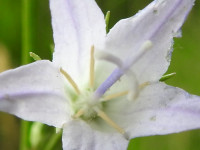
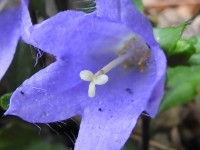
The androecium is formed by five stamens alternating with the petals, with free anthers and filaments free or fused at the base of the corolla. The pollen is spheroidal and tricolpate. In the gynoecium there are from two to five carpels, with generally inferior ovary and axile placentation; the style is single and often has brush-like hairs for pollen collection.
The fruit is a multilocular capsule with dehiscence through lateral pores or slits, containing minute seeds with fleshy endosperm and straight embryo. In some cases the fruit is an indehiscent berry. The calyx teeth often remain persistent around the fruit.
The plants are almost always terrestrial, rarely aquatic or epiphytic, and possess milky sacs and laticiferous tubes containing inulin substances, as well as cystoliths on the hairs.
Distribution and diversity
The family is widely distributed in temperate zones worldwide, with particular concentration in the mountainous regions of Europe, Asia and America. They are absent only in extremely cold or arid regions such as Antarctica, the Sahara and northern Greenland. The species prefer cool or cold climates and are commonly found in the Prealps, Alps, Apennines and the Po Valley in Italy.
The family counts about 89 genera worldwide, with about a dozen genera and approximately 70-100 species present in the Italian territory. Outside Europe, Campanulaceae are also found in subtropical areas and mountain ranges such as the Himalayas and Andes. The shrubby and tree forms are almost exclusively confined to the Hawaiian Islands.
Main genera and representative species
Among the most important genera of Campanulaceae in Italy are:
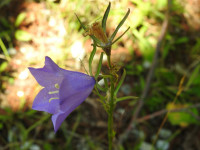
- Campanula: the best-known genus, characterized by small bell-shaped blue or violet flowers, with numerous species widespread in the Italian mountainous areas.
- Lobelia: includes both herbaceous and shrubby species, some with tubular flowers often blue or white in color.
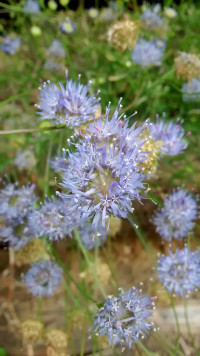
- Jasione: small plants with globose inflorescences of blue or violet flowers.
- Wahlenbergia: characterized by flowers similar to those of Campanula, but generally with a more slender habit.
In Italy, species of the genus Campanula are the most widespread and representative of the family, often present in mountain meadows and clearings.
Etymology
The family name derives from the genus Campanula, which comes from Latin and means “little bell”, referring to the typical campanulate shape of the flowers. The term was first used by the botanist Antoine-Laurent de Jussieu in his natural classification of flowering plants in 1789.
Curiosities and uses
Campanulaceae have an important ecological role, promoting pollination through insects such as bees and butterflies, with specialized mechanisms for pollen release and collection. Seed dispersal occurs mainly through wind and insects, such as ants.
Some species are appreciated for their ornamental value due to their showy and colorful flowers, used in gardens and flower beds. However, specific data on food or medicinal uses are not widely documented for this family in the consulted sources.
Sources
- Wikipedia
Species of the family
8 species catalogued
Explore
Other botanical families