Botanical species
Muscari comosum
(L.) Mill.
Tassel Hyacinth
Description
Morphological description
Perennial herbaceous plant belonging to the family Asparagaceae, with a geophytic bulbous life cycle. The perennial organ is an ovoid bulb, reddish-brown in color, about 2-4 cm in diameter, from which leaves and a flowering stem develop each year.
The height generally varies between 15 and 50 cm, with basal fleshy, linear green leaves, 0.5 to 1.5 cm wide, shorter than the stem. The leaves are grooved underneath, sheathing at the base, with rough margins and tapering to an acute apex; they appear prostrate or erect-spreading and tend to wilt as the season progresses.
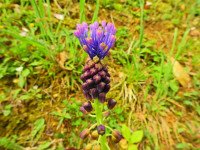
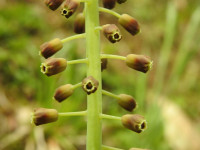
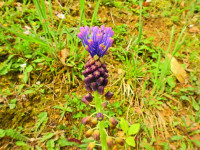
The inflorescence is a terminal raceme often cylindrical or pyramidal, loose and elongated, which can exceed 20 cm in length. The flowers are distinguished into two types: the fertile flowers, located in the lower part of the raceme, are reddish-brown or brownish-green, with a tubular-urn-shaped perigonium 7-9 mm long, blue-violet or dull yellow, equipped with six tepals with yellowish teeth at the apex. These fertile flowers are inserted in the axil of small bracts and have peduncles initially erect that orient horizontally or downward during fruiting. The stamens are six with reddish anthers, while the style and stigma are white; the ovary is superior and tricarpellary.
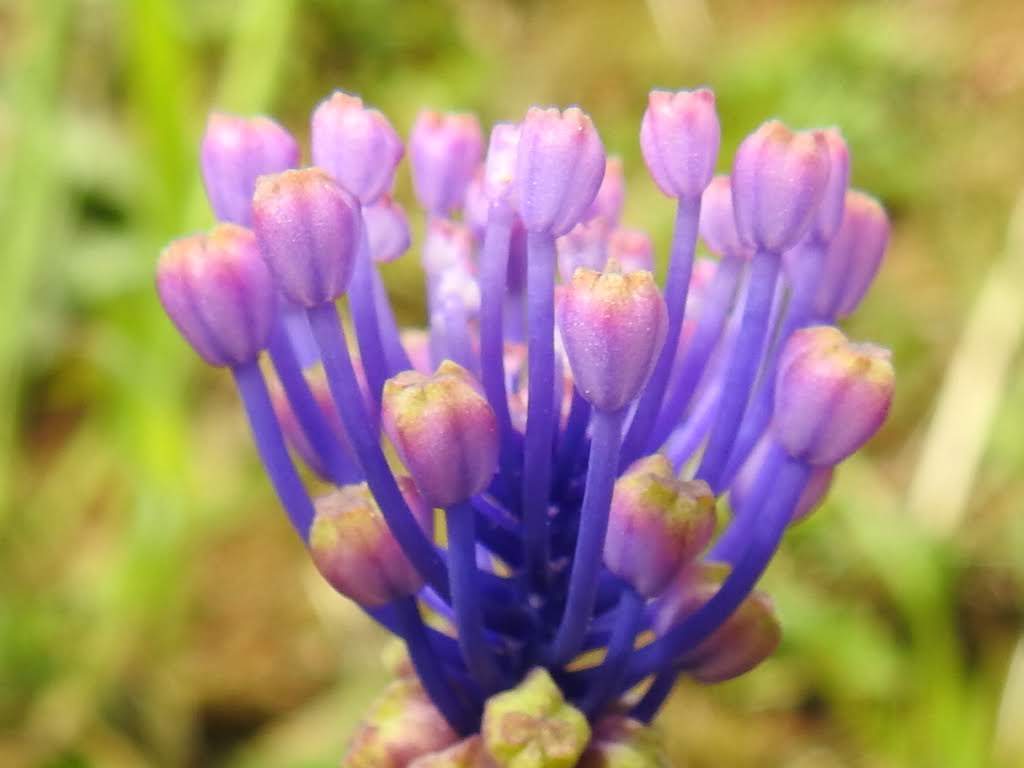
Above the fertile flowers is a characteristic tuft (called “tassel”) of sterile flowers of a bright blue-violet color, smaller in size, with longer peduncles directed upwards. This “plume” gives the plant a distinctive appearance.
The fruits are ovate-triangular, blunt capsules, up to 15 mm long, with three valves that open at maturity to release 6 globose black seeds.
The root system is bulbous and tuberous, with the bulb deep in the soil, allowing the plant to survive the most adverse environmental conditions.
Habitat and distribution
The species is widely distributed in the Mediterranean area, with a range extending throughout Italy, being more frequent in southern regions. It is also present in central and southern Europe, western Asia, and North Africa.
It grows mainly in open environments such as cultivated fields, uncultivated land, vineyards, and dry meadows, preferring calcareous and well-drained soils. It is commonly found up to 1,500 meters of altitude, from hilly to medium mountainous zones.
The preferred exposure is sunny or semi-sunny, in Mediterranean climate conditions with dry summer seasons.
Flowering period
Flowering occurs mainly between April and July, with peaks that may vary slightly depending on latitude and altitude. In Italy and the Mediterranean, the main period is from late spring to early summer.
Ecology and pollination
The fertile flowers, with their brown-green color and tubular shape, are adapted for pollination by pollinating insects, particularly bees and other hymenopterans, attracted both by the color and the flower structure.
The presence of the tuft of blue-violet sterile flowers at the apex of the raceme may have an ecological function as a visual attractant for pollinating insects, thus facilitating the plant’s reproduction.
Seed dispersal occurs through the dropping of mature capsules, which open to release the black and globose seeds, promoting local propagation.
Curiosities and traditional uses
Known in Italy as “Tassel Hyacinth”, it is an edible plant with a long traditional use in food and folk medicine.
The underground bulb is used in cooking similarly to onion: it can be eaten raw in salads or cooked in sauces, boiled, or prepared sweet and sour. It is also preserved pickled as an appetizer or side dish. In Basilicata, the Tassel Hyacinth is recognized as a traditional agri-food product, protected by the Ministry of Agricultural Policies.
From a medicinal point of view, the plant has diuretic and emollient properties, thanks to the presence of sugars and mucilages. It is used to stimulate urinary secretions and, for external use, as an emollient and refresher for irritated, dry skin or with boils.
In ethnobotany, in Spain it is called “Hierba de los amores” and was historically attributed to the bulbs properties stimulating sexual desire.
Etymology
The genus name probably derives from the Sanskrit mushka (testicle), referring to the shape of the bulbs, or from modern Greek moschàri (clustered hyacinth) or classical Greek mòschos (musk), for the scent of some species of the genus.
The specific name comosum means “tufted”, alluding to the characteristic “tassel” of blue sterile flowers crowning the top of the inflorescence.
The synonym Leopoldia is a tribute to Leopold II, Grand Duke of Tuscany.
The Italian common name “lampascione” derives from popular tradition and refers precisely to the edible bulb, similar to the onion.
Sources
- Acta Plantarum - Flora delle regioni italiane (scheda di Giuliano Salvai)
- Tela Botanica / H. Coste, "Flore descriptive et illustrée de la France"
- World Flora Online (WFO)
Characteristics
Scheda botanica
| Famiglia | Asparagaceae |
|---|---|
| Fioritura | aprile – giugno |
| Forma biologica | Bulbous |
| Habitat | edible plant, with purple flowers, plant with a scapose habit |
| Uso alimentare | Commestibile |
Domande frequenti
- Quando fiorisce Tassel Hyacinth?
- Tassel Hyacinth fiorisce aprile – giugno.
- È commestibile Tassel Hyacinth?
- Tassel Hyacinth è considerata commestibile. Verifica sempre le parti eduli e la preparazione corretta prima del consumo.
- Che tipo di pianta è Tassel Hyacinth?
- Tassel Hyacinth è una Geophytes (Bulbous) secondo la classificazione di Raunkiaer.
- A quale famiglia appartiene Tassel Hyacinth?
- Tassel Hyacinth appartiene alla famiglia botanica Asparagaceae.
Where I found it (13 sightings)
Classification
- Kingdom
- Plantae
- Family
- Asparagaceae
- Full name
- Muscari comosum (L.) Mill.
- Synonyms
- Hyacinthus comosus L.; Leopoldia comosa (L.) Parl.
- Life form
- Geophytes bulbous
Similar species
Search for species with similar characteristicsFurther reading
Noticed an error in the identification? Write to me
Other species of the same family
Asparagaceae
Explore
Other species of Asparagaceae