Botanical species
Ornithogalum umbellatum
L.
Garden Star-of-Bethlehem
Description
Morphological description
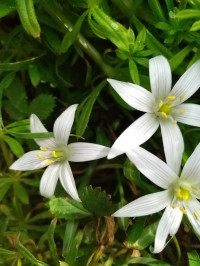
Perennial bulbous herbaceous plant, the common Star of Bethlehem presents an erect, smooth and glabrous scape, reaching a height between 10 and 35 cm. The bulb, ovoid in shape and about 1.5-3 cm in diameter, is equipped with numerous bulbils that allow vegetative multiplication. From the base of the bulb emerge from three to eight basal leaves, linear, fleshy and herbaceous in texture, measuring between 25 and 30 cm long and 0.6-0.8 cm (2–6 mm) wide, characterized by a typical channeling with a central white band on the upper surface.
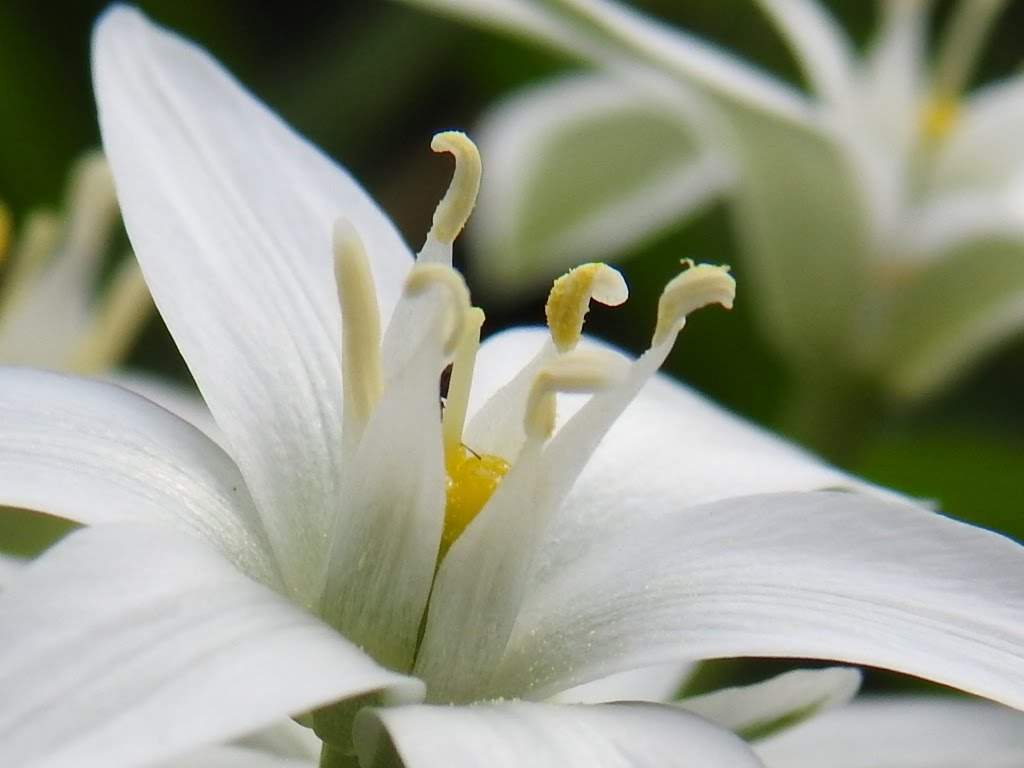
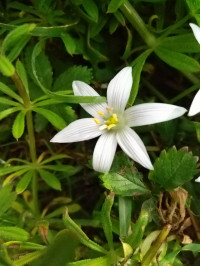
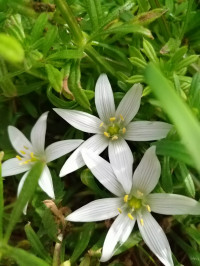
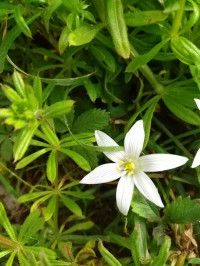
The inflorescence consists of a subapical umbel, formed by 5-15 flowers, with ascending pedicels up to 9 cm long, often longer than the bracts which thus appear shorter or of similar length. The flowers are erect and composed of six tepals arranged in a star shape, elliptical or oblanceolate in shape, 15-25 mm long and 4-8 mm wide. The color of the tepals is milky white inside, while the outer side has a wide central green band bordered with white, giving a characteristic appearance to the flowering. The stamens, numbering six, are about half the length of the tepals and have ribbon-shaped filaments. The ovary is obovoid, generally 3-4 mm longer than the style.
The fruit is an obovoid, fleshy capsule, with three locules and six well-defined ribs, about 1.8 x 1.3 cm in size, containing numerous seeds. The plant has a bulbous root system, which renews annually, and presents a vegetative structure adapted to reproduction both sexually and vegetatively thanks to the bulbils.
Habitat and distribution
This species is native to Europe and is commonly found in many Italian regions and the Mediterranean basin. It prefers woodland environments, moist and fresh meadows, road edges, gardens and vineyards, with a preference for well-drained soils but rich in organic matter. It is frequent in hilly and mountainous environments up to subalpine altitudes, generally between 0 and 1500 meters above sea level.
The common Star of Bethlehem prefers full sun or partial shade exposures, where it can benefit from temperate climatic conditions. Its presence is reported especially in grasslands, orchards, parks and cultivated areas, where it can also colonize disturbed soils and cultivation margins.
Flowering period
Flowering mainly occurs in April and May, with occasional extensions until June in cooler or higher altitude areas. In some southern Italian regions and warmer Mediterranean areas, flowering may start earlier or extend slightly over time, adapting to local climatic conditions.
Ecology and pollination
The reproductive strategy of the common Star of Bethlehem combines the production of numerous seeds through flowering with vegetative multiplication by means of bulbils. The flowers, with white tepals and a characteristic green band, are erect and star-shaped open, facilitating access to pollinating insects.
Pollination is mainly entomogamous, favored by pollinating insects such as bees and other generalist pollinators attracted by the color and shape of the flower. The long pedicels and flowers arranged in umbels make the plant easily accessible to flying insects. Seed dispersal occurs through natural falling from the fleshy capsule, contributing to the colonization of the surrounding soil.
Curiosities and traditional uses
The common name "Star of Bethlehem" probably derives from the milky white color of the flowers, which indeed resembles milk, and from popular belief linked to ancient medicinal or symbolic properties attributed to the plant. It is important to emphasize that the species is toxic if ingested, due to the presence of cardiotonic compounds in the bulbs and leaves, therefore it is not used as food.
Historically, some populations have used the plant in a limited way in herbal medicine, however medicinal use is now discouraged due to toxicity. In folklore, the plant is sometimes associated with popular beliefs related to protection or purification rituals, but such uses are poorly documented and of local character.
Etymology
The scientific name Ornithogalum umbellatum derives from Greek: “ornitho” (bird) and “galum” (milk), referring to the milky white color of the flowers and with a poetic allusion to the fact that birds might be attracted by the color. The specific term “umbellatum” refers to the umbrella-like arrangement of the flowers (inflorescence in umbels or groups similar to umbrellas).
The Italian common name "Latte di gallina" visually recalls the milky white color of the flowers, while “gallina” could be a popular reference linked to tradition or the shape of the plant, although no unequivocal documented explanation is found.
Sources
- Prof. P.V. Arrigoni, "Flora analitica della Toscana", "Flora dell'Isola di Sardegna"
- Tela Botanica / H. Coste, "Flore descriptive et illustrée de la France"
- World Flora Online (WFO)
Characteristics
Where I found it (8 sightings)
Classification
- Kingdom
- Plantae
- Family
- Asparagaceae
- Full name
- Ornithogalum umbellatum L.
- Life form
- Geofite bulbose
Similar species
Search for species with similar characteristicsNoticed an error in the identification? Write to me
Other species of the same family
Asparagaceae
Explore
Other species of Asparagaceae