Botanical species
Prospero autumnale
(L.) Speta
Autumn Squill
Description
Morphological description
Perennial bulbous herbaceous plant, typically 15 to 40 cm tall, characterized by a hemispherical bulb of pyriform shape, with dimensions varying from 1 to 3 cm in height and 1.5 to 5 cm in diameter, covered by brown tunics. The stem, or scape, is erect, cylindrical, and longitudinally striated, with a smooth and glabrous surface; generally, two to three scapes per plant are observed, produced in autumn, external to the leaf sheathing.
The leaves are basal, usually two in number, opposite and linear, about 1-2 mm wide and 60-90 mm long. They are pale green, often slightly chlorotic, with a grooved surface and blunt apex. The outermost leaves may be reduced to more or less chlorotic scales.
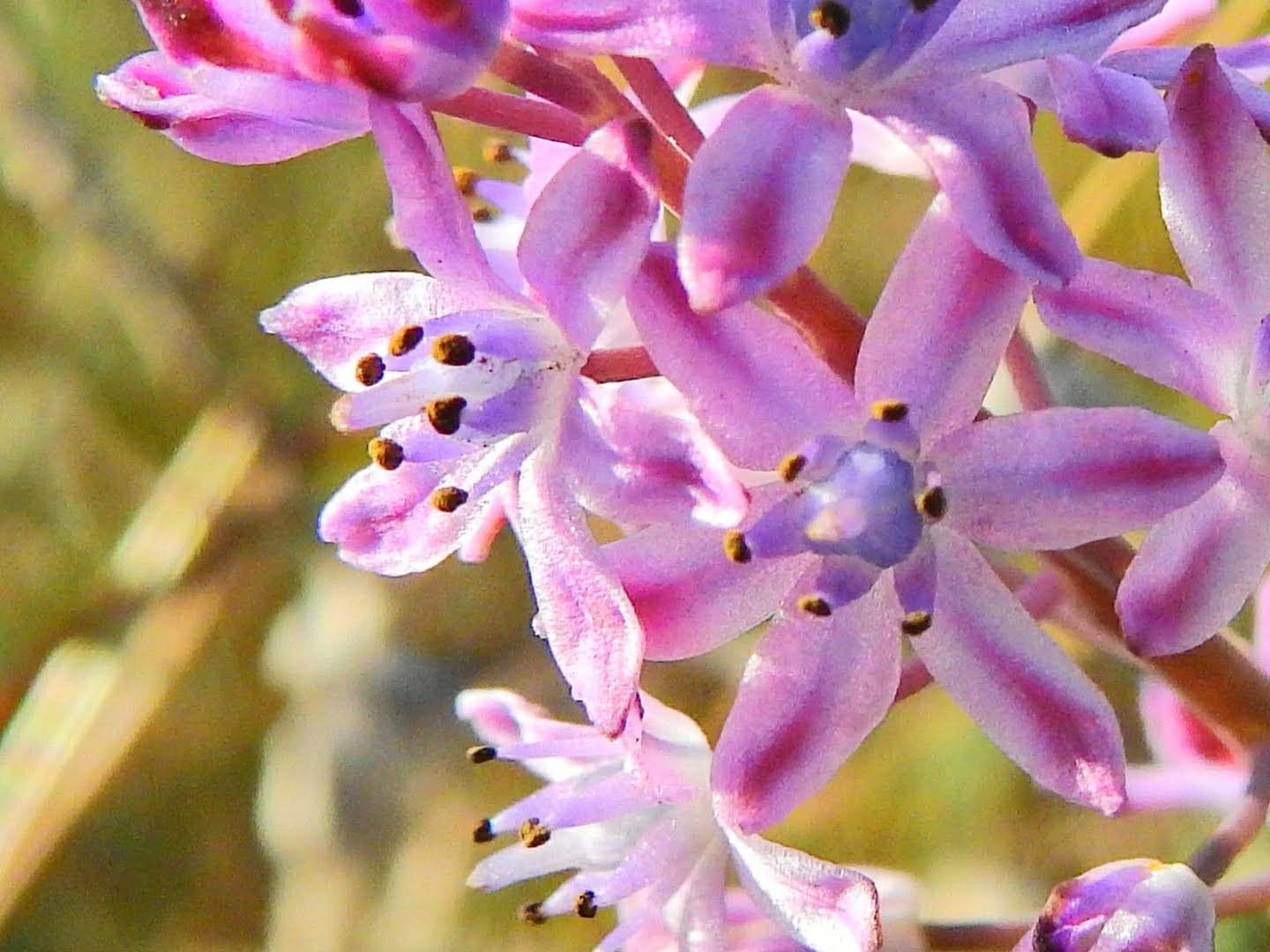
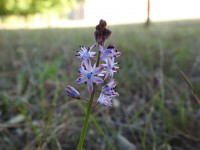
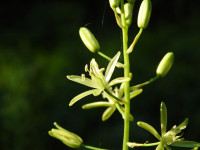
The inflorescence is a simple raceme, initially pyramidal in shape that elongates with maturation, bearing from 6 up to 25 small hexamerous flowers. The flowers are supported by erect and patent pedicels of 3-4 mm, which can elongate up to 15 mm at fruiting. The perigonium consists of two whorls of three tepals each, elliptical and fused at the base giving the flower a campanulate shape, colored pink-violet or lilac with a central green-brownish nerve; white flowers are more rarely observed. The tepals measure about 4-5 mm. The stamens are almost the same height as the perigonium, with thickened violet filaments and bilobed anthers of intense violet color.
The fruit is an ovoid capsule with three edges, which at maturity opens halfway releasing black seeds of 2-3 mm, with a rough surface. The root system consists of branched roots.
Habitat and distribution
The species is typical of the Eurymediterranean regions, widespread along the Mediterranean coasts but with extensions towards the north and east. In Italy, it is commonly found in Liguria, in the central regions of the peninsula up to the Via Emilia, in Sicily, Sardinia, Corsica, and minor islands. It is rarer in Northern Italy, especially in the pre-Alpine hills and some plain areas along major waterways.
It prefers sunny and dry habitats such as garrigues, dry meadows, and path edges, from sea level up to about 1400 meters of altitude. It is adapted to well-drained soils, often calcareous or stony, and tolerates sunny exposures.
Flowering period
Flowering typically occurs between August and September, with some local variations related to altitude and latitude. Being an autumnal species, its appearance is clearly visible in the late summer and early autumn period, when many other species have already finished flowering.
Ecology and pollination
Autumn flowering is strategic to exploit a period with less competition for pollinating insects. The flowers, pink-violet in color with dark violet anthers, attract various pollinating insects, although specific relationships with particular pollinators are not widely documented in the analyzed sources.
Seed dispersal occurs through the partial opening of the capsules at maturity, which release the dark and rough seeds. The rough surface of the seeds could facilitate adhesion to substrates or animals for dissemination, but no specific dispersal strategies are reported.
Curiosities and traditional uses
The plant has a long history of use in herbal medicine, although its bulbs contain toxic substances such as oxalates and glycosides. In folk medicine, it has been used to treat skin inflammations and to promote the resorption of cardiac edemas; however, dietary uses are not recommended due to its toxicity.
From a cultural and historical point of view, Pliny the Elder attributed spiritual properties to Scilla, suggesting that it prevented heart defects and promoted inner balance. Furthermore, in antiquity, the bulbs were used to mock hunters returning without prey by throwing them at them.
The genus name has possible Latin roots: it could derive from "pròsperus" (composed of "pro" = forward and "spes" = hope), meaning to prosper or grow vigorously. Another interpretation refers to Prospero, a mythological or literary character, emphasizing a symbolic link with growth and fortune. The specific epithet "autumnale" clearly indicates the species' flowering period.
Etymology
The scientific name derives from Latin, with “Prospero” that can be interpreted as “he who prospers” or “who grows vigorously,” in relation to the rapid growth of the plant. Another possible origin is linked to the character Prospero, wizard and duke of Milan, protagonist of the drama “The Tempest” by William Shakespeare, recalling a mythological or symbolic connection.
The Italian common name, “Autumn Squill,” reflects the previous inclusion of the species in the genus Scilla and the autumnal flowering period that characterizes it.
Sources
- Prof. S. Pignatti, "Flora d'Italia"
- Acta Plantarum - Flora delle regioni italiane (sheet by Nino Messina)
Characteristics
Scheda botanica
| Famiglia | Asparagaceae |
|---|---|
| Fioritura | agosto – settembre |
| Forma biologica | Bulbous |
| Habitat | with lilac flowers |
Domande frequenti
- Quando fiorisce Autumn Squill?
- Autumn Squill fiorisce agosto – settembre.
- Che tipo di pianta è Autumn Squill?
- Autumn Squill è una Geophytes (Bulbous) secondo la classificazione di Raunkiaer.
- A quale famiglia appartiene Autumn Squill?
- Autumn Squill appartiene alla famiglia botanica Asparagaceae.
Where I found it (39 sightings)
Classification
- Kingdom
- Plantae
- Family
- Asparagaceae
- Full name
- Prospero autumnale (L.) Speta
- Synonyms
- Scilla autumnalis L.
- Life form
- Geophytes bulbous
Similar species
Search for species with similar characteristicsFurther reading
Noticed an error in the identification? Write to me
Other species of the same family
Asparagaceae
Explore
Other species of Asparagaceae