Botanical species
Ornithogalum exscapum
Ten.
Latte di gallina minore
Description
Morphological description
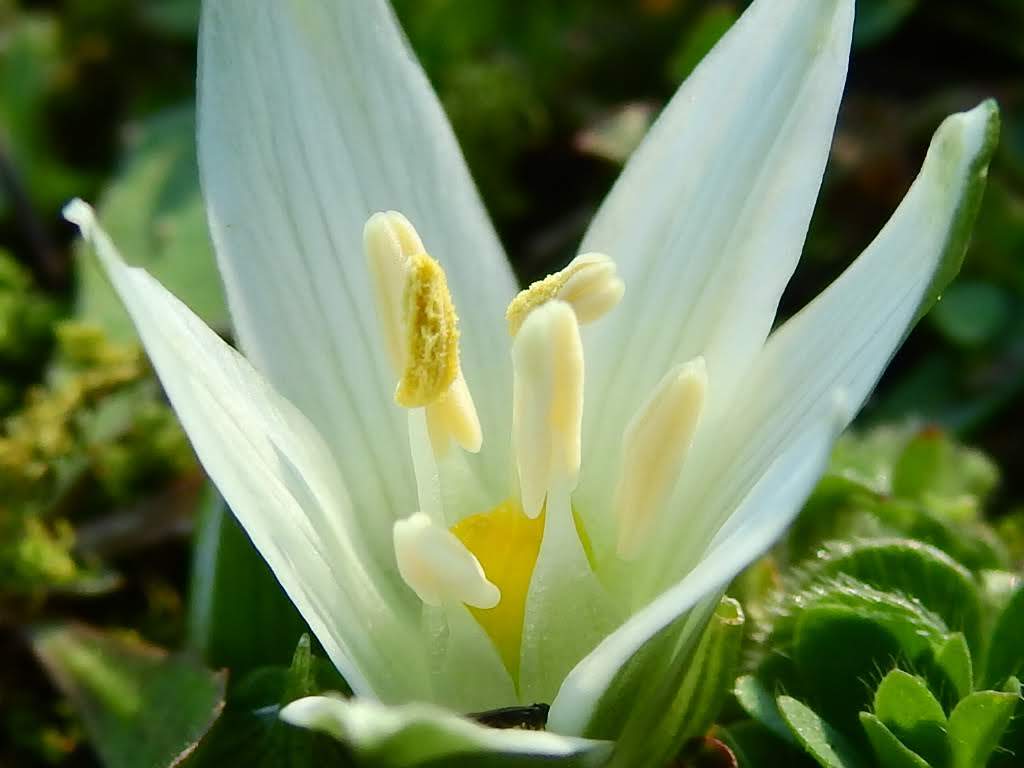
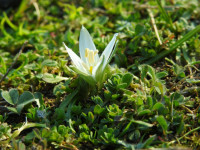
It is a small-sized bulbous geophyte, with a height ranging between 5 and 10 cm. The bulb is oval, single and non-proliferous, with a diameter between 20 and 40 mm, relatively large compared to the overall size of the plant. The leaves, from 6 to 8 per specimen, are strictly linear, channeled, and up to over 20 cm long, with a width between 2 and 8 mm. They feature a characteristic thin white longitudinal line running along their entire length.
The floral scape is short, only 3-10 cm, and supports an umbelliform inflorescence with a variable number of flowers, from 3 to 10, arranged so that the lower ones are very close to the base. The peduncles, at fruiting, elongate up to 4-6 cm, reflex and curve towards the main axis. The tepals are lanceolate to linear-lanceolate, measuring 4-5 mm wide by 5-15 mm long; inside they are milky white, while externally they may appear green with white margins or white with a longitudinal green line.
The fruit is an obovoid capsule with winged ribs, closely paired two by two, a characteristic useful for distinguishing this species from similar ones. The root system is bulbous, with the bulb representing the perennial organ from which leaves and flowers develop each year.
The plant is perennial and presents significant toxicity due to the presence of compounds such as convallatoxin, convallosides, and calcium oxalates; the concentration of these substances is highest in the bulbs, lower in the leaves and flowers.
Habitat and distribution
This species is endemic to Italy, present exclusively in the Italian territory in the wild state. It grows mainly in pastures and dry meadows but can also adapt to anthropized habitats such as edges of cultivated fields, vineyards, olive groves, and even grassy dry stone walls. It is mainly reported at altitudes ranging from 0 to 600 meters above sea level, but in Calabria and Sicily it can reach up to 1000 meters.
The plant prefers well-drained soils and sunny environments, typical of the Mediterranean climate, with a preference for open and sunny places, often under conditions of modest humidity and low herbaceous competition.
Flowering period
Flowering generally occurs between February and April, with possible variations depending on the locality and specific climatic conditions of the region. This period coincides with the end of winter and the beginning of spring, when temperatures start to rise and precipitation is still sufficient to support growth.
Ecology and pollination
The early flowering and milky white flowers suggest an adaptation to pollination by pollinating insects, probably hymenopterans and dipterans, attracted by the color and arrangement of the flowers. The umbelliform inflorescence facilitates access to the flowers, increasing pollination efficiency.
No specific data are available on seed dispersal, but like many bulbous geophytes, the plant likely relies on barochory (falling to the ground) and possibly secondarily on the action of small animals or abiotic agents such as wind.
Curiosities and traditional uses
The common name “lesser hen’s milk” refers to the milky white color of the flowers, a distinctive trait of the genus Ornithogalum. Species of this genus are known for their toxicity, due to the presence of convallatoxin and convallosides, substances that affect the cardiac system. For this reason, although they were once exploited for their cardiotonic properties, medicinal use is now strongly discouraged, especially in domestic settings, because intoxication can be severe and in rare cases even fatal.
No alimurgic or folkloric uses are reported for this species, probably precisely because of its toxicity. The presence of calcium oxalates also contributes to making it unappealing as food.
Etymology
The genus name Ornithogalum derives from ancient Greek: “ornithos” means “bird” and “gala” means “milk,” referring to the milky white color of the flowers which resembles bird’s milk, an expression historically used to indicate white and milky substances.
The specific epithet exscapum means “without stem” or “without scape” and refers to the very short and inconspicuous floral scape that characterizes this species, distinguishing it from other similar ones with longer scapes.
The common name “lesser hen’s milk” similarly recalls the white color of the flowers (milk) and the small size of the plant compared to other related species.
Sources
- Acta Plantarum - Flora delle regioni italiane (actaplantarum.org)
- Acta Plantarum - Flora delle regioni italiane (scheda di Umberto Ferrando)
Characteristics
Where I found it (10 sightings)
Classification
- Kingdom
- Plantae
- Family
- Asparagaceae
- Full name
- Ornithogalum exscapum Ten.
- Synonyms
- Ornithogalum ambiguum A.Terracc.; Ornithogalum exscapum Ten. var. ambiguum (A.Terracc.) Fiori
- Life form
- Geofite bulbose
Similar species
Search for species with similar characteristicsFurther reading
Noticed an error in the identification? Write to me
Other species of the same family
Asparagaceae
Explore
Other species of Asparagaceae