Botanical species
Melomphis arabica
(L.) Raf.
Latte di gallina d'Arabia
Description
Morphological description
Perennial herbaceous plant, generally 30 to 80 cm tall, characterized by a bulbous root system, with an ovoid or spherical bulb, measuring between 3.5 and 5.5 cm in length and 3-5.5 cm in diameter. The bulb has a light brown membranous tunic and produces small sessile secondary bulbils (1.5-2 mm), up to 7 per bulb, which contribute to vegetative propagation.
The stem is shorter and wider than the leaves, with a slightly rough surface, light green in color, and measures on average 40-60 cm in height and 0.7-0.9 cm in diameter.
The leaves, generally 5-8 per plant, are linear, herbaceous, light green, and slightly canaliculate (i.e., with a slight longitudinal groove). Their length ranges from 20 to 80 cm, while the width is about 0.7-0.9 cm. They do not have a white midline, typical of some related species.
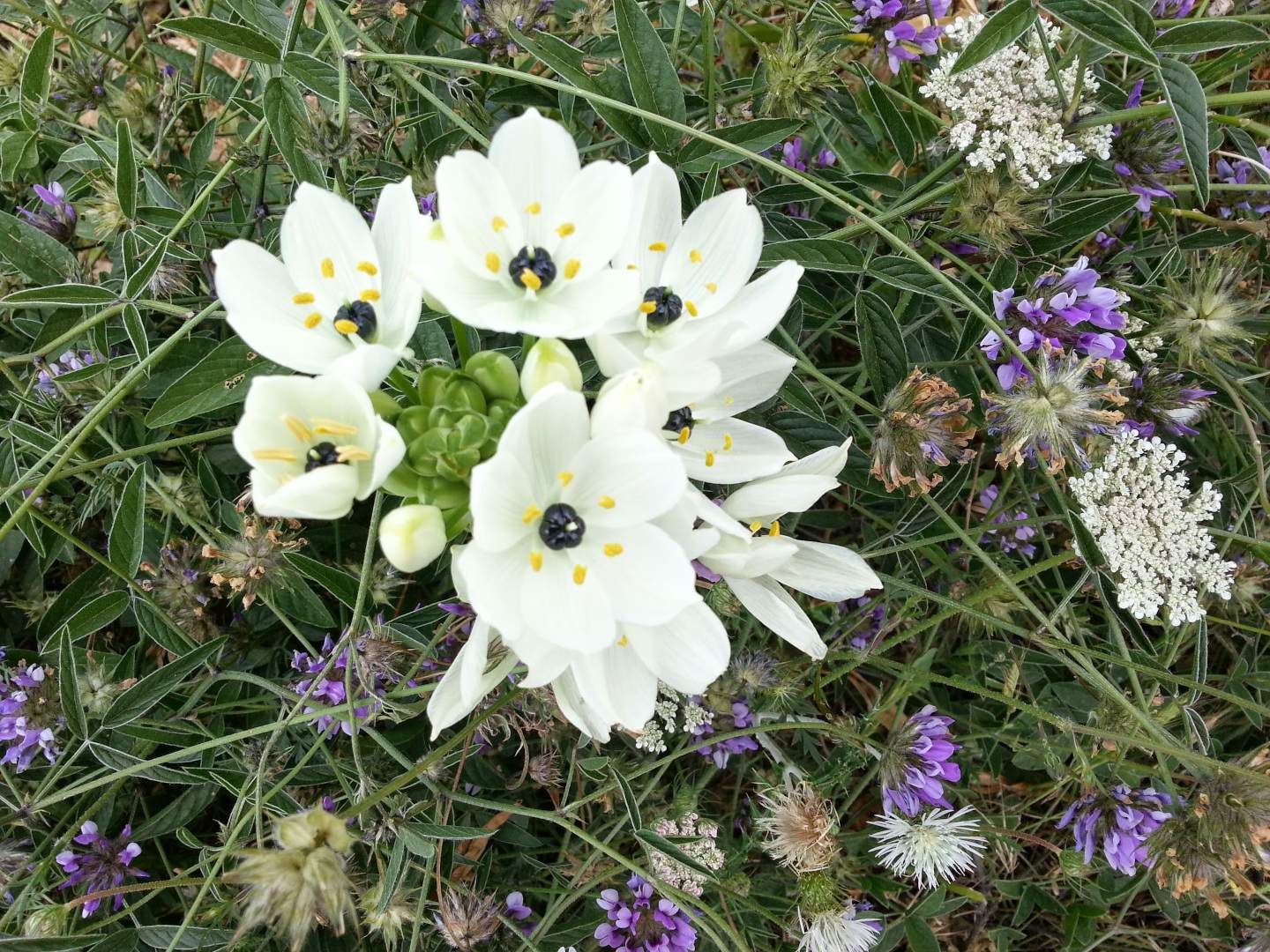
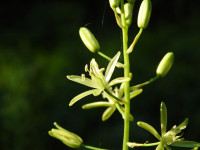
The inflorescence is a corymbiform raceme, which elongates further during fruiting, bearing from 6 up to 25 flowers. The floral peduncles are erect and appressed, with length varying depending on the position of the flowers: the lower ones are 30-50 mm long, the intermediate ones 30-40 mm, and the upper ones 7-15 mm. The bracts are membranous, triangular in shape and hyaline white in color, 25-50 mm long and 10-22 mm wide, always shorter than the peduncles.
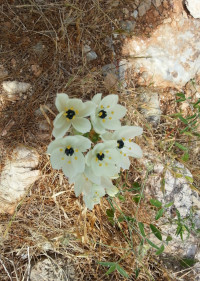
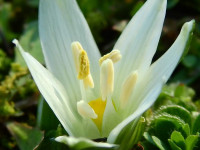
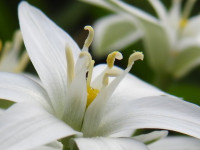
The flowers are white, delicately scented, with a campanulate perianth measuring 40-45 mm in diameter. The tepals, six in number, are ovate with a prominent mucro and bear glands at the apex; the inner ones are slightly shorter (about 1-2 mm) than the outer ones. The stamens are about one-third the length of the tepals, with pale yellow anthers of sagittate shape (6 x 1.8-2 mm). The style is 4-5 mm long, supported by a black filament at the base. The ovary is trigonal, with the upper part shiny black and the lower part green, subglobose in shape with a truncate apex.
The fruit is a trigonal and subspherical capsule, about 10 x 12 mm, black-violet in color. Inside are 6-7 black seeds, irregular in shape, measuring between 2.8-3.4 mm in length and 2.4-3.5 mm in width.
The root system consists of a deeply tuberous bulb, which allows the plant to survive adverse conditions and regrow each year.
Habitat and distribution
The species is typical of the southern Mediterranean regions, with a distribution that includes the southern Atlantic and Mediterranean coasts, extending into Mediterranean Europe and North Africa. In Italy it has naturalized mainly along the central-southern coasts, where it is frequently found in marine environments, particularly on sandy or rocky substrates, in pastures, fallow lands, and vineyards, from sea level up to about 600 meters altitude.
It prefers sunny exposures and well-drained soils, typical of Mediterranean coastal areas. Its presence is also reported in regions such as Corsica, Var, and the French Maritime Alps, always linked to coastal environments.
Flowering period
Flowering typically occurs in April and May. Depending on the geographic area, especially in the warmer southern regions, flowering may begin as early as April, while in cooler climates it can extend until late May.
Ecology and pollination
The white and fragrant flowers are visited by pollinating insects that facilitate pollination. The campanulate shape of the perianth and the presence of apical glands on the tepals suggest an adaptation to attract pollinating insects such as bees and other hymenopterans.
The plant reproduces both sexually, through the production of black seeds inside the trigonal capsule, and vegetatively via secondary bulbils produced by the main bulb. Seed dispersal likely occurs by falling near the mother plant, while wider dispersal can occur through natural transport events (wind or water) typical of coastal environments.
Curiosities and traditional uses
This plant, thanks to its ornamental appearance, has been widely used to beautify gardens and flowerbeds, as well as a cut flower. Its ability to naturalize in the coastal areas of central-southern Italy is also due to its adaptability and ease of propagation.
In some southern regions, before flowering, young shoots are harvested and consumed as asparagus, after cooking, demonstrating a traditional food use. This practice reflects an ancient ethnobotanical knowledge related to the edibility of the species.
The common name “Latte di gallina d’Arabia” recalls the plant’s original range and probably alludes to the milky white color of the flowers.
Etymology
The genus name derives from Greek: “mélas” (μέλας) means “black” or “dark,” while “omphalos” (ὀμϕαλός) means “navel.” This denomination refers to the black or dark ovary or capsule present at the center of the flower, resembling a black navel.
The specific epithet “arabica” indicates the geographic area of origin or first description of the species, namely the Arabian or Middle Eastern region.
The Italian common name “Latte di gallina d’Arabia” refers both to the milky white coloration of the flowers and to the geographic origin of the species.
Sources
- Acta Plantarum - Flora delle regioni italiane (scheda di Marinella Zepigi)
- Tela Botanica / H. Coste, "Flore descriptive et illustrée de la France"
Characteristics
Where I found it (1 sightings)
Classification
- Kingdom
- Plantae
- Family
- Asparagaceae
- Full name
- Melomphis arabica (L.) Raf.
- Synonyms
- Ornithogalum arabicum L.
- Life form
- Geofite bulbose
Similar species
Search for species with similar characteristicsFurther reading
Noticed an error in the identification? Write to me
Other species of the same family
Asparagaceae
Explore
Other species of Asparagaceae