Botanical species
Muscari botryoides
(L.) Mill.
Compact Grape-hyacinth
Description
Morphological description
Perennial bulbous herbaceous plant, generally 10 to 30 cm tall, with an erect and cylindrical scape that can reach 40 cm, often taller than the leaves. The root system consists of an ovate-pyriform bulb, solitary or with bulbils, about 1-2 cm wide and 2-3 cm long, covered by a dark and leathery outer tunic, deeply inserted in the soil.
The leaves, typically 2 to 5 per plant, are basal, linear-lanceolate in shape, with a width ranging from 3 to 7 mm, 10 to 20 cm long, glaucous in color. They are erect or arcuate, keeled, with evident longitudinal veins and often slightly canaliculate on the upper part. The shape widens from the base to the apex, changing from linear to spatulate-ovate. The leaves are generally shorter than the flowering scape.
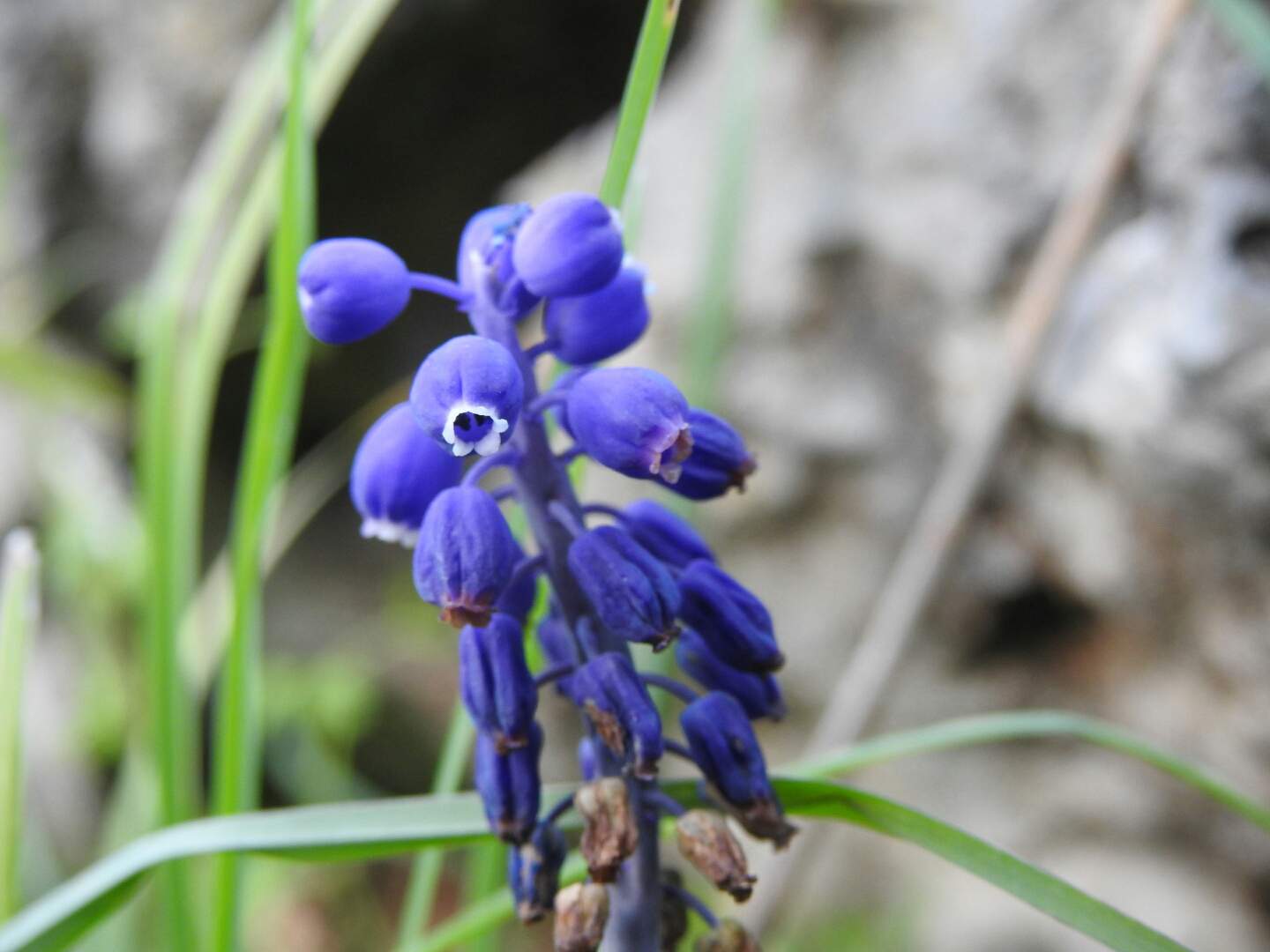
The inflorescence is a terminal raceme, initially dense and compact, which elongates and becomes looser as it matures, with a shape ranging from conical to oblong, about 8-12 mm wide and 2 to 4 cm long at flowering time. It includes 12 to 20 flowers, blue-light or violet in color, with smaller and lighter sterile flowers at the top. The flowers are urceolate, with connate and longitudinally ribbed tepals, 2 to 4 mm long, equipped with a throat bordered by whitish teeth. The scent is mild, often almost absent or with a note reminiscent of violet.
The pedicels are short (0.5-5 mm), green and generally pendulous after flowering. The ovary is elliptical. The fruit is a three-carpellate ovate-trigonous capsule 4-6 mm in size, with suborbicular valves 6-8 mm wide. The seeds are dark, wrinkled and striated.
Habitat and distribution
This species is typical of sub-Mediterranean and Mediterranean regions, widespread in central and eastern Europe, Asia Minor and the Caucasus, and well present in Italy, including mountainous and hilly regions. It grows in open environments such as meadows, pastures, vineyards, forest edges, from sea level up to about 2000 meters altitude, preferring fresh and well-drained soils, from dry to moderately moist. It is common in mountainous and hilly environments, often in areas with sunny or semi-shaded exposure.
In Italy it is present throughout the peninsula, more frequently in internal and mountainous areas, and is also reported in Corsica. It can also be found in anthropized habitats such as vineyards and managed meadows.
Flowering period
Flowering occurs mainly between March and May, with some variation related to altitude and latitude. In the mountains flowering can start from April and continue until May, while in lower and temperate areas it can begin as early as March. Flowers appear before the leaves are fully developed on the rigid scape.
Ecology and pollination
The species is mainly pollinated by pollinating insects, attracted by the blue-violet color of the flowers, although the scent is faint or almost absent. The urceolate shape of the flowers favors pollination by small insects, such as solitary bees and other hymenoptera, which can access the nectar inside the perianth.
Seed dispersal mainly occurs through direct fall near the mother plant; no particularly effective long-distance dispersal strategies are known, although the release of seeds from three-carpellate capsules may facilitate some natural distribution.
Curiosities and traditional uses
The Compact Grape-hyacinth is the progenitor of numerous ornamental varieties of Muscari, highly appreciated for flowering borders in gardens. Crosses with different colorations have been obtained from the wild species.
Traditionally, the bulbs of this species have been used in folk medicine for their emollient and diuretic properties. They contain mucilages, tannins, mineral salts, gums and sugars. Nevertheless, medicinal and food use is limited and should be considered with caution, as applications are not universally recognized and the plant may contain potentially irritating substances.
The common name “Compact Grape-hyacinth” probably derives from the characteristic bulb and the light blue color of the flowers, very evident in spring blooms.
Etymology
The genus name derives from the Arabic term “muskarini”, translated into Greek as “moscûs” and into Latin as “muscus”, meaning “moss”, referring to the musky scent of some related species. Another hypothesis links it to the Sanskrit “mushka” meaning “testicle”, recalling the shape of the bulb.
The specific epithet “botryoides” derives from the Greek “botrys”, which can mean “cluster”, referring to the shape of the inflorescence, or, according to some interpretations, recalls the resemblance to the plant Dysphania botrys.
The Italian common name “cipollaccio azzurro” refers to the bulb similar to a small onion and to the blue color of the flowers, which is one of the most distinctive characteristics of this species.
Sources
- Acta Plantarum - Flora delle regioni italiane (scheda di Marinella Zepigi)
- Tela Botanica / H. Coste, "Flore descriptive et illustrée de la France"
- World Flora Online (WFO)
Characteristics
Scheda botanica
| Famiglia | Asparagaceae |
|---|---|
| Fioritura | febbraio – aprile |
| Forma biologica | Bulbous |
| Habitat | with purple flowers, with blue-purple flowers, plant with a scapose habit |
Domande frequenti
- Quando fiorisce Compact Grape-hyacinth?
- Compact Grape-hyacinth fiorisce febbraio – aprile.
- Che tipo di pianta è Compact Grape-hyacinth?
- Compact Grape-hyacinth è una Geophytes (Bulbous) secondo la classificazione di Raunkiaer.
- A quale famiglia appartiene Compact Grape-hyacinth?
- Compact Grape-hyacinth appartiene alla famiglia botanica Asparagaceae.
Where I found it (2 sightings)
Classification
- Kingdom
- Plantae
- Family
- Asparagaceae
- Full name
- Muscari botryoides (L.) Mill.
- Synonyms
- Hyacinthus botryoides L.
- Life form
- Geophytes bulbous
Similar species
Search for species with similar characteristicsFurther reading
Noticed an error in the identification? Write to me
Other species of the same family
Asparagaceae
Explore
Other species of Asparagaceae