Botanical species
Betonica hirsuta
L.
Betonica del monte Prada
Description
Morphological description
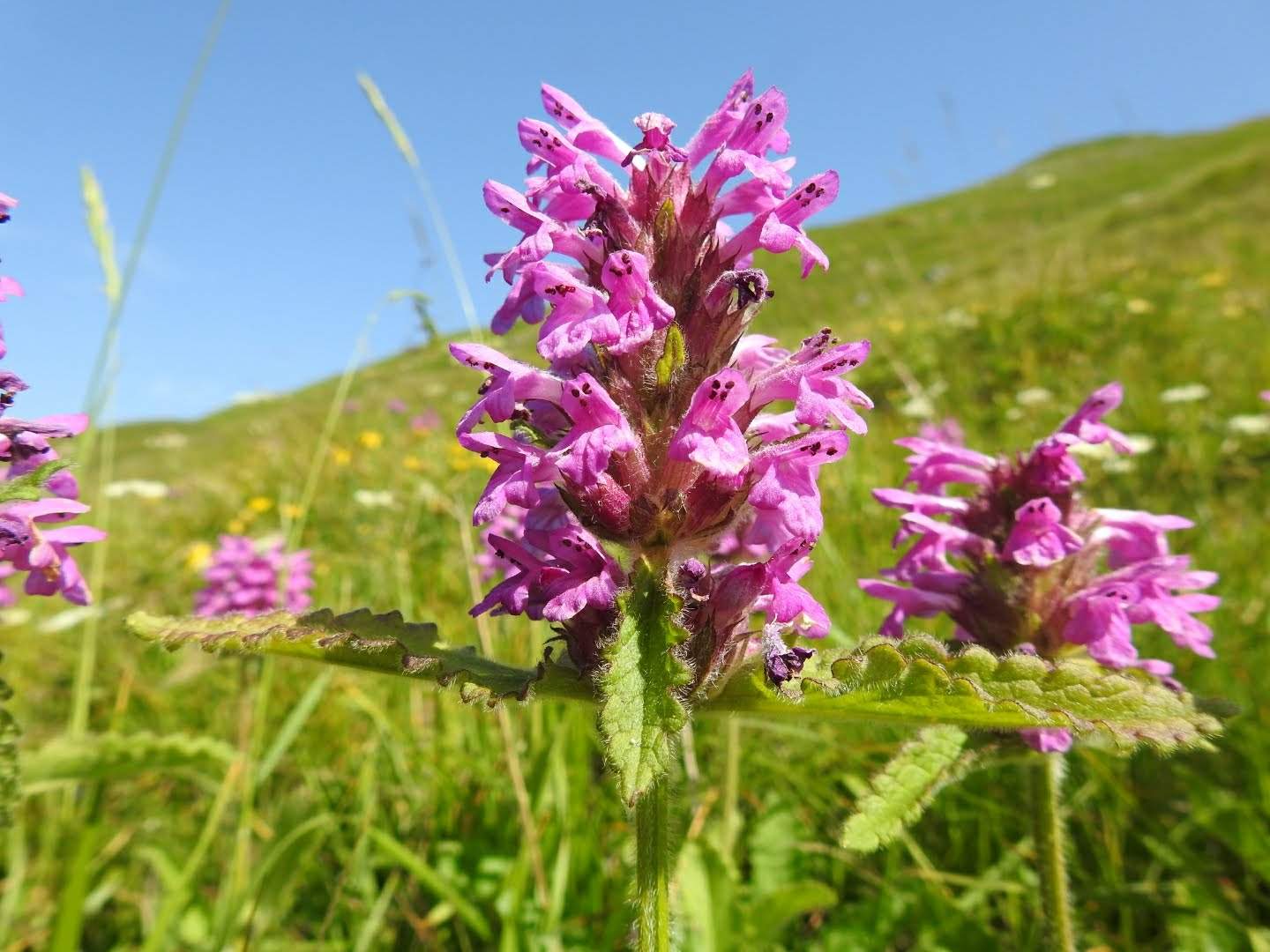
Perennial herbaceous plant belonging to the family Lamiaceae, characterized by a scapose habit and a height varying from 10-20 cm in the early stages of development up to 20-40 cm during fruiting. The stem is erect, generally unbranched, with a hirsute, tomentose and wrinkled surface, covered with long patent hairs 1.5-3 mm long that give a typical hairiness. The habit is branched-ascending.
The leaves are arranged oppositely along the stem, oblong and cordate at the base, with crenate-dentate margins. The leaf surface is velvety and hairy on both sides, with a soft texture given by dense pubescence. The basal leaves form a rosette, are petiolate, while the cauline leaves are subsessile, generally with only one pair present. The lower leaves of the inflorescence are well developed and often at least half the length of the spike.
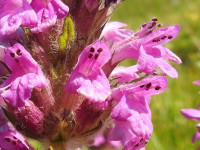
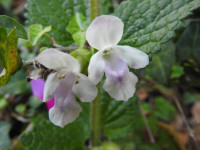
The inflorescence consists of flowers arranged in pseudo-whorls forming a compact, short and continuous spike, with a dense and oval structure. At the base of the inflorescence there are two inclined bract leaves. The flowers have a corolla of violet-purple or intense fuchsia color, about 15-22 mm long, with a prominent network of veins. The upper lip is entire or slightly emarginate, almost glabrous, while the lower lip is broad and obtuse. The corolla tube lacks an internal ring of hairs, a distinctive feature useful for identification. The calyx is tubular, elongated (11-14 mm), completely hairy and with long pointed teeth (4-5 mm), lanceolate and mucronate, about one third the length of the tube.
The stamens are two pairs (2+2), with parallel filaments. The fruit is a tetrachene drupe, consisting of four nutlets.
The root system is not described in detail in the sources, but as typical of perennial mountain herbaceous species, it is presumably quite robust to anchor the plant in often rocky and well-drained soils.
Habitat and distribution
The species is typical of mountain and subalpine environments, preferring grassy meadows, high-altitude pastures and subalpine and alpine heaths. It generally grows on decalcified soils, with a preference for well-drained and often calcareous soils.
In Italy it is mainly found in the Alps and northern Apennines, with reports also from mountainous regions of the Peninsula. The range extends in southwestern Europe, with a strong presence in the Iberian Peninsula and the French Massif Central, and is also present in Switzerland and Austria. It is rare or absent in the Balkans.
The growth altitude ranges from about 1300 up to 2300 meters, typical of high mountains. In France it is reported in the Alps of Savoy, Dauphiné and Provence, as well as in the central Pyrénées.
Flowering period
Flowering mainly occurs between July and August, corresponding to summer in the mountain regions where the plant is present. No significant variations in flowering period are indicated depending on geographic location.
Ecology and pollination
The plant is a scapose hemicryptophyte, that is, perennial with buds at ground level and an elongated floral axis often leafless. The flower structure, with tubular corollas colored violet-purple and fuchsia, suggests an adaptation to pollination by pollinating insects, probably hymenopterans such as bees and bumblebees, attracted by the bright color and flower shape.
The compact spike and the arrangement of flowers in pseudo-whorls facilitate visits by pollinating insects. The absence of an internal ring of hairs inside the corolla tube may influence how insects access the nectar.
The tetrachene fruit with four nutlets allows seed dispersal probably by falling to the ground and subsequent local distribution, with no indications of long-distance dispersal by wind or animals.
Curiosities and traditional uses
No specific information has been found on traditional, ethnobotanical or medicinal uses of this species. The genus Betonica in general is known in herbal medicine for some related species, but no traditional food or medicinal uses are reported for Betonica hirsuta.
The common name "Betonica del Monte Prada" refers to the typical place of finding or the reference locality (Monte Prada), used to distinguish it from other species of the genus.
Etymology
The genus name "Betonica" derives from "Vettonica," a term used by Pliny to indicate a medicinal plant that grew in a region of the Iberian Peninsula inhabited by the Vettónes, a Lusitanian population. The specific name "hirsuta" refers to the characteristic presence of long and sparse hairs on the plant, which give a typical hairiness and a rough appearance to the surface of stem and leaves.
The Italian common name "Betonica del Monte Prada" refers to the mountain locality of origin or the area where the species was found, useful to distinguish it in the context of the Italian spontaneous flora.
Sources
- Acta Plantarum - Flora delle regioni italiane (scheda di Mirna Medri)
- Tela Botanica / H. Coste, "Flore descriptive et illustrée de la France"
Characteristics
Scheda botanica
| Famiglia | Lamiaceae |
|---|---|
| Fioritura | luglio – agosto |
| Forma biologica | Scapose |
| Habitat | with fuchsia flowers, Perennial plant, plant with a scapose habit |
Domande frequenti
- Quando fiorisce Betonica del monte Prada?
- Betonica del monte Prada fiorisce luglio – agosto.
- Che tipo di pianta è Betonica del monte Prada?
- Betonica del monte Prada è una Hemicryptophytes (Scapose) secondo la classificazione di Raunkiaer.
- A quale famiglia appartiene Betonica del monte Prada?
- Betonica del monte Prada appartiene alla famiglia botanica Lamiaceae.
Where I found it (8 sightings)
Classification
- Kingdom
- Plantae
- Family
- Lamiaceae
- Full name
- Betonica hirsuta L.
- Synonyms
- Stachys pradica (Zanted.) Greuter & Pignatti
- Life form
- Hemicryptophytes scapose
Similar species
Search for species with similar characteristicsFurther reading
Noticed an error in the identification? Write to me
Other species of the same family
Lamiaceae
Explore
Other species of Lamiaceae