Botanical species
Lamium amplexicaule
L.
Henbit Dead-nettle
Description
Morphological description
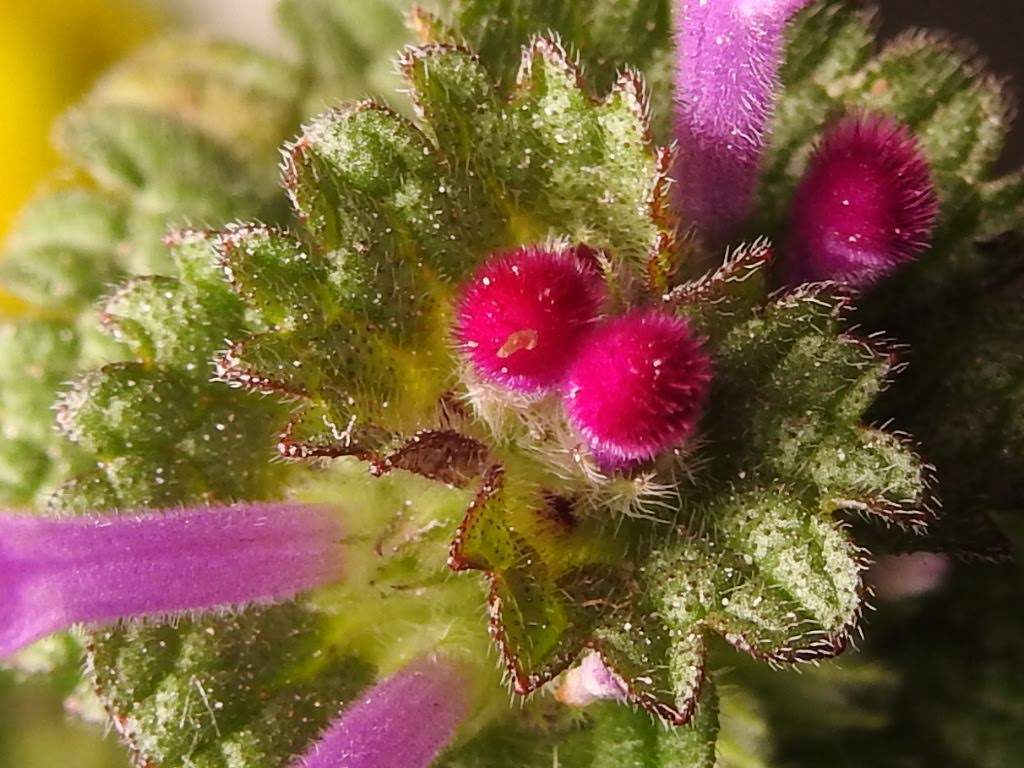
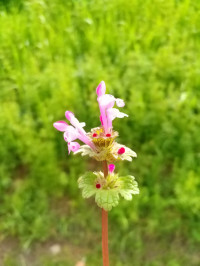
Annual herbaceous plant, Lamium amplexicaule presents erect or decumbent stems, thin, with variable height between 5 and 30 cm, often branching at the base. The stem surface is generally glabrous in the basal part, while in the apical zone it is covered by a fine, adherent and appressed pubescence, sometimes with glandular hairs. The stems are generally leafless in the upper part, giving rise to a scapose habit.
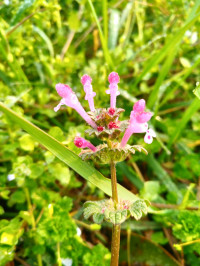
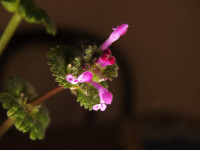
The leaves are arranged oppositely along the stem and are distinguished into basal leaves and floral leaves. The basal leaves are petiolate, reniform or cordate in shape with irregularly crenate or lobed margins. The floral leaves, on the other hand, are sessile and amplexicaul, that is, they clasp the stem at their base, and have a more orbicular or reniform shape with crenate or lobed edges. The texture of the leaves is herbaceous, and both the leaves and the stem may present slight pubescence.
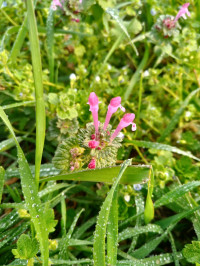
The inflorescence consists of dense verticillasters (whorled inflorescences), generally composed of 3 to 6 verticillasters, with 3-10 flowers each. These verticillasters are more spaced towards the base and more compact towards the apex. The flowers vary in color from purple to fuchsia, sometimes tending to lavender or purplish red, with a labiate corolla measuring about 1.5 cm (15 mm) in length. The corolla tube is thin, straight, and abruptly widens towards the apex; the upper lip is entire, concave, and ascending, while the lower lip is wider and can be deflexed or extended. The calyx is tubular, about 6 mm long, villous and equipped with five lanceolate or subulate teeth, slightly shorter than the calyx tube, which become connivent after flowering. The anthers bear tufts of whitish woolly hairs.
The fruit consists of four brown nutlets (mericarp), trigonal in shape and about 2 mm in size, with a smooth surface or sometimes tuberculate with small white projections.
The root system is typical of annual herbaceous plants, with fibrous and shallow roots, suitable for plowed or cultivated soils.
Habitat and distribution
Lamium amplexicaule is a species typical of anthropized areas, widespread in gardens, vineyards, hoed crops, roadside edges, and uncultivated lands. It prefers sunny or partially shaded environments, generally facing south or southwest. It is common from the plains up to about 1200 meters altitude, occurring in both lowland soils and hilly and submontane slopes.
The geographic distribution is broadly Eurasian and Mediterranean: it is found throughout Europe, in Asia up to Japan, and in North Africa. In Italy it is present throughout the national territory, including coastal and inland environments. The species has been introduced in other parts of the world, such as the Americas, where it has naturalized in some temperate and mountainous areas.
Preferred soils are generally dry or moderately moist, well-drained, including sandy or clayey types, often disturbed by agricultural or anthropic activities. The plant tolerates poor and calcareous soils typical of Mediterranean areas.
Flowering period
The flowering of Lamium amplexicaule extends from March to September, with a main spring peak that may vary slightly depending on latitude and altitude. In milder climate regions, flowering can begin as early as late winter and continue until autumn. In general, flower presence is more consistent in the spring months (March-June).
Ecology and pollination
The species exhibits a reproductive strategy typical of Lamiaceae, with labiate flowers that favor entomophilous pollination. The main pollinating insects are bees, bumblebees, and other pollinators attracted by the purple color and nectar produced at the base of the corolla tube. Besides normal flowers (chasmogamous), cleistogamous flowers, smaller and closed, are often observed, which self-pollinate ensuring seed production even in the absence of pollinators.
Seed dispersal occurs mainly by falling to the ground; the mericarps can be locally transported by small animals or rainwater. The species is considered a “weed” in agricultural and horticultural contexts due to its ability to rapidly colonize cultivated soils.
Curiosities and traditional uses
Lamium amplexicaule has been known since antiquity for its food and medicinal uses. Young leaves are collected and consumed raw in salads or cooked as a vegetable, similarly to other edible wild plants. Medicinally, the plant has traditionally been used for its antirheumatic, febrifuge, laxative, and stimulating properties.
Despite these virtues, it is important to emphasize that phytotherapeutic and alimentary uses are based on tradition and do not replace official medical advice.
The common name "Henbit Dead-nettle" seems to refer to the particular circular arrangement, in verticillasters, of the flowers around the stem, resembling a wheel. The name "false reniform nettle" recalls the similarity of the leaves to those of nettles, although belonging to a different family (Lamiaceae) and lacking stinging hairs.
Etymology
The generic name Lamium derives from the Greek "λαμία" (lamía), meaning "open mouth," referring to the characteristic bilabiate shape of the corolla, which resembles a wide-open mouth. The specific name amplexicaule refers to the shape of the floral leaves, which are amplexicaul, that is, they clasp the stem at their base.
The Italian common names, such as "erba ruota" and "falsa ortica reniforme," describe respectively the circular arrangement of the flowers and the similarity of the leaves to those of nettle, although it is not a true nettle.
Sources
- Prof. P.V. Arrigoni, "Flora analitica della Toscana", "Flora dell'Isola di Sardegna"
- Acta Plantarum - Flora delle regioni italiane (scheda di Gianluca Nicolella)
- Tela Botanica / H. Coste, "Flore descriptive et illustrée de la France"
- World Flora Online (WFO)
Characteristics
Scheda botanica
| Famiglia | Lamiaceae |
|---|---|
| Fioritura | marzo – settembre |
| Forma biologica | Scapose |
| Habitat | with fuchsia flowers, annual plant |
Domande frequenti
- Quando fiorisce Henbit Dead-nettle?
- Henbit Dead-nettle fiorisce marzo – settembre.
- Che tipo di pianta è Henbit Dead-nettle?
- Henbit Dead-nettle è una Therophytes (Scapose) secondo la classificazione di Raunkiaer.
- A quale famiglia appartiene Henbit Dead-nettle?
- Henbit Dead-nettle appartiene alla famiglia botanica Lamiaceae.
Where I found it (7 sightings)
Classification
- Kingdom
- Plantae
- Family
- Lamiaceae
- Full name
- Lamium amplexicaule L.
- Life form
- Therophytes scapose
Similar species
Search for species with similar characteristicsFurther reading
Noticed an error in the identification? Write to me
Other species of the same family
Lamiaceae
Explore
Other species of Lamiaceae