Botanical species
Lamium bifidum
Cirillo
Falsa ortica bifida
Description
Morphological description
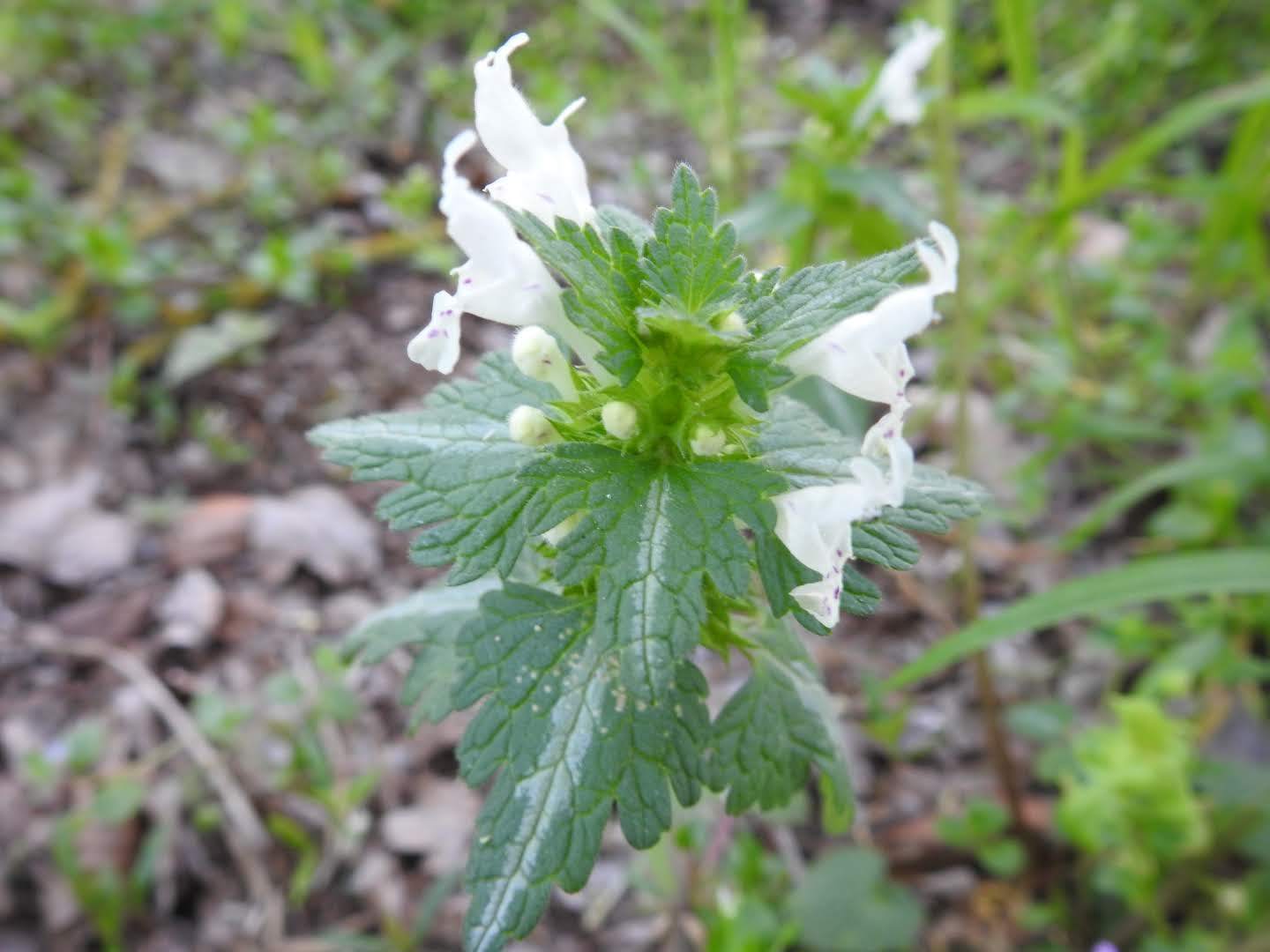
The plant is an annual herbaceous species with a scapose habit, equipped with quadrangular stems, often reddish at the base, erect or ascending, sometimes branched. The stem divides at the base, with prostrate-spreading lateral branches and a more erect central axis, characterized by a pubescent surface. The height generally varies but does not reach large dimensions, being a plant of modest size.
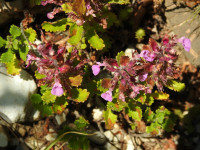
The leaves are arranged oppositely along the stem, with an ovate-triangular blade of variable size between 1-2 cm in width and 2-4 cm in length. The base of the leaves can be truncate or cordate, while the apex is acuminate. The margin is irregularly dentate or lobed, with a pubescent surface that gives a slight hairiness. The leaves are long-petiolate, with a petiole about 1-2 cm long, and show well-evident reticulate veins; often a white stripe is visible along the central vein. The floral bracts are similar to the leaves but smaller and subsessile.
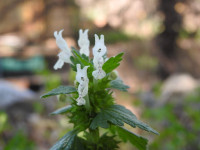
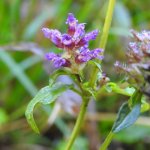
The flowers are hermaphroditic, zygomorphic, pure white in color, gathered in dense verticillasters located in the axils of the bract leaves. The inflorescence is scapose, with flowers arranged in compact verticillasters. The calyx is 7-9 mm long, with five faint veins, equipped with a hairy tube of 4-5 mm and calyx teeth of 3-4 mm, more or less spreading. The corolla has a straight tube of 12-14 mm, without a ring of hairs inside. The lower lip, 5-6 mm long, is bilobed and sometimes stained with purple; the lateral lobes are very small, linear or absent. The upper lip, 6-8 mm long, is deeply bifid, with lobes often reflexed and hirsute on the upper surface. The stamens are four, didynamous, with anthers bearing tufts of whitish hairs. The ovary is superior and tetracyclic.
The fruit is a tetrachene formed by four trigonal nutlets, truncated at the apex. The root system is not particularly described but, as for many Lamiaceae, a fibrous and superficial root system is presumed.
Habitat and distribution
The species is typically Mediterranean, mainly present in the coastal areas of the olive-growing region, with a range limited to the Mediterranean coasts. In Italy it grows in humid environments such as wet woods, gardens, and uncultivated lands, from sea level up to about 1200 meters altitude. It prefers well-drained but not excessively dry soils, with generally sunny or partially shaded exposure in woods or cultivated areas. It is a steno-Mediterranean species, i.e., with distribution limited to the narrow Mediterranean regions.
Flowering period
Flowering occurs mainly between February and May, with slight variations related to altitude and latitude. In the milder climates of the Mediterranean coastal belt, flowering can start early already at the end of winter, while in colder or inland areas it can extend until late spring.
Ecology and pollination
The plant is pollinated by pollinating insects, mainly bees and other hymenopterans that visit the flowers for nectar and pollen. The zygomorphic structure and the shape of the corolla favor entomogamous pollination, facilitating insect contact with the stamens and stigma. The presence of hairs on the anthers and on the upper lip may play a role in pollen management during insect visits.
Seed dispersal occurs through the release of the four nutlets at fruit maturity; no specific mechanisms of animal or wind dispersal are known, so diffusion is probably limited to natural dropping in the immediate vicinity of the mother plant.
Curiosities and traditional uses
No specific data are available on traditional, medicinal, or food uses of this species. However, like other Lamiaceae, it may have had a local role in phytotherapy or nutrition, albeit marginally. The common name “falsa ortica bifida” (false bifid nettle) recalls the similarity to nettle, but the plant does not possess stinging hairs and belongs to a different genus, known for showy flowers and peculiar morphological characteristics.
Etymology
The genus name, Lamium, derives from the Greek “laimós” meaning “throat” or “pharynx,” referring to the shape of the corolla which resembles an open mouth. The specific epithet “bifidum” derives from the Latin “bifidus,” meaning “divided into two parts,” recalling the characteristic upper lip of the flowers, deeply bifid. The Italian common name “falsa ortica bifida” emphasizes the superficial similarity to true nettles, although belonging to a different family and lacking stinging properties, and also refers to the bifid floral lip that characterizes the species.
Sources
- Prof. S. Pignatti, Flora d'Italia
- Acta Plantarum – Flora delle regioni italiane (sheet by Anja Michelucci)
Characteristics
Where I found it (9 sightings)
Classification
- Kingdom
- Plantae
- Family
- Lamiaceae
- Full name
- Lamium bifidum Cirillo
- Life form
- Terofite scapose
Similar species
Search for species with similar characteristicsNoticed an error in the identification? Write to me
Other species of the same family
Lamiaceae

Explore
Other species of Lamiaceae