Botanical species
Himantoglossum robertianum
(Loisel.) P. Delforge 1999. Handb. Skand. Fl. 329
Giant orchid
Description
Morphological description
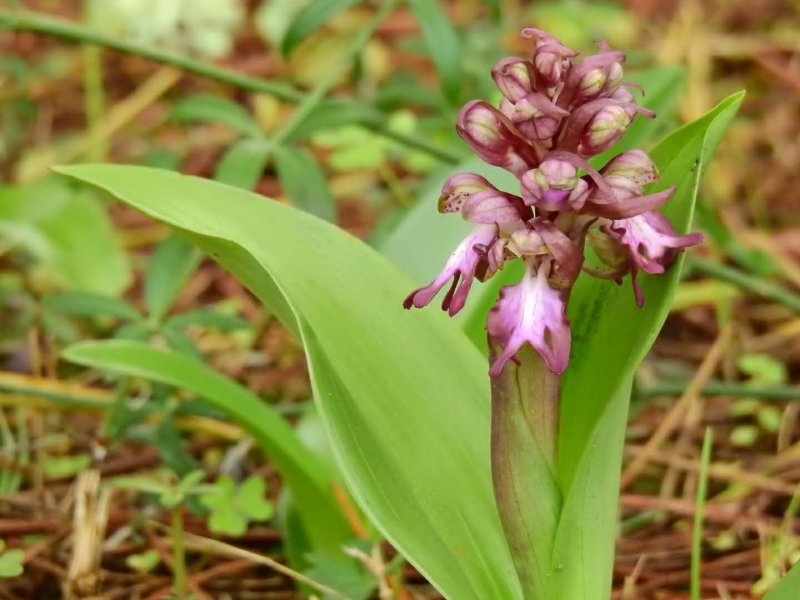
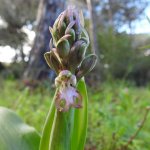
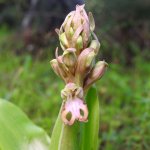
Perennial herbaceous plant between 20 and 80 cm tall, characterized by an erect and robust habit. The stem is thick, ascending, with a violet coloration in the upper part that fades into light green towards the base, where it is wrapped by scarious scales. The root system consists of 2-3 large deep rhizotubers, about 3 cm in diameter, from which secondary roots originate.
The leaves are large and fleshy and glossy in texture. The two lower leaves are ovate-lanceolate, ovate to elliptical in shape, with smooth margins, and measure between 5-10 cm in width and 10-30 cm in length. The median leaves are smaller and wrap around the stem. All leaves are intense green in color.
The inflorescence is dense and can bear up to 60 flowers, initially conical then becoming elongated and cylindrical, measuring between 8 and 25 cm long. The bracts are lanceolate-linear, shaded with violet, and exceed the flowers in length.
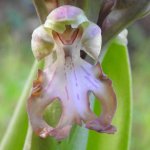
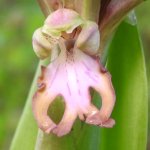
The flowers are rather large, fragrant with an aroma reminiscent of iris, and present coloration ranging from violet, pink, to white with greenish shades and purplish spots. The corolla is composed of five connivent tepals forming a helmet: the outer tepals are ovate and curved with reddish-violet striations, while the inner ones are shorter and linear.
The labellum, up to 2 cm long, is trilobed with falciform lateral lobes, turned backward and with crenulate outer margins. The median lobe is longer and divided into two obtuse and divergent segments. Characteristic is the very long ribbon-shaped labellum that gave rise to the genus name. The spur is short, conical, about 3-6 mm long, and directed downward.
The gynostemium is large and contains dark pollinia masses; the stigma is heart-shaped. The ovary is sessile. The plant produces capsule fruits, typical of Orchidaceae, containing numerous minute seeds, favoring anemochorous dispersal.
Habitat and distribution
Stenoendemic Mediterranean species, found mainly along Mediterranean coasts, particularly in the Olive area. In Italy it grows in environments characterized by dry meadows, garrigues, and shrublands, always in full sun and preferably on calcareous soils. Its range extends from the plains up to about 1000 meters altitude.
This species prefers sunny and well-drained habitats, with poor and dry soils typical of Mediterranean areas, where it coexists with other xerophilous species.
Flowering period
Flowering extends from January to April, with geographic variations related to altitude and latitude. In warmer and coastal areas flowering may start earlier in January-February, while at higher altitudes it lasts until March-April.
Ecology and pollination
Not producing nectar, this orchid attracts pollinating insects thanks to the presence of aphids (Dysaphis tulipae) living on its parts and producing honeydew, a sugary substance sought by apoidea hymenopterans, particularly bumblebees such as Bombus hortus and large hymenopterans such as Xylocopa violacea. These insects visit the flowers to collect honeydew and, in the process, favor pollination.
The flowers have a scent reminiscent of iris, an additional attractant for pollinators. The flower structure, with the trilobed labellum and conical spur, is adapted to visits by pollinating insects that favor pollen transfer.
Seed dispersal occurs through the release of very small winged seeds transported by wind (anemochory), typical of Orchidaceae.
Curiosities and traditional uses
This orchid has aroused interest and fascination since antiquity. Although it has no documented specific medicinal uses, in popular tradition it has been considered a "magical" and "ritual" plant.
It is called "malefica" due to an ancient ritual according to which rubbing the flower on the edge of a cauldron containing milk would cause it to dry up. It is also defined as "enigmatic" because a similar orchid was consecrated to the cult of Demetria, a goddess linked to fertility and nature.
In the love sphere, it was believed to favor the revival of unrequited love, hence the epithet "magical". Furthermore, in Central American civilizations, similar orchids accompanied man throughout life's journey, emphasizing their ritual value.
Etymology
The genus name Himantoglossum derives from Greek: ἱμάς (himás, "strap") and γλῶσσα (glóssa, "tongue"), referring to the characteristic long ribbon-shaped labellum resembling a strap.
The specific epithet robertianum is a tribute to Gaspard Nicolas Robert (1776-1857), French pharmacist, botanist, and horticulturist, friend of the botanist Parlatore. The Italian common name "Giant orchid" derives from the former genus Giant orchid, dedicated to Joseph Hieronymus Barla (1817-1896), mycologist and orchid specialist from Nice.
Sources
- Acta Plantarum - Flora delle regioni italiane (actaplantarum.org)
- Acta Plantarum - Sheet by Antonino Messina
- World Flora Online (WFO)
Characteristics
Where I found it
The sighting locations of this species are not public for conservation reasons.
Classification
- Kingdom
- Plantae
- Family
- Orchidaceae
- Full name
- Himantoglossum robertianum (Loisel.) P. Delforge 1999. Handb. Skand. Fl. 329
- Synonyms
- Barlia robertiana, Barlia longibracteata (Biv.) Parl.; Himantoglossum longibracteatum (Biv.) Schltr.; Himantoglossum robertianum (Loisel.) P.Delforge; Orchis longibracteata Biv.; Orchis robertiana Loisel.
- Life form
- Geofite bulbose
Similar species
Search for species with similar characteristicsNoticed an error in the identification? Write to me
Other species of the same family
Orchidaceae
Explore
Other species of Orchidaceae