Botanical species
Anacamptis papilionacea
(L.) R. M. Bateman, Pridgeon & M. W. Chase
Pink-butterfly Orchid
Description
Morphological description
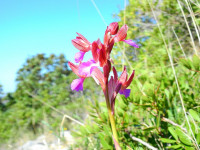
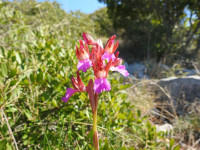
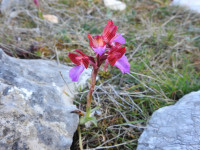
Perennial herbaceous plant belonging to the Orchidaceae family, characterized by an erect habit and variable height, generally contained within 20-40 cm. The stem is slender, erect, with a robust but not woody texture, supported by a tuberous root system typical of terrestrial orchids, which allows the accumulation of reserves for the vegetative dormancy season.
The leaves are mainly arranged in a basal rosette, lanceolate in shape and fleshy in texture, with entire margins and smooth surface. There are also some cauline leaves, numbering from 2 to 5, sheathing the stem and often transformed into bracts that partially wrap the inflorescence; these upper leaves may show reddish shades. The basal leaves are erect-patent, linear-lanceolate and generally 2-8 per plant.
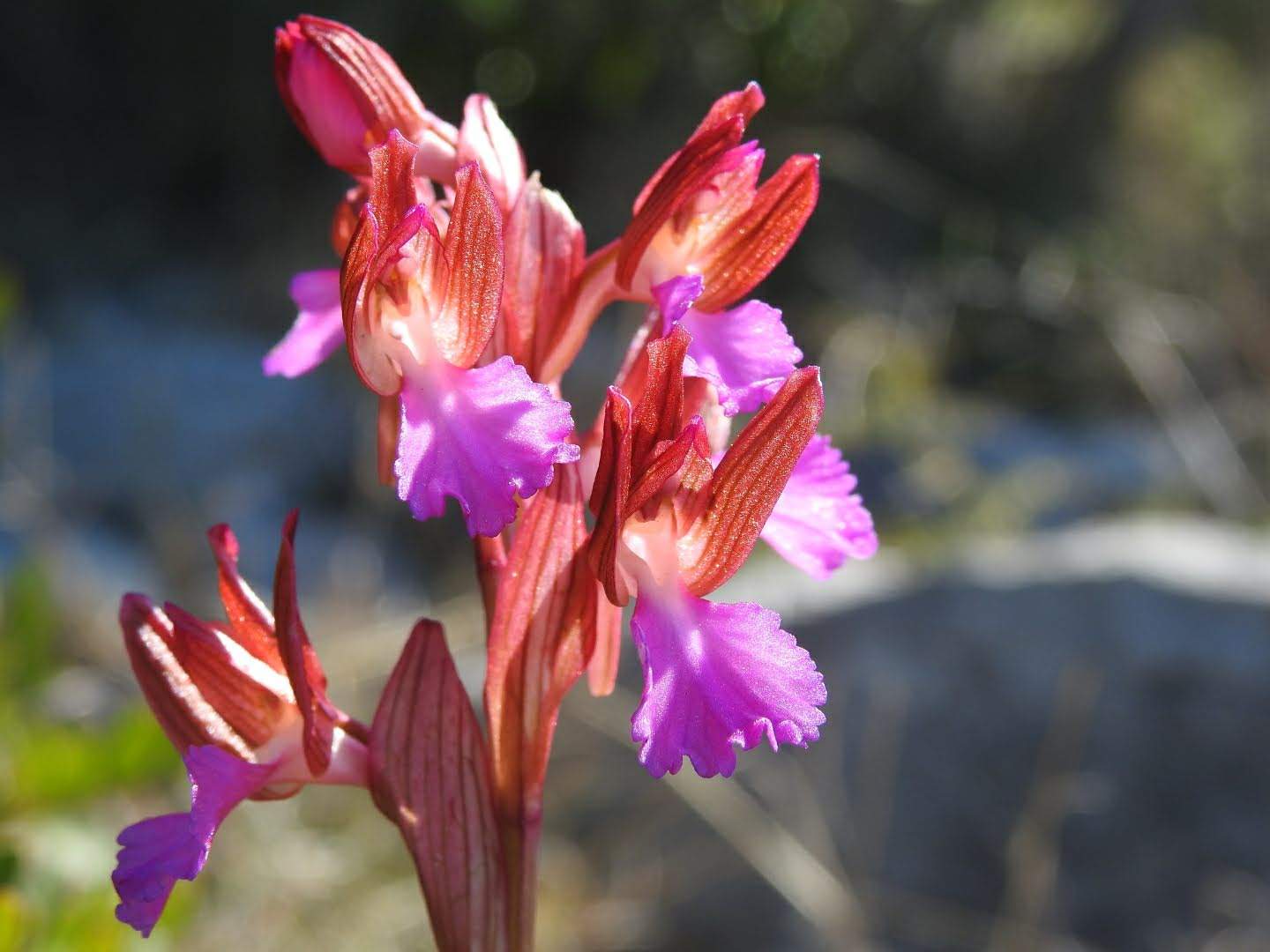
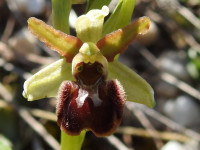
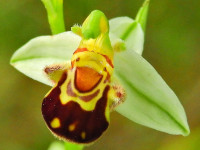
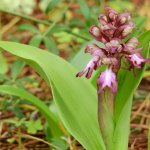
The inflorescence is racemose, usually ovoid and loose, but on some occasions it can take a cylindrical and more compact form. The number of flowers per inflorescence is variable, from 2 up to 12, with bracts as long as or longer than the ovary. The flowers are characterized by a bright coloration ranging from fuchsia to reddish-brown, with sepals and petals more or less convergent forming a widened helmet above the labellum. The sepals and petals have very evident veins that accentuate the flower structure.
The labellum is entire, narrow at the base and with raised margins, more or less deeply incised, of variable shape and size depending on the individuals. The color of the labellum is generally uniformly pink or whitish, with divergent purplish lines and dots fanning out, often lighter towards the base. The spur, conical and relatively thin, has a length similar to that of the ovary and presents a downward curvature.
The fruits are capsules containing numerous small winged seeds, typical of orchids, which disperse easily by wind. The tuberous root system functions as a reserve and anchorage to the soil.
Habitat and distribution
This orchid is present in various Italian regions, particularly in Mediterranean areas, with a distribution that also covers the wider Mediterranean basin. It grows mainly in open environments such as garrigues, poor meadows, and light woods, where the soil is well-drained and often calcareous or clay-sandy in type.
It is generally found at low and medium altitudes, up to about 1000 meters, preferring sunny or partially shaded exposures. The species favors habitats that are not too humid but with some seasonal moisture availability, typical of Mediterranean climates.
Flowering period
Flowering mainly extends through the months of April and May, with possible variations related to altitude and local climatic conditions. In milder areas, flowering can start as early as April, while in cooler or mountainous zones it can continue until May.
Ecology and pollination
The plant reproduces through entomogamous pollination, favored by pollinating insects attracted by the bright colors of the flower and the particular shape of the labellum, which serves as a landing platform. Among the most common pollinators are bees and bumblebees, which are able to access the spur containing the nectar.
The reproductive strategy is based on visual and olfactory attraction, with chromatic and structural signals that facilitate contact between the insect and the reproductive structures, allowing pollen transfer. Seed dispersal occurs through the wind, thanks to capsules that release minute and light seeds, promoting colonization of new suitable sites.
Curiosities and traditional uses
No specific medicinal or food uses of this species are known, nor particular folkloric traditions associated with it. Like many wild orchids, it is appreciated for its aesthetic value and its indication of natural environments of high quality and biodiversity.
Etymology
The generic name Anacamptis derives from the Greek “anakámptō” meaning “to bend back” or “to curve,” referring to the arched shape of the flower spur. The specific epithet papilionacea refers to the flower’s resemblance to a butterfly (from Latin “papilio,” butterfly), evoking the shape and bright colors of the labellum and inflorescence.
The Italian common name “Orchidea a farfalla” (Butterfly Orchid) precisely reflects this morphological characteristic, emphasizing the elegant and “flying” aspect of the flowers that resemble butterfly wings.
Sources
- Prof. P.V. Arrigoni, "Flora analitica della Toscana"
- Prof. P.V. Arrigoni, "Flora dell'Isola di Sardegna"
Characteristics
Where I found it
The sighting locations of this species are not public for conservation reasons.
Classification
- Kingdom
- Plantae
- Family
- Orchidaceae
- Full name
- Anacamptis papilionacea (L.) R. M. Bateman, Pridgeon & M. W. Chase
- Synonyms
- Anacamptis papilionacea (L.) R.M.Bateman, Pridgeon & M.W.Chase subsp. aegaea (P.Delforge) L.Lewis & Kreutz; Anacamptis papilionacea (L.) R.M.Bateman, Pridgeon & M.W.Chase subsp. expansa (Ten.) Amard. & Dusak; Anacamptis papilionacea (L.) R.M.Bateman, Pridgeon & M.W.Chase subsp. grandiflora (Boiss.) Kreutz; Anacamptis papilionacea (L.) R.M.Bateman, Pridgeon & M.W.Chase var. expansa (Ten.) V.Campo & El Mokni; Anacamptis papilionacea (L.) R.M.Bateman, Pridgeon & M.W.Chase var. grandiflora (Boiss.) Romolini & Biagioli; Anacamptis papilionacea (L.) R.M.Bateman, Pridgeon & M.W.Chase var. vexillifera (Terraciano) Romolini & Biagioli; Herorchis papilionacea (L.) D.Tyteca & E.Klein; Orchis expansa Ten.; Orchis papilionacea L.; Orchis papilionacea L. subsp. expansa (Ten.) Guadagno; Orchis papilionacea L. subsp. grandiflora (Boiss.) H.Baumann; Orchis papilionacea L. var. vexillifera Terraciano; Orchis rubra Jacq.; Vermeulenia papilionacea (L.) Á.Löve & D.Löve; Vermeulenia papilionacea (L.) Á.Löve & D.Löve var. aegaea P.Delforge
- Life form
- Geofite bulbose
Similar species
Search for species with similar characteristicsFurther reading
Noticed an error in the identification? Write to me
Other species of the same family
Orchidaceae
Explore
Other species of Orchidaceae