Botanical species
Cephalanthera rubra
(L.) Rich.
Red Helleborine
Description
Morphological description
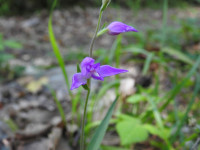
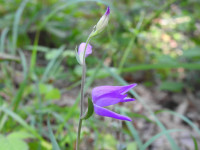
Perennial herbaceous plant belonging to the Orchidaceae family, characterized by a slender habit and a height ranging from 15 to 70 cm. The root system has a horizontal, short and vertical rhizome, from which fibrous roots and adventitious stems develop. The stem is erect, slender, often reddish at the base and in the upper part it has a slight glandular pubescence and a reddish coloration.
The leaves are from 2 up to 8 per plant, alternate, narrow lanceolate, 5 to 14 cm long and 1-3 cm wide, with well-marked parallel veins. The leaves clasp the stem through a sheathing base, with the lower ones often reduced to sheaths.
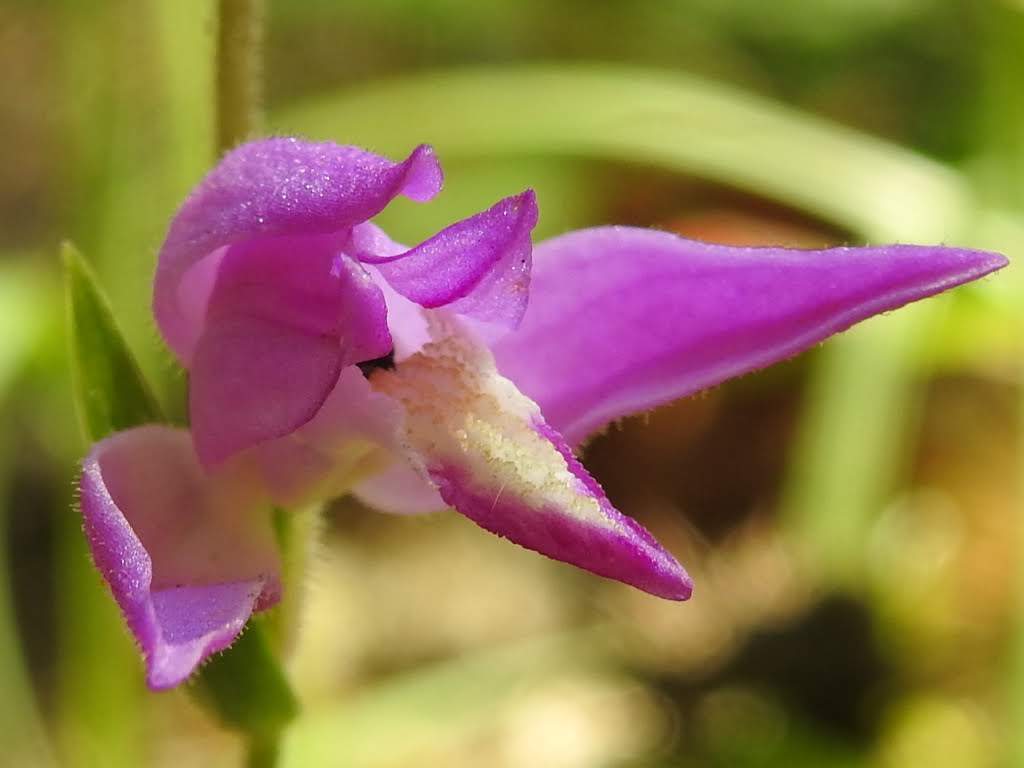
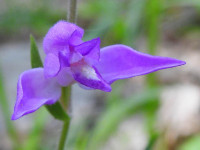
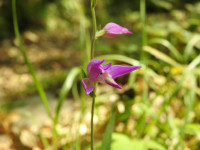
The inflorescence is a rather loose raceme, 3 to 24 cm long, with a number of flowers ranging from 3 up to 15, sometimes 12, sessile and inserted in the axil of lanceolate bracts, which in the lower parts are leafy and longer than the flower, while in the upper parts they are shorter but still protruding beyond the ovary. The flowers are purplish red or intense fuchsia in color, with lanceolate and pointed tepals (3 sepals and 3 petals), about 18-20 mm long, initially convergent and then the two lateral tepals open. The trilobed labellum is as long as the sepals, transversely divided by a constriction, with a concave hypochile and an ovate-lanceolate epichile, whitish with longitudinal yellow crests and purplish margins. The spur is absent.
The ovary is sessile, elongated, 1 to 1.5 cm long, pubescent and not twisted. The fruit is an erect capsule with six ribs, containing minute seeds, approximately 0.67-0.8 mm by 0.2-0.3 mm in size.
Habitat and distribution
Eurasian species, widespread from Europe to Japan, in Italy it is mainly found in mountainous and hilly environments, up to 2000 m altitude. It grows in open and sparse woods, in sunny or semi-shaded positions, on calcareous and meso-xerophilous soils. It adapts to well-drained substrates, typical of mountainous environments where light is moderate but not absent.
Flowering period
Flowering generally occurs between May and July, with possible variations related to altitude and latitude. In the mountains, flowering may start later due to lower temperatures.
Ecology and pollination
Sexual reproduction through seeds is very rare or almost absent, as germinating seedlings are rarely observed in nature. The plant mainly reproduces vegetatively, thanks to the formation of adventitious buds on the roots.
Pollination is mainly carried out by hymenopterans, which penetrate into the plant's gynostemium. During entry, the hypochile forces the insect to scrape its thoracic part on the sticky stigma, allowing pollen deposition. The anther is positioned so as to transfer pollen onto the insect's body, facilitating cross-pollination.
Curiosities and traditional uses
No significant traditional food or medicinal uses are documented for this species. However, its beauty and the vivid color of the flowers have made the Red Helleborine a subject of interest for wild orchid enthusiasts and for the conservation of botanical biodiversity.
Etymology
The genus name derives from the Greek "κεφαλή" (cephalé), meaning "head", and from the Latin "anthera", indicating the anther, probably referring to the globose shape or the apical position of the anther on the flower column. The specific epithet "rubra" refers to the characteristic purplish red color of the flowers. The Italian common name "cefalantera rossa" directly reflects these characteristics, highlighting the bright color of the flower.
Sources
- Prof. S. Pignatti, "Flora d'Italia"
- Acta Plantarum - Flora delle regioni italiane (scheda di Marinella Zepigi)
- World Flora Online (WFO)
Characteristics
Scheda botanica
| Famiglia | Orchidaceae |
|---|---|
| Fioritura | maggio – luglio |
| Forma biologica | Rhizomatous |
| Habitat | with fuchsia flowers, with red flowers |
Domande frequenti
- Quando fiorisce Red Helleborine?
- Red Helleborine fiorisce maggio – luglio.
- Che tipo di pianta è Red Helleborine?
- Red Helleborine è una Geophytes (Rhizomatous) secondo la classificazione di Raunkiaer.
- A quale famiglia appartiene Red Helleborine?
- Red Helleborine appartiene alla famiglia botanica Orchidaceae.
Where I found it
The sighting locations of this species are not public for conservation reasons.
Classification
- Kingdom
- Plantae
- Family
- Orchidaceae
- Full name
- Cephalanthera rubra (L.) Rich.
- Synonyms
- Cephalanthera maravignae Tineo; Serapias rubra L.
- Life form
- Geophytes rhizomatous
Similar species
Search for species with similar characteristicsNoticed an error in the identification? Write to me
Other species of the same family
Orchidaceae
Explore
Other species of Orchidaceae