Botanical species
Limodorum abortivum
(L.) Sw.
Violet Bird's-nest
Description
Morphological description
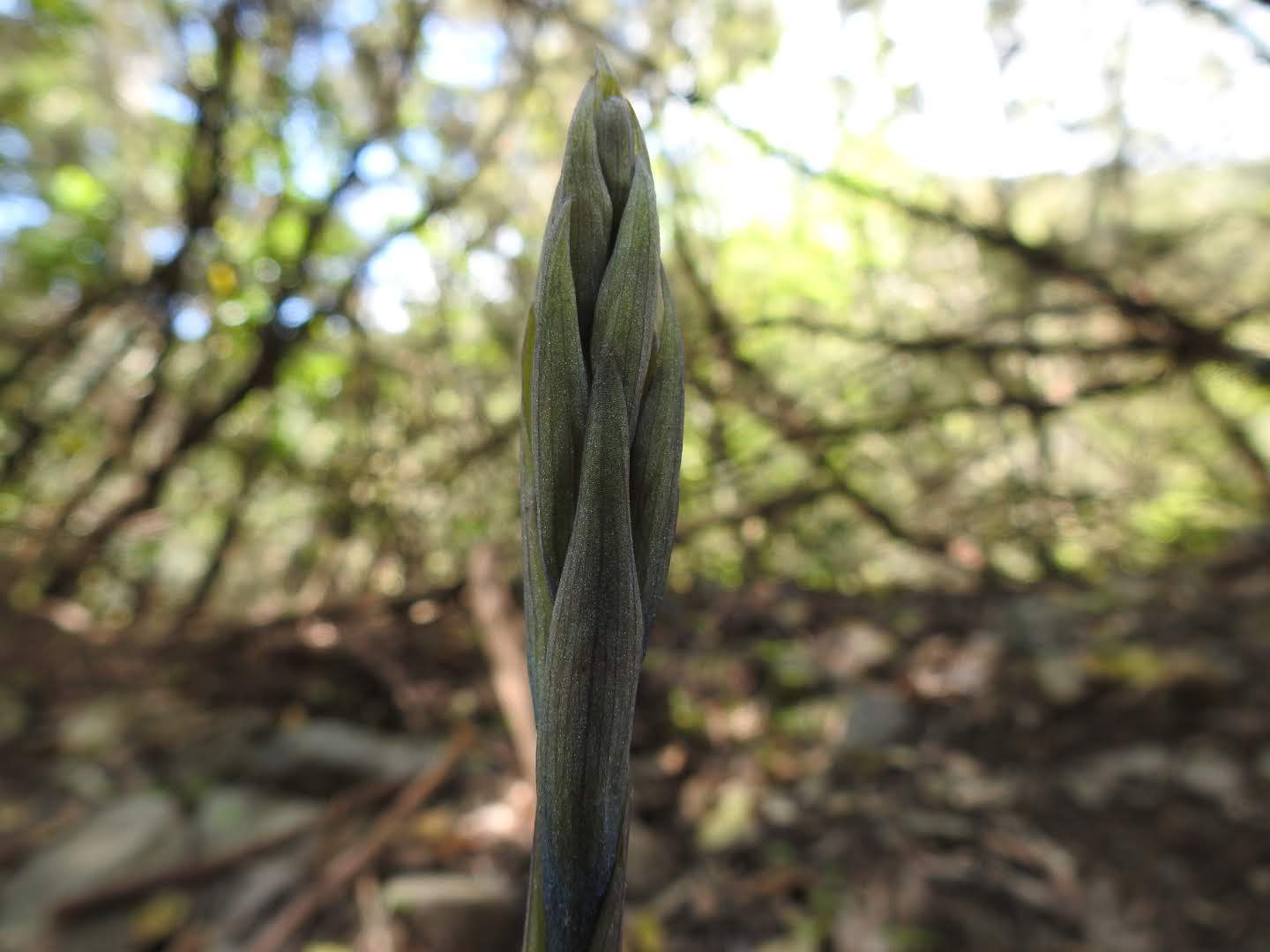
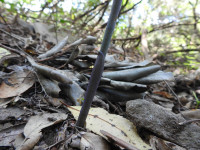
Perennial herbaceous plant belonging to the Orchidaceae family, characterized by an erect habit and a height generally ranging between 20 and 80 cm. The stem lacks true leaves but presents numerous leaf sheaths and scales of gray-green-violet or dark purple color, which wrap the basal part and give the plant a characteristic hue. The root system consists of a fleshy, superficial fasciculate rhizome, from which the stems develop annually.
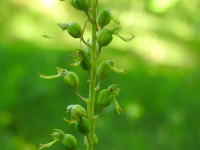
The inflorescence is composed of 6-20 flowers arranged rather sparsely along the stem. The flowers have average dimensions of about 15-20 mm and feature outer tepals that are lanceolate, spreading, and acute, violet or violet-livid in color, about 15-20 mm long, while the inner tepals are narrower but of similar length. The labellum, 15-17 mm long, is narrow at the base, widened in the anterior part, with entire and raised margins, showing a darker violet color along the edges and veins, providing a marked chromatic contrast. The labellum has a saddle shape and the apex is curved downward. The spur, cylindrical and descending, 10-15 mm long, is similar in length to the ovary and sometimes slightly curved.
The flowers often remain closed or open only partially, and the bracts accompanying them are about as long as the ovary, overtopping it. The fruit is an erect, oblong capsule, provided with six ribs and opens with a fissure to release the flat and reticulated seeds typical of orchids.
Habitat and distribution
This species is widespread in the hilly and mountainous areas of the northern and central Apennines, with a range extending also along the Mediterranean coasts and some continental areas of southern Europe, reaching altitudes between 0 and 1,200 meters above sea level. It prefers thermophilous and sub-Mediterranean environments, such as meadows, open oak, chestnut, and thermophilous beech woods, favoring well-drained calcareous soils.
The species is typically associated with light pine and oak woods, where light is sufficient for its growth but not excessive. Its presence can be irregular over time, with populations that may disappear and then reappear in stations where it had not been observed for years, due to its dependence on specific mycorrhizal fungi.
Flowering period
Flowering generally occurs from April to July, with variations depending on the altitude and latitude of the population. Under favorable conditions and at lower altitudes, it can start as early as late April, while in the mountains flowering shifts towards June and July.
Ecology and pollination
The plant is a parasite species of mycorrhizal fungi, particularly associating mainly with species of the genus Russula, such as Russula delica, Russula chloroides, and Russula brevipes. It does not possess functional green leaves and therefore does not perform photosynthesis efficiently; it feeds through the symbiotic fungus, from which it obtains vital nutrients.
Although the flowers produce nectar, visits by insect pollinators are scarce. Among the pollinating insects are bees and bumblebees, but the species' reproduction is mainly based on self-pollination, which can occur even without the complete opening of the flower, a mechanism advantageous in unfavorable environmental conditions or in the absence of pollinators.
Seed dispersal occurs through the release from fissured capsules that free very small and light seeds, easily transported by the wind.
Curiosities and traditional uses
The specific name "abortivum" refers to the fact that many flowers of the plant often wither before fully blooming, a phenomenon that has also inspired interpretations linked to presumed abortive properties, although there is no scientific evidence of such effects. The species is commonly known as "Violet Bird's-nest" or "fior di legna" in Italian, names that recall its appearance and woodland habitat.
Like all Orchidaceae, Limodorum abortivum is protected by international regulations such as the Washington Convention, which prohibits indiscriminate collection and protects the conservation of natural habitats.
Etymology
The genus name Limodorum probably derives from the Greek "leimódoron," meaning "gift of the meadow." Some scholars suggest it derives from "limódes," meaning "hungry," referring to the parasitic nature of these plants, while others link it to the term "aimodóron" used by Theophrastus to indicate a parasitic plant similar to Orobanche.
The specific term "abortivum" has Latin origins and indicates flowers that often abort, i.e., wither prematurely before opening. The common Italian name "Violet Bird's-nest" recalls the woody and forest nature of the plant's habitat.
Sources
- Prof. S. Pignatti, "Flora d'Italia"
- Acta Plantarum - Flora delle regioni italiane (sheet by Marinella Zepigi)
- World Flora Online (WFO)
Characteristics
Where I found it
The sighting locations of this species are not public for conservation reasons.
Classification
- Kingdom
- Plantae
- Family
- Orchidaceae
- Full name
- Limodorum abortivum (L.) Sw.
- Synonyms
- Ionorchis abortiva (L.) Beck; Orchis abortiva L.
- Life form
- Geofite rizomatose
Similar species
Search for species with similar characteristicsFurther reading
Noticed an error in the identification? Write to me
Other species of the same family
Orchidaceae
Explore
Other species of Orchidaceae