Botanical species
Anacamptis morio
(L.) R.M.Bateman, Pridgeon & M.W.Chase
Green-Winged Orchid
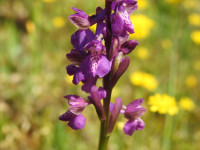
Description
Morphological description
It is a perennial herbaceous plant belonging to the Orchidaceae family, characterized by the presence of two whole oval tubers, deep in the soil, which represent the perennial organ from which the stem, leaves, and flowers develop every year. The height generally varies from 8 to 40 cm.
The stem is erect, cylindrical or slightly angular in the upper part, robust and often with a purplish hue. The basal leaves are linear-lanceolate, acute, uniformly glaucous green, without spots and with delicate veins, measuring from 6 to 12 cm in length. The upper leaves are sheathing, progressively smaller, membranous, glabrous, lanceolate and acute, with 1 to 6 veins; their coloration can be purplish or reddish, sometimes more intense towards the apex, and their length is similar to that of the ovary.
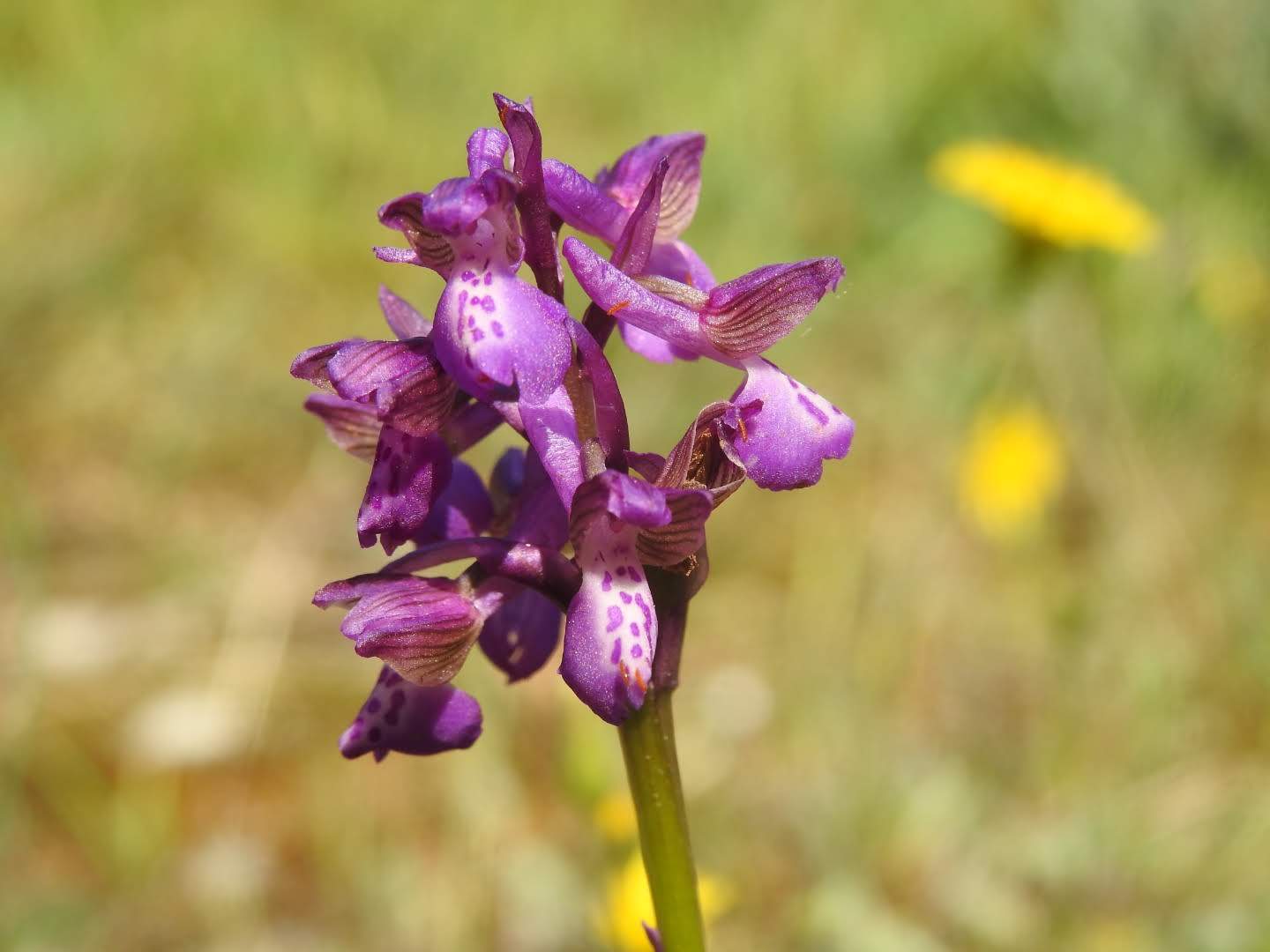
The inflorescence can be lax or dense and presents single flowers in the axil of the bracts, with colors ranging from pink to reddish-violet, but white forms may also occur. The flowers open progressively from the base towards the apex.
The tepals are free and tend to join to form a hood above the gynoecium; the sepals and petals are ovate-oblong, with evident greenish veins: the petals are slightly smaller than the sepals. The labellum is reniform, wider than long, glabrous and trilobed, with a median lobe truncated or incised, papillose, white-pinkish with violet spots and streaks. The two lateral lobes, generally larger and light purple in color, can be spreading or reflexed and have truncated or slightly crenate margins.
The spur is cylindrical, slightly clavate at the apex, nectariferous, straight or slightly curved, horizontal or descending, as long as the labellum or slightly longer, but shorter than the ovary. Its coloration varies from whitish to pinkish.
During development, the flower undergoes a helical torsion that brings the labellum, initially facing downward, to position itself upwards, while the hood formed by the tepals moves downward; this torsion is evident from a helical streak on the ovary.
The gynostemium, straight and whitish, ends with a bilocular pinkish anther containing the pollinia—massive masses of agglutinated pollen grains—connected to a mucilaginous caudicle and a viscous retinaculum, which allows the pollinia to be easily picked up by pollinating insects.
The fruit is a six-ribbed capsule, three of which are more prominent, containing very small, linear, reddish seeds.
Habitat and distribution
The species is widespread in Europe and the Caucasus, present in various Italian regions and the Mediterranean basin. It is ecologically tolerant and colonizes very diverse environments, including grasslands, forest edges, garrigues, and shrublands. It grows from sea level up to about 1300 meters of altitude.
It prefers well-drained soils, often calcareous or neutral, with variable exposure but generally in sunny or partially shaded positions. Its adaptability makes it present in a wide range of habitats, from plains to hilly and submontane areas.
Flowering period
Flowering occurs between March and June, with variations related to altitude and latitude: in warmer and lower areas it begins earlier, while it lasts longer in cooler and mountainous zones. Flower opening proceeds from the bottom to the top of the inflorescence.
Ecology and pollination
The orchid mainly relies on pollinating insects for sexual reproduction. The pollinia, thanks to the viscous retinaculum, easily attach to the bodies of insects when they visit the flower for the nectar contained in the spur. This mechanism ensures effective cross-pollination.
The helical torsion of the flower facilitates contact between pollinating insects and reproductive structures. The seeds are small and light, dispersed mainly by the wind once the mature capsules open.
Curiosities and traditional uses
This species is also known by popular names such as Lesser Orchid, Clown Orchid, Goat Lily, Salep, or Cuckoo Bread, reflecting its presence in local tradition and culture. The term "Salep" refers to the traditional use of the tubers of some orchids as a base for a nutritious and medicinal beverage, widespread in various Mediterranean and Middle Eastern cultures.
Apchromia, i.e., the presence of flowers with white or greenish coloration due to pigment deficiency, is a phenomenon observed in this species, as well as hyperchromia, which results in a more intense coloration than normal. These chromatic variations are linked to genetic and environmental factors.
Etymology
The genus name, Anacamptis, derives from Greek and means "bent backward," referring to the torsion of the flower. The specific name morio probably refers to the spotting and variegated color of the labellum, which can resemble the costume of a jester or buffoon, hence also the common name "Lesser Orchid" or "Clown Orchid."
Sources
- Acta Plantarum - Flora delle regioni italiane (scheda di Marinella Zepigi)
Characteristics
Where I found it
The sighting locations of this species are not public for conservation reasons.
Classification
- Kingdom
- Plantae
- Family
- Orchidaceae
- Full name
- Anacamptis morio (L.) R.M.Bateman, Pridgeon & M.W.Chase
- Synonyms
- Anacamptis morio (L.) R.M.Bateman, Pridgeon & M.W.Chase subsp. caucasica (K.Koch) H.Kretzschmar, Eccarius & H.Dietr.; Anacamptis morio (L.) R.M.Bateman, Pridgeon & M.W.Chase subsp. picta (Loisel.) Jacquet & Scappat.
- Life form
- Geofite bulbose
Similar species
Search for species with similar characteristicsFurther reading
Noticed an error in the identification? Write to me
Other species of the same family
Orchidaceae
Explore
Other species of Orchidaceae