Botanical species
Ophrys apifera
Huds.
Bee Orchid
Description
Morphological description
Perennial herbaceous plant, geophyte with subglobose tubers, generally 20 to 60 cm tall, with an erect, simple, glabrous and smooth stem. The stem bears 2 to 4 basal lanceolate-oblong leaves, herbaceous in texture, intense green in color, and 2 to 3 cauline leaves that partially clasp the stem; the latter are ovate-lanceolate, smaller and often green or yellowish in color.
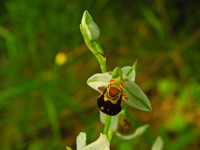
The inflorescence is a terminal cylindrical spike, lax in appearance, with an erect and elongated axis, bearing 3 to 12 sessile flowers. The bracts are leafy, ovate-lanceolate, acuminate, longer than the flower and green or yellowish in color.
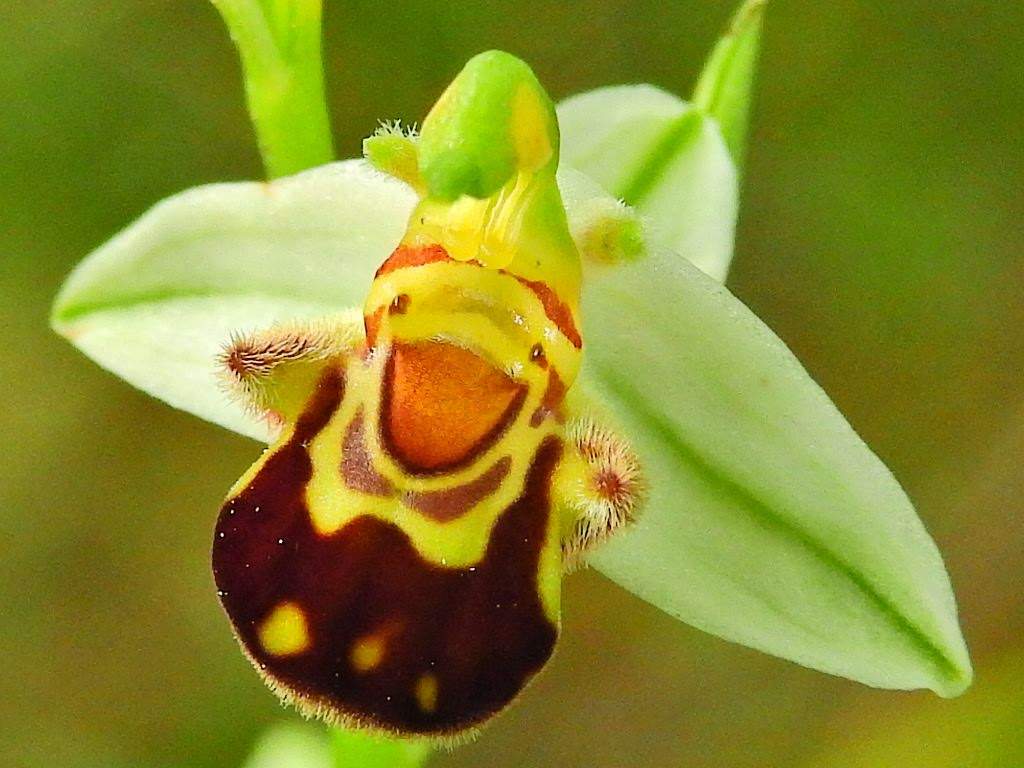
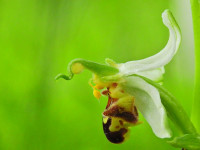
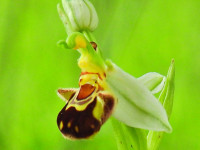
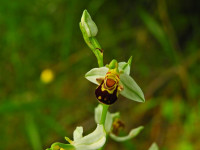
The flowers are characteristic and variable in color: the outer tepals are ovate, acute, concave and free, pink-purple, reddish-violet or white in color, with a central longitudinal green dorsal vein; the central tepal can be erect or bent backward relative to the gynostemium, while the two lateral ones are directed downward. The two inner tepals, smaller (1-3 mm), are subtriangular, obtuse and velvety.
The labellum is the most distinctive and complex part: suborbicular, convex, velvety and trilobed, reddish-brown with a yellow or white-yellowish fringe. The lateral lobes are gibbous, triangular, curved downward and adorned with yellow hairs, while the median lobe, larger and oval, is strongly revolute (folded downward) with a yellow triangular appendage facing inward. The surface of the labellum shows a central yellow-orange, glabrous and bilobed spot, which can take different shapes. The overall structure of the labellum resembles the appearance of a female insect.
The gynostemium is green-yellowish with a triangular and reflexed apex, lacking a spur. The ovary is cylindrical, not twisted, glabrous, bent forward. The fruit is a fissure-dehiscent capsule containing up to 12,000 tiny seeds, typical of Orchidaceae.
Habitat and distribution
This is a typically Mediterranean and Atlantic species, present along coasts and with wide penetration inland. In Italy it is widespread from the plains up to about 800 meters altitude, with exceptional reports up to 1500 meters. It grows in very varied environments, preferring meadows and grassy places both humid and dry, shrubs, forest clearings and forest edges, favoring calcareous and poor soils.
The species is commonly found in coastal regions and hilly areas of Italy and the Mediterranean, extending also into central and southern Europe and North Africa.
Flowering period
Flowering extends from April to July, with peak months in May and June. The duration and intensity of flowering may vary depending on climatic conditions and altitude.
Ecology and pollination
The reproductive strategy of this orchid is particularly fascinating and complex. The labellum has the appearance and texture of a female insect, and produces a scent that mimics the sexual pheromones of certain hymenopteran species, particularly males of Eucera (Eucera longicornis, Eucera pulveracea, Eucera lucasi). These males, attracted by the false sexual signal, attempt to copulate with the labellum, coming into contact with the pollinia sacs. In this way, the pollen sticks to the insect's head and is transported to the next flower, allowing cross-pollination.
However, Ophrys apifera is unique among Ophrys for its ability to self-pollinate (autogamy). This occurs thanks to the elongation of the caudicle which allows the folding of the pollinia sacs directly onto the stigmatic cavity, ensuring fertilization even in the absence of pollinating insects.
Seed dispersal occurs through the release from the fissure-dehiscent capsule of thousands of microscopic seeds, which are dispersed by the wind.
Curiosities and traditional uses
The particular deceptive sexual pollination strategy of Ophrys apifera is an emblematic example of coevolution and mimicry within Orchidaceae. This mechanism is studied as a model of “sexual trap” in plants.
No significant traditional medicinal or food uses are documented for this species, probably due to its rarity and legal protection. It is nevertheless a nationally protected species and protected in several Italian regions, which is why its collection is prohibited.
Etymology
The generic name Ophrys derives from the Greek ophrys, meaning “eyebrow”, probably referring to the arched shape and position of the upper tepals which recall this facial feature. The specific name apifera derives from the Latin apis = bee and fero = I carry, “bee-bearer”, referring to the appearance of the labellum which simulates the pollinating insect, a female bee. The Italian common name "Bee Orchid" directly reflects this evocative characteristic.
Sources
- Prof. S. Pignatti, "Flora d'Italia"
- Acta Plantarum - Flora delle regioni italiane (sheet by Giuliano Salvai)
- Tela Botanica / H. Coste, "Flore descriptive et illustrée de la France"
- World Flora Online (WFO)
Characteristics
Scheda botanica
| Famiglia | Orchidaceae |
|---|---|
| Fioritura | maggio – luglio |
| Forma biologica | Bulbous |
| Habitat | with purple flowers, with pink flowers, with brown flowers |
Domande frequenti
- Quando fiorisce Bee Orchid?
- Bee Orchid fiorisce maggio – luglio.
- Che tipo di pianta è Bee Orchid?
- Bee Orchid è una Geophytes (Bulbous) secondo la classificazione di Raunkiaer.
- A quale famiglia appartiene Bee Orchid?
- Bee Orchid appartiene alla famiglia botanica Orchidaceae.
Where I found it
The sighting locations of this species are not public for conservation reasons.
Classification
- Kingdom
- Plantae
- Family
- Orchidaceae
- Full name
- Ophrys apifera Huds.
- Synonyms
- Ophrys apifera Huds. var. aurita (Moggr.) Gremli; Ophrys apifera Huds. var. botteronii (Chodat) Brand; Ophrys apifera Huds. var. chlorantha (Hegetschw.) Nyman; Ophrys apifera Huds. var. tilaventina Nonis & Liverani; Ophrys apifera Huds. var. trollii (Hegetschw.) Rchb.f.
- Life form
- Geophytes bulbous
Similar species
Search for species with similar characteristicsFurther reading
Noticed an error in the identification? Write to me
Other species of the same family
Orchidaceae
Explore
Other species of Orchidaceae