Botanical species
Gymnadenia conopsea
(L.) R.Br.
Fragrant Orchid
Description
Morphological description
Perennial herbaceous plant, with an erect habit, of variable size from 20 to 60 cm in height, exceptionally up to 80 cm. The root system consists of two deeply palmated rhizotubers, one light-colored with a vegetative function and the other dark, flaccid, reserved for the following year. The stem is robust, slightly striated and leafy, with 3-7 cauline leaves of gray-green color, arranged along the stem. The leaves are lanceolate, linear and keeled, with dimensions ranging from 10 to 25 cm in length and 1-2 cm in width, the upper ones shorter and with more bract-like shapes.
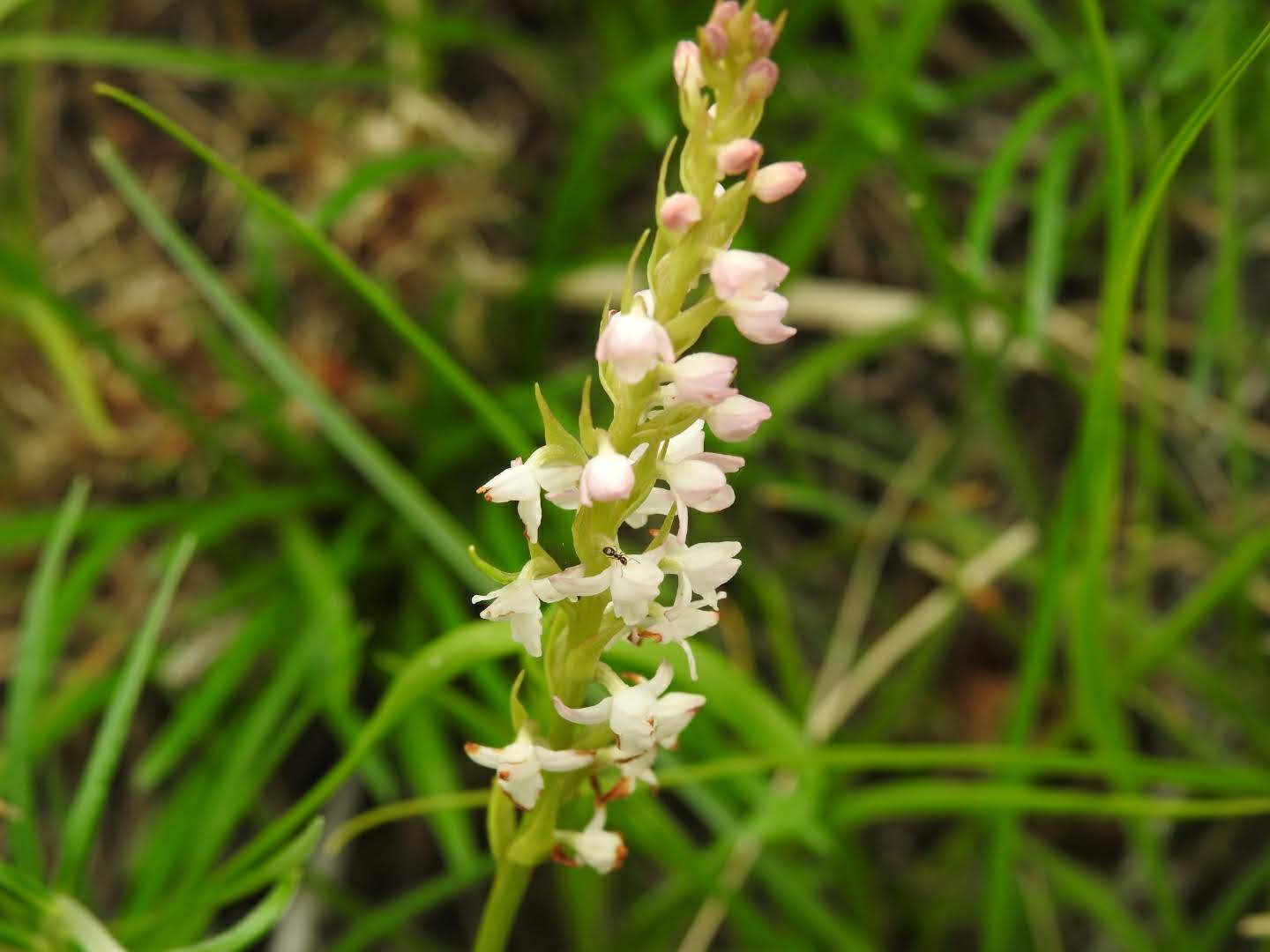
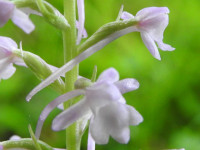
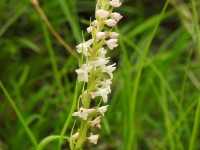
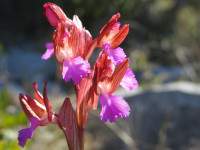
The inflorescence is cylindrical, compact and multiflorous, 5 to 25 cm long, with lanceolate bracts often decorated with violet shades that can exceed the length of the flower ovary. The flowers, generally pinkish-violet in color, are very fragrant and rarely appear white or pale pink. They have six tepals: the three outer ones, wide and spreading, and the three inner ones shorter and connivent, which together form a hood above the labellum. The labellum is trilobed, longer than wide, with the three lobes almost equal to each other, rounded or slightly triangular in shape; the lateral lobes are elliptical or ovate, while the central one is smaller and triangular. The spur is filiform, pendulous and curved downward, about 15-20 mm long, about twice the length of the ovary, and is rich in nectar.
The fruits are erect capsules containing minute, flat and reticulated seeds.
Habitat and distribution
This species is mainly widespread in the mountainous and submontane regions of northern Italy, particularly in the Alps, Prealps and northern Apennines, where it is common. Its presence becomes rarer moving towards the southern regions of the Peninsula. The distribution extends throughout the Eurasian area, from Europe to Japan.
It grows in various habitats, typically sparse and bright woods, wet meadows and pastures, preferring cool and humid environments, but adapts to exposures from bright to partially shaded. The species can be found from sea level up to about 2,400 meters of altitude, often frequenting moist soils with subalpine-montane substrates.
Flowering period
Flowering generally occurs between June and August, with local variations linked to climatic and altitudinal conditions. In the summer months the flowers open emitting a delicate fragrance, often perceived in the evening hours, which serves to attract pollinating insects.
Ecology and pollination
The Fragrant Orchid is mainly pollinated by lepidopterans, particularly by diurnal and also nocturnal butterflies, attracted by the scent and nectar present in the spur. The large length of the spur favors pollination by insects with long mouthparts, such as some species of butterflies and moths. Nectar production is strategic to encourage visits from pollinating insects. Seed dispersal occurs through capsules that open at maturity, releasing numerous minute and light seeds, favoring dispersal mainly by wind.
Curiosities and traditional uses
In the past, this orchid was collected for herbal purposes, especially for its supposed anticonvulsant properties. In Abruzzo and other Italian regions, the Fragrant Orchid and other similar orchids were used by magicians and witches in popular practices related to matters of love and family discord. The root system, consisting of two joined tubers, resembled two joined hands and was considered a powerful amulet: dividing the tubers was believed to foment discord, while joining them favored reconciliation and social peace. This symbolism gave the plant the popular names of “plant of concord” or “of discord.”
The species is also cultivated for ornamental purposes, valued for the beauty and fragrance of its flowers.
Etymology
The genus name Gymnadenia derives from the Greek “gymnos” (naked) and “aden” (gland), referring to the absence of bursicles in the retinacula of the flowers of these orchids. The specific epithet “conopsea” comes from the Greek “konops” meaning mosquito, probably referring to the elongated and slender shape of the spur, which resembles the mouthparts of these insects. The Italian common name “Fragrant Orchid” recalls the delicacy and pink color of the flowers.
Sources
- Prof. S. Pignatti, Flora d'Italia
- Acta Plantarum - Flora delle regioni italiane (scheda di Marinella Zepigi)
- World Flora Online (WFO)
Characteristics
Scheda botanica
| Famiglia | Orchidaceae |
|---|---|
| Fioritura | maggio – agosto |
| Forma biologica | Bulbous |
| Habitat | with white flowers, with pink flowers |
Domande frequenti
- Quando fiorisce Fragrant Orchid?
- Fragrant Orchid fiorisce maggio – agosto.
- Che tipo di pianta è Fragrant Orchid?
- Fragrant Orchid è una Geophytes (Bulbous) secondo la classificazione di Raunkiaer.
- A quale famiglia appartiene Fragrant Orchid?
- Fragrant Orchid appartiene alla famiglia botanica Orchidaceae.
Where I found it
The sighting locations of this species are not public for conservation reasons.
Classification
- Kingdom
- Plantae
- Family
- Orchidaceae
- Full name
- Gymnadenia conopsea (L.) R.Br.
- Synonyms
- Gymnadenia conopsea (L.) R.Br. var. alpina Rchb.f. ex Beck; Habenaria gymnadenia Druce; Orchis conopsea L.
- Life form
- Geophytes bulbous
Similar species
Search for species with similar characteristicsNoticed an error in the identification? Write to me
Other species of the same family
Orchidaceae
Explore
Other species of Orchidaceae