Botanical species
Anacamptis pyramidalis
(L.) Rich.
Pyramidal Orchid
Description
Morphological description
Perennial bulbous geophyte, the Pyramidal Orchid has a variable height between 20 and 60 cm. The stem is erect, cylindrical, glabrous and shiny, often with a slightly wavy and angular surface in the upper part. At the base of the stem, some basal leaves develop, linear-lanceolate in shape, acute and pale green in color, up to 15 cm long and about 1.5-2 cm wide, with an acuminate apex and entire margin. Moving up the stem, the leaves become progressively smaller and wrap tightly around the stem, assuming a bract-like shape; during flowering, the lower leaves tend to wither.
The root system consists of two ovoid-elliptical tubers, from which new aerial structures develop each year, accompanied by thin roots.
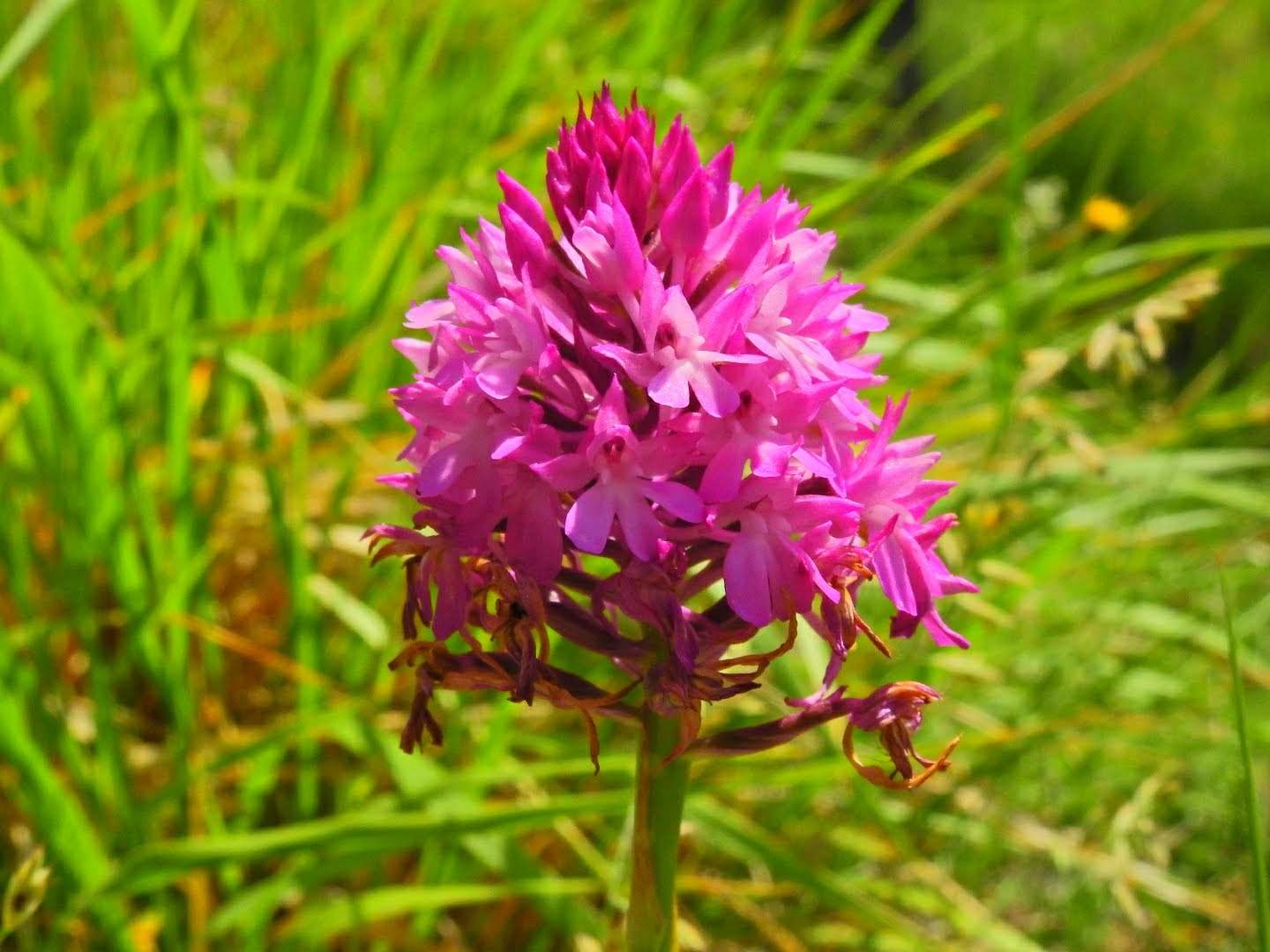
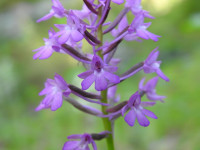
The inflorescence is very showy and initially conical in shape, about 3 cm wide and 3 cm high; as flowering progresses, it elongates up to 7-8 cm, assuming a more cylindrical or ovoid shape. This inflorescence is dense with small flowers (about 10 mm in diameter), which vary in color from pale pink almost white to cobalt violet, passing through shades of fuchsia and pink-purple. Each flower is supported by a lanceolate bract, similar to a leaf, as long as the ovary (about 12-15 mm), which shows a more intense violet coloration in the apical part.
The outer tepals are three, ovate-lanceolate in shape and distinctly bent backward, about 5 mm long. The two inner tepals are connivent, forming a sort of "helmet" that overhangs the gynostemium. The labellum is deeply trilobed and presents, at the base, two prominent petaloid lamellae that extend downward. The lobes of the labellum are oblong, about 5 mm long, with the median lobe generally narrower than the lateral ones, but the shape can vary among individuals. The spur, filiform and flexible, measures from 10 to 15 mm in length, is curved in an "S" shape and projects backward and downward; it contains nectar and acts as an attractant for pollinating insects.
The fruit is a capsule containing numerous minute seeds, typical of Orchidaceae, which favor mainly anemochorous dispersal (carried by the wind).
Habitat and distribution
The Pyramidal Orchid is a species widely distributed in Italy and the Mediterranean basin, with a range extending over much of southern and central Europe, with particular concentration along the Mediterranean coasts but with extensions northwards and eastwards. In Italy it grows throughout the national territory, from plains up to medium-high mountain altitudes (up to about 1400 m, as documented in the Apuan Alps).
It prefers habitats characterized by calcareous and well-drained soils, such as poor meadows, pastures, uncultivated areas, forest edges and slopes, as well as road and path margins. It can be found in both mountainous and hilly environments, commonly from 0 to 800 m altitude, but also at higher elevations. It requires sunny or semi-shaded exposures, in contexts with poor or moderately fertile soil, typical of Mediterranean and temperate environments.
Flowering period
The flowering of the Pyramidal Orchid generally extends from May to June, with possible local variations due to climatic and altitudinal conditions. In some areas, especially in southern regions or islands, it can start as early as April or extend until July. The subspecies serotina, less common, can anticipate flowering as early as February in certain Mediterranean localities.
Ecology and pollination
The plant's reproductive strategy is closely linked to entomogamous pollination, particularly by certain species of butterflies. These insects, attracted by the nectar contained in the spur, are guided by the two lamellae present at the entrance of the spur itself. When the insect's proboscis penetrates inside the spur to reach the nectar, its surface touches the structure called the viscidium, which releases the sticky adhesive disc containing the pollinia. These attach to the butterfly's proboscis and are transported to the next flower, where contact with the stigma can trigger fertilization.
The fruit is a capsule that opens at maturity, releasing a multitude of very small and light seeds, which are dispersed mainly by the wind. This type of anemochorous dispersal favors colonization of new habitats where environmental conditions are favorable.
Curiosities and traditional uses
The Pyramidal Orchid is a species protected at the national level and in some Italian regions, precisely because of its beauty and vulnerability due to collection and loss of natural habitat. No specific traditional medicinal or food applications are known for this species, although many Mediterranean orchids have historically been collected for food or medicinal uses. However, its characteristic shape and bright colors make it a highly appreciated plant in naturalistic and botanical contexts.
The appearance of its inflorescence, which resembles a pyramid or pointed cone, is the origin of the Italian common name, while its particular floral structure has fascinated naturalists and orchid enthusiasts for the complexity of its pollination mechanisms.
Etymology
The genus name, Anacamptis, derives from the Greek “anakamptein,” meaning “to bend backward” or “to fold upward.” This term can refer to the shape of the tepals, which fold upward, or to the two petaloid lamellae at the entrance of the spur, which rise and bend outward. The specific epithet pyramidalis refers to the conical and pyramidal shape of the inflorescence, a very evident characteristic especially in the early stages of flowering, although over time the shape tends to become more cylindrical or ovoid.
The Italian common name “Orchidea piramidale” reflects this peculiar shape of the inflorescence, which makes it immediately recognizable even to non-experts.
Sources
- Prof. P.V. Arrigoni, "Flora analitica della Toscana", "Flora dell'Isola di Sardegna"
- Acta Plantarum - Flora delle regioni italiane (scheda di Giuliano Salvai)
- World Flora Online (WFO)
Characteristics
Scheda botanica
| Famiglia | Orchidaceae |
|---|---|
| Fioritura | maggio – giugno |
| Forma biologica | Bulbous |
| Habitat | with fuchsia flowers, with fragrant flowers |
Domande frequenti
- Quando fiorisce Pyramidal Orchid?
- Pyramidal Orchid fiorisce maggio – giugno.
- Che tipo di pianta è Pyramidal Orchid?
- Pyramidal Orchid è una Geophytes (Bulbous) secondo la classificazione di Raunkiaer.
- A quale famiglia appartiene Pyramidal Orchid?
- Pyramidal Orchid appartiene alla famiglia botanica Orchidaceae.
Where I found it
The sighting locations of this species are not public for conservation reasons.
Classification
- Kingdom
- Plantae
- Family
- Orchidaceae
- Full name
- Anacamptis pyramidalis (L.) Rich.
- Synonyms
- Anacamptis pyramidalis (L.) Rich. subsp. serotina Presser
- Life form
- Geophytes bulbous
Similar species
Search for species with similar characteristicsNoticed an error in the identification? Write to me
Other species of the same family
Orchidaceae
Explore
Other species of Orchidaceae