Botanical species
Epipactis atrorubens
(Hoffm.) Besser
Dark-Red Helleborine
Description
Morphological description
Perennial herbaceous plant equipped with a cylindrical and horizontal rhizome from which secondary roots originate. The stem is erect, generally solitary, between 20 and 80 cm tall, with a glabrous surface in the basal part and slightly pubescent in the upper part; its coloration tends to be reddish-purple. At the base of the stem there are 2-3 basal scales of violet color, scarious and blunt in shape.
The cauline leaves are arranged in two rows, alternate and distichous, concentrated in the lower half of the stem. The lower leaves are almost in contact with the ground, amplexicaul, ovate or ovate-lanceolate, dark green in color with a slightly leathery texture; they are erect-patent and well developed. The upper leaves are thinner, lanceolate and progressively smaller in size.
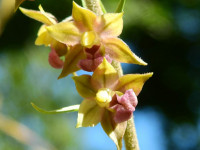
The inflorescence is elongated, multiflorous, generally unilateral, with a densely hairy axis of grayish-purple color. It can contain from 10 up to 40 pedicellate flowers, patent or slightly pendulous. The bracts of the inflorescence are patent, lanceolate and acute; the lower ones are equal to or longer than the flowers, while the upper ones resemble the ovary.
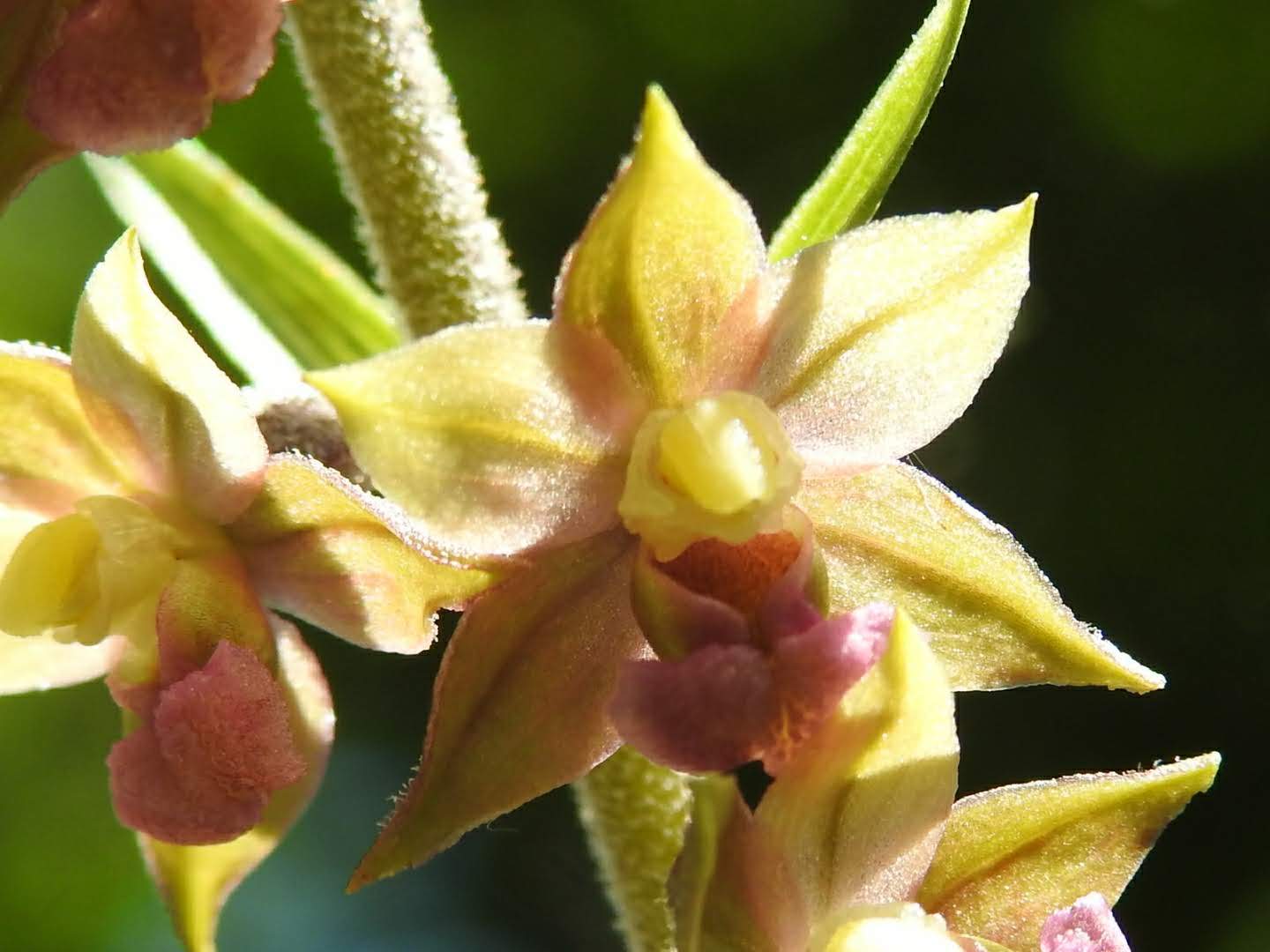
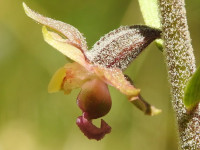
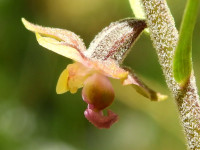
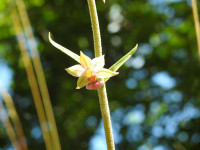
The flowers have a perianth of brown-pink or brown-purple color, with acute oval-lanceolate sepals, densely hairy on the outside and glabrous on the inside. The lateral petals are oval-lanceolate, glabrous or sparsely hairy externally and glabrous internally, similar in color to the sepals.
The labellum, characteristic of the genus, is slightly shorter than the petals and is divided into two parts separated by a deep notch: the anterior part (hypochile) is hemispherical, concave, nectariferous, purple in color with a whitish margin; the posterior part (epichile) is trigonal in shape, with a fringed margin and conspicuous wrinkles at the base. The ovary is pyriform and pubescent.
The fruit is an elliptical capsule, patent or slightly pendulous, containing numerous very small brown seeds.
Habitat and distribution
This species has a Eurasian range extending from Europe to Japan, with a predominant presence in the Euro-Caucasian area. In Italy it grows in bright woodland environments, poor meadows and scrublands, preferring calcareous habitats. It is particularly frequent in coniferous forests.
The growth altitude ranges from 0 up to 2,000 m a.s.l., with occasional reports up to 2,400 m. It prefers sunny or semi-shaded exposures and well-drained soils, often with calcareous substrate.
In marshy environments it can be confused with Epipactis palustris, which is distinguished by greenish outer tepals, white-pink labellum and fusiform ovary.
Flowering period
Flowering occurs between June and August, with possible variation depending on altitude and latitude: in higher or northern areas flowering may start later and last until late August. Flowers open progressively from the bottom towards the apex of the inflorescence.
Ecology and pollination
The flowers are fragrant with a vanilla scent, an adaptation that attracts pollinating insects. Although specific data on pollinator species are not available, the scent and flower structure suggest an entomogamous pollination strategy, probably by bees and other pollinating insects attracted by the nectar produced in the hypochile.
The plant does not have a spur, but the nectariferous labellum with two pleated humps acts as a lure and guide for pollinating insects. The seeds, very small and light, are mainly dispersed by wind, facilitating colonization of new habitats.
Curiosities and traditional uses
No certain traditional food or medicinal uses are reported for this species. However, like all Orchidaceae, it is subject to international protection under the Washington Convention (CITES), which prohibits wild collection to prevent the risk of extinction.
The common name “Dark-Red Helleborine” recalls the color of the flowers and the resemblance of the leaves to those of hellebore, a plant known in herbal medicine and popular tradition. The aesthetic characteristics and presence in calcareous woods make it a species appreciated by enthusiasts of wild orchids.
Etymology
The genus name Epipactis derives from the Greek “epí” (above) and “pégnymi” (I grow), or alternatively from “Epipaktis”, an ancient name of a plant called hellebore, recalling the resemblance of the leaves to those of Veratrum album (white hellebore).
The specific epithet atrorubens derives from Latin “ater” (black) and “ruber” (red), referring to the dark purple shade of the flowers.
The Italian common name “Elleborina violacea” emphasizes precisely the intense violet color of the flowers and the resemblance to hellebore.
Sources
- Acta Plantarum - Flora delle regioni italiane (actaplantarum.org)
- Acta Plantarum - Flora delle regioni italiane (scheda di Marinella Zepigi)
- World Flora Online (WFO)
Characteristics
Scheda botanica
| Famiglia | Orchidaceae |
|---|---|
| Fioritura | maggio – agosto |
| Forma biologica | Rhizomatous |
| Habitat | with purple flowers, with purple flowers |
Domande frequenti
- Quando fiorisce Dark-Red Helleborine?
- Dark-Red Helleborine fiorisce maggio – agosto.
- Che tipo di pianta è Dark-Red Helleborine?
- Dark-Red Helleborine è una Geophytes (Rhizomatous) secondo la classificazione di Raunkiaer.
- A quale famiglia appartiene Dark-Red Helleborine?
- Dark-Red Helleborine appartiene alla famiglia botanica Orchidaceae.
Where I found it
The sighting locations of this species are not public for conservation reasons.
Classification
- Kingdom
- Plantae
- Family
- Orchidaceae
- Full name
- Epipactis atrorubens (Hoffm.) Besser
- Synonyms
- Epipactis atropurpurea Raf.; Epipactis rubiginosa (Crantz) W.D.J.Koch; Helleborine atropurpurea (Raf.) Schinz & Thell.; Serapias latifolia Huds. [unranked] atrorubens Hoffm.
- Life form
- Geophytes rhizomatous
Similar species
Search for species with similar characteristicsFurther reading
Noticed an error in the identification? Write to me
Other species of the same family
Orchidaceae
Explore
Other species of Orchidaceae