Botanical species
Helminthotheca echioides
(L.) Holub
Bristly Oxtongue
Description
Morphological description
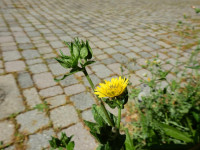
Annual or biennial herbaceous plant, the Bristly Oxtongue generally reaches a height between 40 and 60 cm, but can grow up to 1 meter. The stem is erect, robust, often reddish, striated and divaricate-branched from the base, with a rough surface covered by strong sub-spiny bristles. The plant secretes a white latex, typical of many Asteraceae.
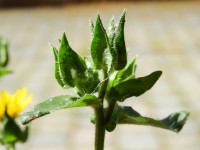
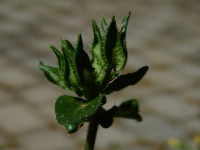
The leaves appear in two main forms: the basal ones are arranged in a rosette, spatulate or oblanceolate in shape, with sinuate and dentate margins, varying in size between 5-15 cm in length and 1-5 cm in width. They bear large rough anchor-shaped or hooked bristles, some with a white warty base. These basal leaves have a narrow and winged petiole. The cauline leaves are instead lanceolate, sessile, semi-clasping and often auriculate, with smaller dimensions (4-7 cm in length and 1-3 cm in width).
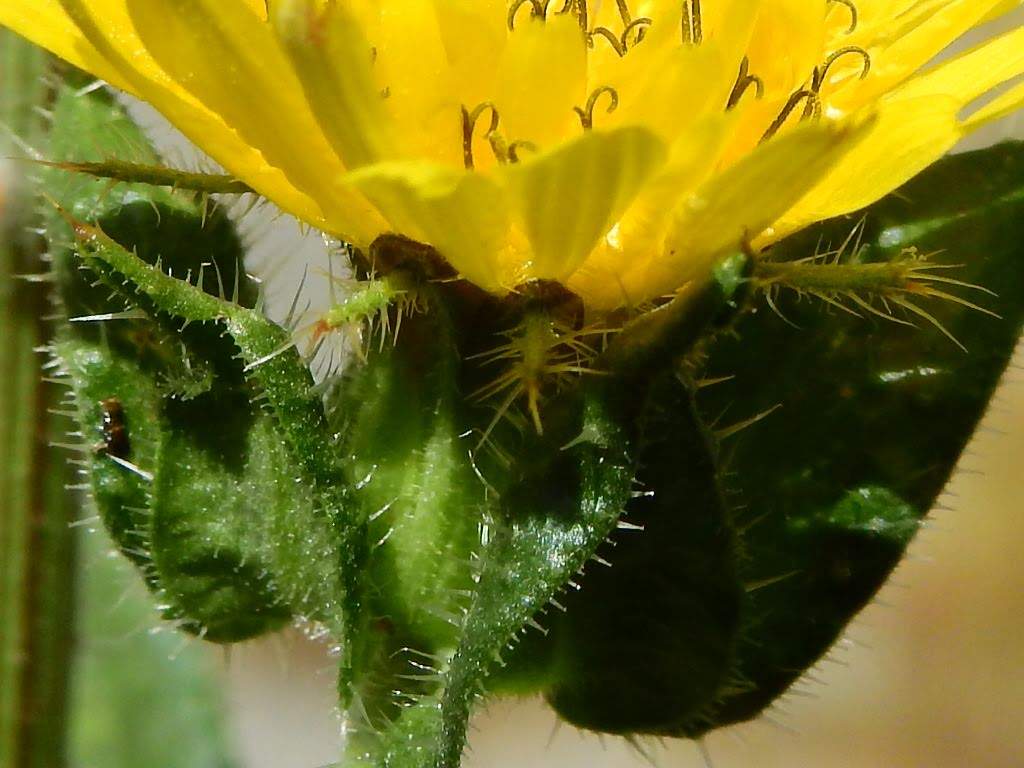
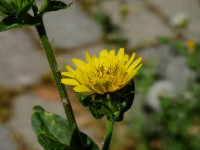
The flower heads, 15-30 mm in diameter, are grouped in irregular corymbs located at the ends of the branches, supported by peduncles 1 to 5 cm long, also rough. The involucre is formed by two series of scales: the outer ones are wide, heart-shaped or triangular-astate, spiny at the margins and aculeate-mucronate at the apex; the inner ones are narrower, linear and mucronate, forming a cylindrical involucre. The flowers are all ligulate, hermaphroditic, bright yellow with purple veins on the underside, giving a vivid and luminous appearance.
The fruit is a brown-yellowish cypsela, rough and transversely striated, 2.5-3.5 mm, equipped with a beak 3-5 mm long, topped by a snow-white pappus with feathery hairs. The presence of two types of achenes – outer villous with a short beak and inner glabrous, rough and with a long beak – favors different dispersal modes. The chromosome number is 2n = 10.
The root system is typical of annual herbs, with well-developed but not particularly deep roots, suitable for variable soil conditions.
Habitat and distribution
The Bristly Oxtongue is widely distributed in Italy and the Mediterranean basin, with a range extending from southern Europe to the Balkans, Turkey and Egypt. It grows mainly on calcareous substrates, in anthropized environments such as uncultivated areas, road edges, ruins, disturbed soils and abandoned fields. It adapts to both dry and humid conditions, showing marked hardiness.
In Italy it is present from the plains up to mountain altitudes of about 1300 meters above sea level, showing excellent colonization capacity in different altitudinal and climatic belts. The species prefers sunny or semi-shaded exposures, typical of open and disturbed environments.
Flowering period
Flowering occurs mainly from June to October, with some geographic variations that can extend it from November to February in some areas with milder climates. The yellow flowers are therefore visible for a long period, favoring the annual or biennial reproduction of the plant.
Ecology and pollination
The Bristly Oxtongue appears as a weed in disturbed environments, with an effective reproductive strategy thanks to its hermaphroditic ligulate flowers that attract numerous pollinating insects, particularly bees and other generalist pollinators. The bright yellow coloration and purple veins are features that enhance insect attraction.
Seed dispersal occurs through cypselae equipped with a feathery pappus, facilitating anemochory (wind dispersal). The presence of two types of achenes allows both local dispersal through the outer villous fruits retained in the involucre, and wider dispersal thanks to the inner seeds with a more developed pappus.
Curiosities and traditional uses
The Bristly Oxtongue is a bitter species, but the young basal rosettes are edible and are traditionally consumed both raw and cooked, or preserved in vinegar. This use is particularly widespread in the subglabra variety and is generally limited to the period before stem development, when the plant is still “tallischia” (young and tender).
From an ethnobotanical point of view, the plant is known for its bitter-tonic properties, although medicinal uses are less documented compared to other Asteraceae. It remains appreciated as a wild food in traditional Mediterranean cuisines.
Etymology
The genus name Helminthotheca derives from the Greek “hélmins, -inthos” (worm) and “théke” (box), a clear reference to the shape of the rough and transversely striated achenes that resemble small worms. The specific epithet echioides means “similar to Echium”, referring to the roughness and general habit of the plant, which resembles that of the genus Echium.
The Italian common name Bristly Oxtongue probably refers to the roughness and harshness of the leaves and stem, a characteristic perceived to the touch due to the strong spiny bristles.
Sources
- Acta Plantarum - Flora delle regioni italiane (actaplantarum.org)
- Acta Plantarum - Flora delle regioni italiane (scheda di Anja Michelucci)
- World Flora Online (WFO)
Characteristics
Scheda botanica
| Famiglia | Asteraceae |
|---|---|
| Fioritura | maggio – giugno |
| Forma biologica | Scapose |
| Habitat | edible plant, with yellow flowers, spiny plant |
| Uso alimentare | Commestibile |
Domande frequenti
- Quando fiorisce Bristly Oxtongue?
- Bristly Oxtongue fiorisce maggio – giugno.
- È commestibile Bristly Oxtongue?
- Bristly Oxtongue è considerata commestibile. Verifica sempre le parti eduli e la preparazione corretta prima del consumo.
- Che tipo di pianta è Bristly Oxtongue?
- Bristly Oxtongue è una Therophytes (Scapose) secondo la classificazione di Raunkiaer.
- A quale famiglia appartiene Bristly Oxtongue?
- Bristly Oxtongue appartiene alla famiglia botanica Asteraceae.
Where I found it (12 sightings)
Classification
- Kingdom
- Plantae
- Family
- Asteraceae
- Full name
- Helminthotheca echioides (L.) Holub
- Synonyms
- Helminthia echioides (L.) Gaertn.; Helminthia tuberculata Moench, nom. illeg.; Picris echioides L.
- Life form
- Therophytes scapose
Similar species
Search for species with similar characteristicsFurther reading
Noticed an error in the identification? Write to me
Other species of the same family
Asteraceae
Explore
Other species of Asteraceae