Botanical species
Helichrysum stoechas
(L.) Moench
Goldilocks
Description
Morphological description
Perennial suffrutescent plant, the scented helichrysum appears as a small shrub 15 to 30 cm tall, characterized by woody stems mainly branched at the base, forming a dense basal cushion. These stems are white-tomentose, covered with curly hairs forming a thin layer, which over time tends to detach, revealing the underlying tissues. The root system is thin and fusiform, arranged horizontally in the soil, facilitating stability and absorption in often arid environments.
The leaves are alternate, linear and filiform, with variable sizes from 15 to 35 mm in length and about 1 mm in width. They have a completely revolute margin (folded downward), are tomentose with a color ranging from gray-green to ash-gray and are covered by a white tomentum that gives them a velvety and aromatic appearance. Numerous leaf fascicles can be observed at the base of the leaves.
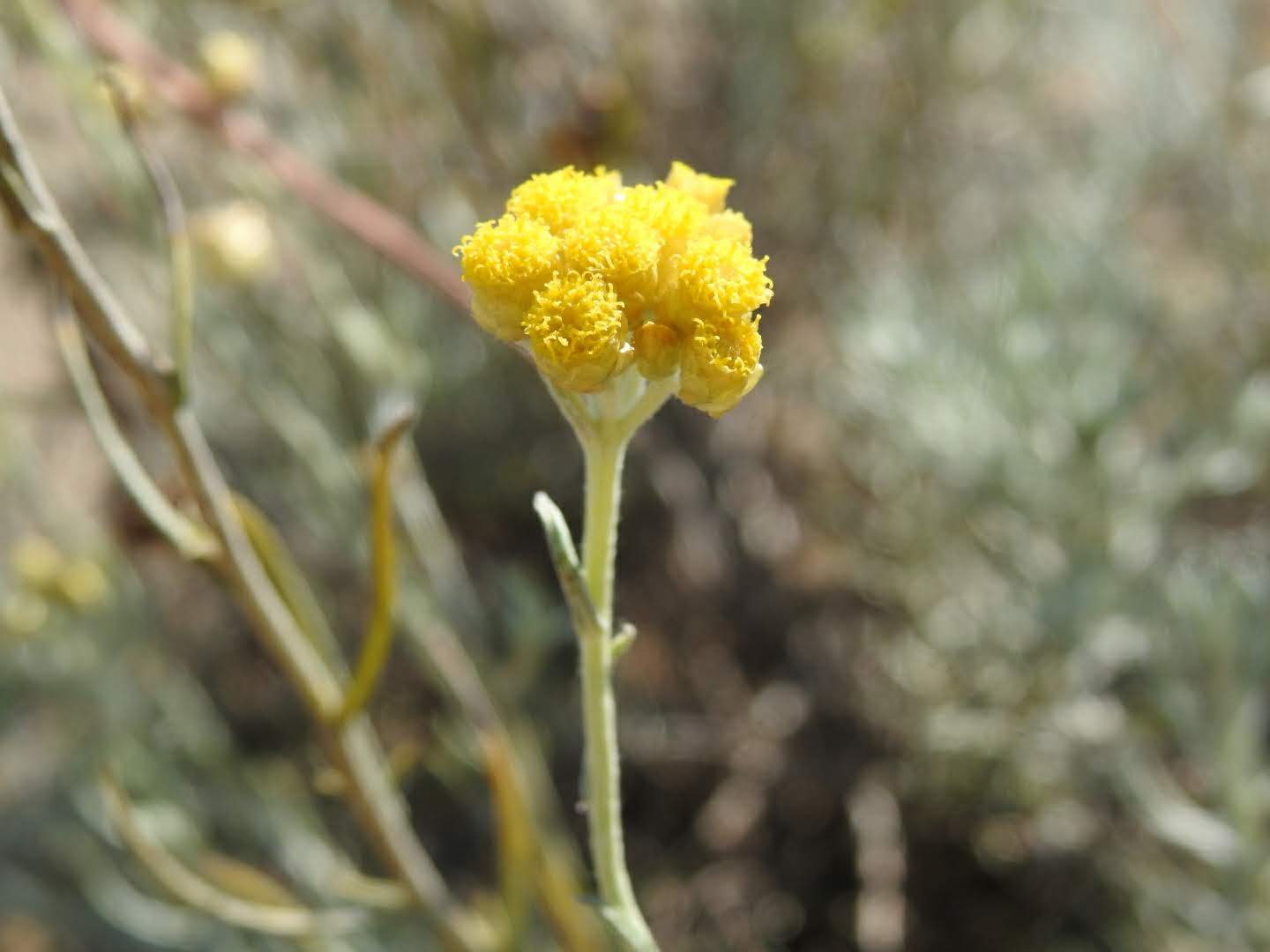
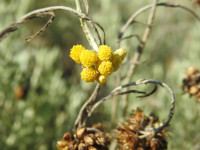
The flowers are gathered in hemispherical capitula, about 5-6 mm in diameter, each containing about 16-30 tubular flowers of pale yellow color. The involucral bracts are pale yellow, tending to brown with maturation, with the uppermost acute and slightly velvety on the back. The flower tube widens in the upper half and ends with five triangular teeth; the stamens are inserted inside the tube. The capitula are grouped in dense terminal corymbs, often glomeriform, with 5-10 capitula per corymb.
The fruit is an ovate-oblong achene, 3-5 mm long, with a papillose surface and a thin beak, a characteristic that facilitates dispersal.
Habitat and distribution
The scented helichrysum is a typical species of the western Mediterranean basin, present from Liguria to southern France, in Spain and Algeria, with a predominantly western steno-Mediterranean range. In Italy it is mainly widespread in western Liguria, where it represents a prevalent species, and is also found in Sardinia and Sicily, although other related species are present there.
It prefers coastal and subcoastal habitats, particularly scrublands, garrigues and sandy or rocky soils near the sea. It grows up to about 1000 meters of altitude, adapting to poor, well-drained substrates often exposed to strong solar radiation and sea wind. The plant tolerates the marine environment and salt spray well, frequently found in sunny and arid Mediterranean environments.
Flowering period
Flowering occurs from May to July, with possible extension until September in some Mediterranean areas. This period coincides with the warm and dry season, optimal for the reproduction and pollination of the species.
Ecology and pollination
The pale yellow tubular flowers are particularly attractive to pollinating insects, such as bees and other hymenopterans, which facilitate entomophilous pollination. The compact structure of the capitula and their arrangement in densely grouped corymbs favor efficient pollen collection by insects.
Seed dispersal occurs through the achenes, which thanks to the papillose surface and thin beak can be transported by wind or possibly by animals, although the main mode remains anemochory (wind dispersal).
Curiosities and traditional uses
The scented helichrysum is known not only for its pleasant fragrance, similar to a curry aroma, but also for its multiple medicinal properties and traditional uses. The leaves are used to flavor risottos, soups, poultry meats and fillings, imparting a delicate aroma to culinary preparations. From a medicinal point of view, it has anti-inflammatory, anti-allergic, healing, expectorant, antibacterial and antifungal properties, very similar to those of Helichrysum italicum.
The flowers, due to their compactness and the yellow color that lasts long, are widely used in dried flower arrangements and pot-pourri, as well as being used as a dye plant. Historically, the plant was burned indoors to purify the air.
In ancient Rome, helichrysum was a symbol of eternity and was used to adorn statues of deities, associated with the cult of the Sun. These cultural aspects testify to the importance of the species not only as a medicinal plant but also as a ritual and symbolic element.
Etymology
The genus name "Helichrysum" derives from the Greek "hélios" (sun) and "khrysós" (gold), referring to the golden color of the flowers and their habit of opening in the sun. The specific name "stoechas" seems to derive from “stòichades”, a Greek term meaning “islands arranged in a row”, probably a reference to the Porquerolles islands in front of Hyères in the western Mediterranean, a typical area of presence of the species.
The Italian common name "perpetuino profumato" alludes to the long duration of the flowers, which maintain color and shape even when dry, and to the aromatic scent that characterizes the plant.
Sources
- Prof. S. Pignatti, "Flora d'Italia"
- Acta Plantarum - Flora delle regioni italiane
- Tela Botanica / H. Coste, "Flore descriptive et illustrée de la France"
Characteristics
Where I found it (19 sightings)
Classification
- Kingdom
- Plantae
- Family
- Asteraceae
- Full name
- Helichrysum stoechas (L.) Moench
- Life form
- Camefite suffruticose
Similar species
Search for species with similar characteristicsFurther reading
Noticed an error in the identification? Write to me
Other species of the same family
Asteraceae
Explore
Other species of Asteraceae