Botanical species
Globularia bisnagarica
L.
Common Globularia
Description
Morphological description
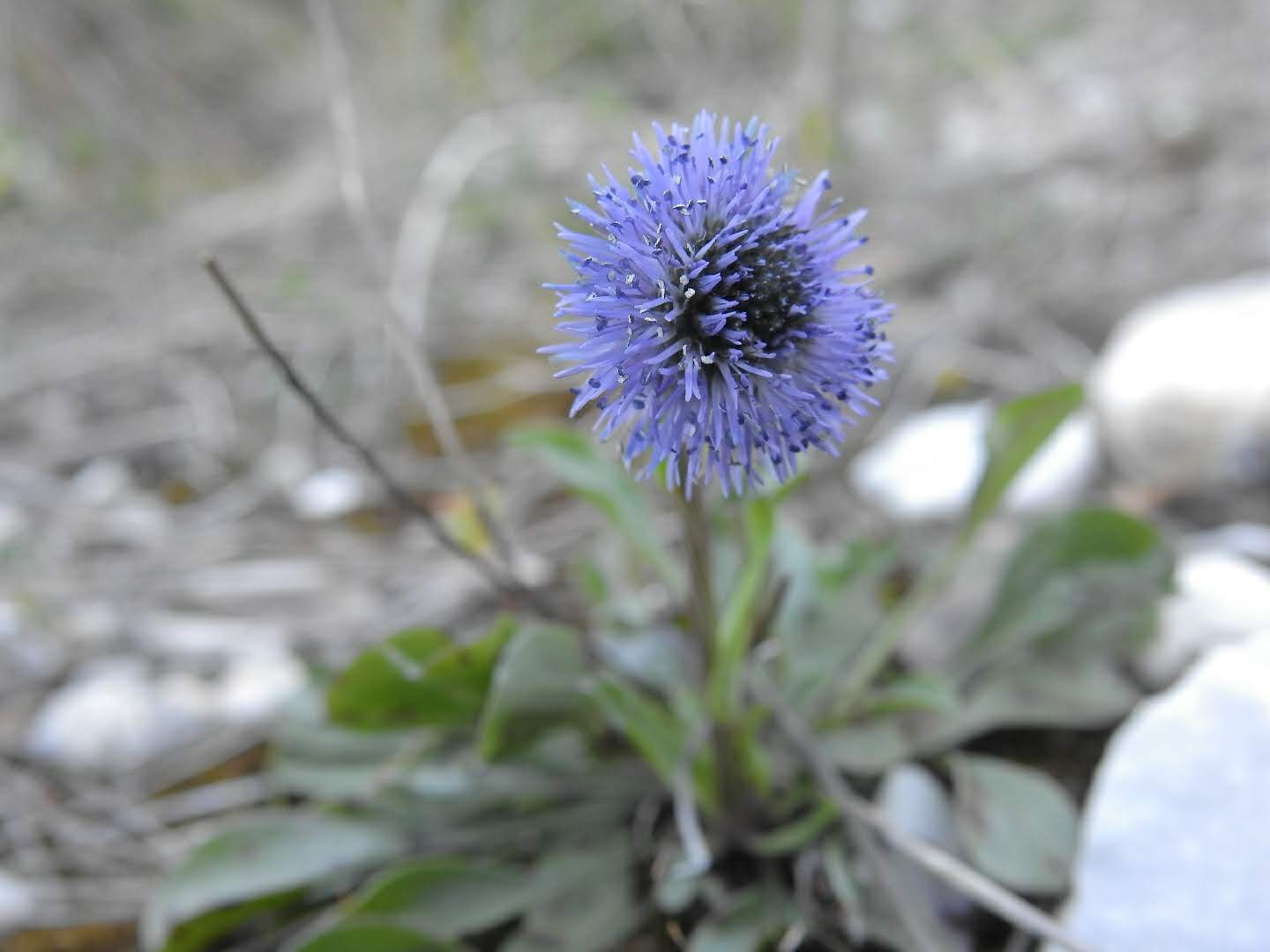
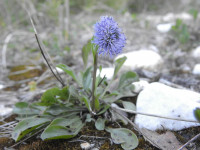
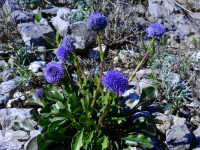
The plant is a perennial herbaceous species with a scapose habit, reaching a height between 10 and 30 cm. The stem is erect, simple, and bears numerous lanceolate cauline leaves that are sessile and 1 to 2 cm long. The basal leaves form a rosette, are obovate or spatulate in shape, with a slightly dentate margin and length up to 12 cm; they taper into a short petiole, with well-visible lateral veins on the upper surface.
The root system consists of a superficial, short, and almost woody rhizome, which allows the plant to overwinter.
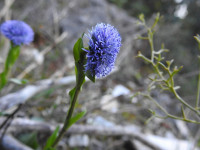
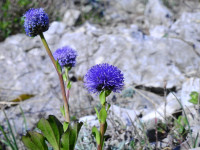
The inflorescence is terminal, composed of globose and dense heads, with a diameter of 1-1.5 cm. Each head is hemispherical, solitary, and has imbricate involucral bracts, acuminate and hairy in the upper half. The calyx is tubular, divided at the apex into five irregular teeth, and covered with hairs. The corolla is tubular, 6-8 mm long, indigo violet in color (rarely white), with a bilabiate structure: the upper lip is bilobed and shorter, while the lower lip is trilobed and larger with linear lobes. There are four stamens arranged in two pairs.
The fruit is an oblong achene, laterally compressed and enclosed within a persistent calyx.
Habitat and distribution
This species is widespread in the mountainous and hilly regions of southern Europe, with a distribution mainly concerning Italy and Mediterranean areas. In Italy it grows on dry and rocky meadows and pastures, preferring sunny exposures. It favors calcareous, well-drained, and xerothermic soils, typical of hilly and mountainous environments up to about 1500 meters altitude. The species is typical of garrigues and sparse vegetation environments, where competition with other herbaceous species is limited.
Flowering period
Flowering occurs mainly between March and May, with some geographical variations that may extend flowering until June. During this period the globose heads develop and remain visible even after anthesis, thanks to the growth of the floral scapes.
Ecology and pollination
The plant adapts to xerophilous and calcareous conditions, typical of sunny and nutrient-poor environments. Flowering is characterized by showy violet inflorescences, which attract pollinating insects, mainly bees and other hymenopterans, which play a fundamental role in pollination. The tubular and bilabiate structure of the flowers is typical of species adapted to insects capable of penetrating the corolla tube to reach the nectar.
Seed dispersal occurs through achenes enclosed in persistent calyces, which facilitate mechanical dispersal and, probably, spread by wind or animal movement.
Curiosities and traditional uses
The species is known for its medicinal properties, although it is considered toxic if taken in high doses. The leaves contain several active compounds, including a glucoside called globularin, essential oils, a resin named globularetin, and a bitter substance, globulariacitrine, which has stimulating effects similar to theine. At high doses, these compounds are toxic.
Traditionally, the leaves were used in decoction form as a depurative, diuretic, and laxative. However, great caution is recommended in therapeutic use due to the plant's potential toxicity. No food uses are documented.
Etymology
The scientific name derives from the Latin "globulus", meaning “small sphere”, referring to the globose shape of the inflorescence composed of dense and spherical heads. The specific epithet "bisnagarica" recalls a term of Nahuatl origin (indigenous language of central Mexico), "visnaga", which indicates a spiny cactus (Echinocactus visnaga) and means “surrounded by rays”. The term thus highlights the radiate or surrounding shape of the inflorescence.
The Italian common name "Common Globularia" or "Vedovelle dei prati" is probably linked to the dark color of the flowers (similar to mourning) and the open and rural habitat of the species.
Sources
- Acta Plantarum - Flora delle regioni italiane (scheda di Nino Messina)
- World Flora Online (WFO)
Characteristics
Scheda botanica
| Famiglia | Plantaginaceae |
|---|---|
| Fioritura | marzo – maggio |
| Forma biologica | Scapose |
| Habitat | with purple flowers, Perennial plant, plant with a scapose habit |
| Uso officinale | Pianta officinale |
Domande frequenti
- Quando fiorisce Common Globularia?
- Common Globularia fiorisce marzo – maggio.
- Che tipo di pianta è Common Globularia?
- Common Globularia è una Hemicryptophytes (Scapose) secondo la classificazione di Raunkiaer.
- A quale famiglia appartiene Common Globularia?
- Common Globularia appartiene alla famiglia botanica Plantaginaceae.
Where I found it (5 sightings)
Classification
- Kingdom
- Plantae
- Family
- Plantaginaceae
- Full name
- Globularia bisnagarica L.
- Synonyms
- Globularia punctata Lapeyr.; Globularia vulgaris auct. Fl. Ital.
- Life form
- Hemicryptophytes scapose
Similar species
Search for species with similar characteristicsNoticed an error in the identification? Write to me
Other species of the same family
Plantaginaceae
Explore
Other species of Plantaginaceae