Botanical species
Plantago lanceolata
L.
Ribwort Plantain
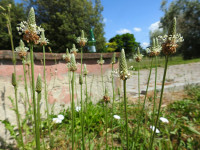
Description
Morphological description
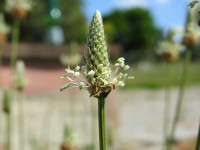
Perennial herbaceous plant belonging to the family Plantaginaceae, it has a compact habit with a height ranging between 20 and 60 cm. The stem is absent or very reduced, while the flowering scapes are erect, thin, angular, longitudinally grooved (generally with five striations) and covered with stiff hairs or almost glabrous. These scapes far exceed the leaf rosette and end in oval or conical spikes, dense with small tightly appressed flowers.
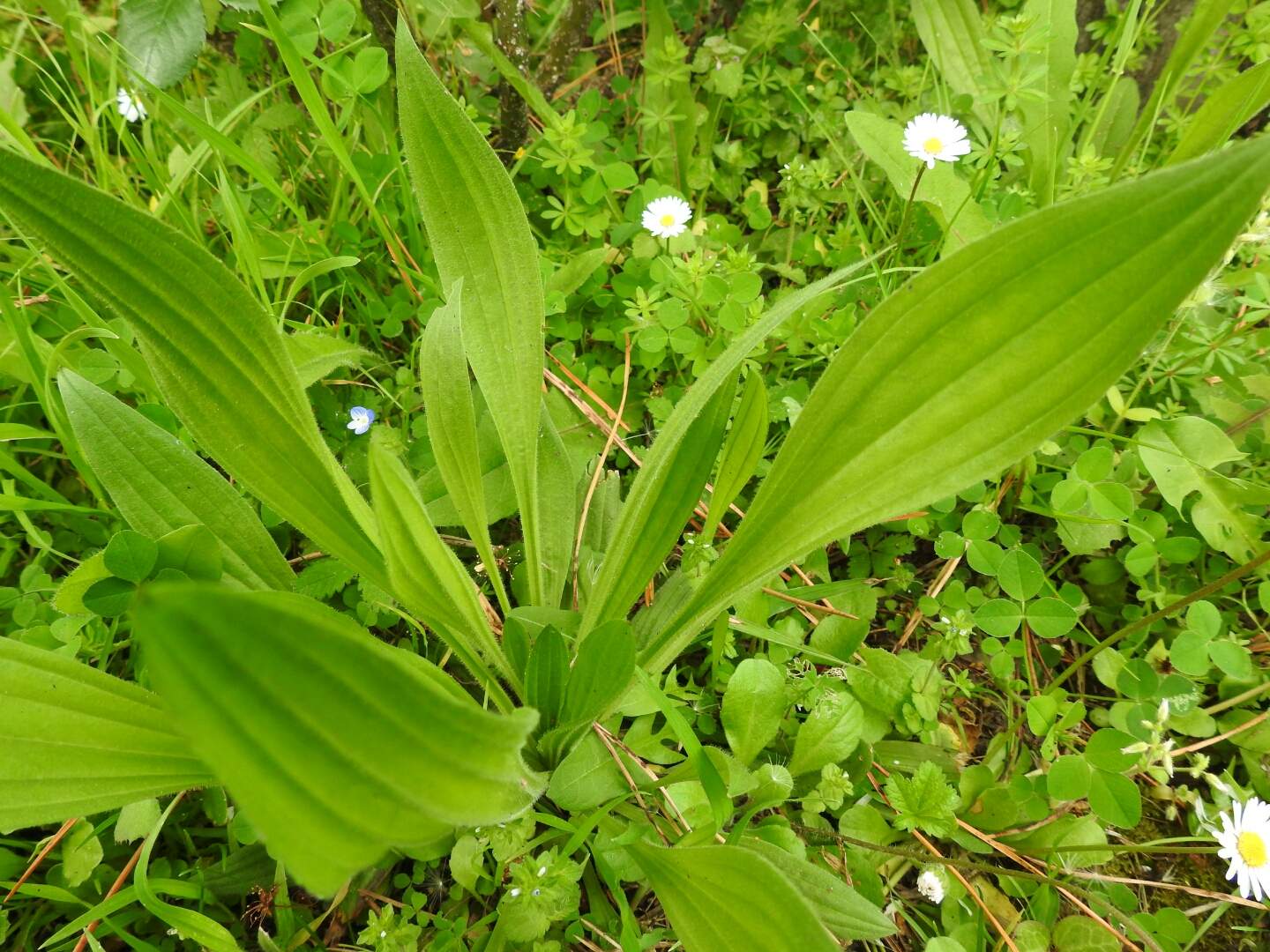
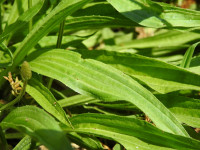
The leaves are arranged in a basal rosette and are characterized by a lanceolate or ovate-lanceolate shape, with sizes generally ranging from 6 to 20 cm in length and 0.5-4.5 cm in width. The blade is thin, with a membranous or papery texture, with an entire or slightly denticulate margin and an acuminate or pointed apex. The leaf surface is usually glabrous or slightly pubescent, sometimes with appressed hairs, and presents 3-7 well-marked parallel veins, of which five are more evident and run along the entire leaf. The petiole is short and narrow, often decurrent at the base of the blade.
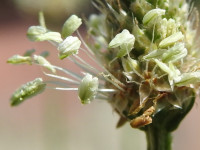
The flowers are small, hermaphroditic, white or white-greenish in color, and arranged on ovoid or cylindrical spikes up to 5-8 cm long. Each flower is supported by membranous bracts, ovate or elliptical, with an acuminate apex and a dark back. The calyx consists of two lateral sepals, one of which has a central green vein and slight pubescence, and two sepals fused almost to the apex. The tubular corolla is funnel-shaped with ovate-lanceolate lobes, glabrous, 1.5-3 mm long. There are four stamens with anthers initially yellow that become orange or white, protruding beyond the corolla.
The root system consists of a short fibrous rhizome and fasciculate roots, suitable for excellent anchorage and absorption.
The fruit is a dehiscent capsule (piside) of strictly ovoid shape, 3-4 mm long, which opens transversely at the base to release 1 or 2 shiny, brown or dark, ellipsoid seeds, with a characteristic concavity on the ventral face.
Habitat and distribution
Plantago lanceolata is a species ubiquitously distributed throughout Italy and the Mediterranean area, extending also into Europe, Western Asia, and North Africa. In Italy, it grows from near sea level up to about 2000 m altitude, adapting to a wide range of environmental conditions.
It prefers open and sunny habitats such as meadows, pastures, roadsides, uncultivated lands, rubble, gardens, and disturbed soils, showing marked synanthropy. The species is hardy and very adaptable, tolerating various soil types, from loose and sandy to more compact and clayey, provided they are well-drained. Its presence is very common in hilly and submontane environments, but it is also found in plains and mountains.
Flowering period
Flowering extends from April to June, with possible extensions up to October in some milder areas or favorable conditions. In Italy, the main flowering period is therefore spring, but the species can maintain flowers for many months of the year, especially in temperate climate regions.
Ecology and pollination
Plantago lanceolata is a polymorphic species with a predominantly anemophilous reproductive strategy, i.e., wind-pollinated. This is evident from the structure of the stamens, long and vibrating, which extend beyond the corolla and form a sort of mobile crown that facilitates the release of pollen into the air. Nevertheless, it can also be occasionally visited by insects, but these do not represent the main pollination vectors.
The seeds are dispersed mainly by falling near the mother plant, but can also be transported by animals and water. The seeds are shiny and small, equipped with mucilages that favor adhesion to the soil and germination.
Curiosities and traditional uses
Plantago lanceolata has been known for centuries for its medicinal and food properties. Rich in mucilages, tannins, glycosides (such as aucubin), vitamins (A, C, K), and silicic acid, it is used in phytotherapy as antibacterial, expectorant, hemostatic, astringent, soothing, and laxative. The seeds, rich in mucilage, are used as natural laxatives due to their ability to swell and decongest intestinal mucosae.
For external use, fresh leaves or infusions can be applied on sores, wounds, burns, and insect bites to promote healing and soothe pain. The juice extracted from the plant is used in the preparation of cough candies. Moreover, the plant is employed in the pharmaceutical industry for the production of expectorant syrups.
In cooking, young leaves can be consumed raw in salads or cooked like spinach. The seeds are highly appreciated by birds as food.
Historically, the plant was associated with astrological and magical symbolism, particularly with the planet Mars, from which the name “Erba di Marte” (Herb of Mars) derived. It was considered effective in wound healing and improving blood circulation, as well as useful for diseases related to the genital apparatus of Aries and Scorpio, zodiac signs governed by Mars.
Etymology
The genus name "Plantago" probably derives from the Latin planta, meaning sole of the foot, referring to the broad and flattened shape of the leaves of some species, similar to the sole of the human foot. Another possible origin is the combination of planta and agere, meaning "plant that makes other herbs grow".
The specific name lanceolata refers to the characteristic shape of the leaves, lanceolate, i.e., narrow and pointed, similar to a small lance.
In Italian, "Ribwort Plantain" precisely recalls this particular leaf shape, distinguishing it from other species of the genus.
Sources
- Prof. S. Pignatti, "Flora d'Italia"
- Acta Plantarum - Flora delle regioni italiane (sheet by Marinella Zepigi)
- Tela Botanica / H. Coste, "Flore descriptive et illustrée de la France"
- World Flora Online (WFO)
Characteristics
Where I found it (5 sightings)
Classification
- Kingdom
- Plantae
- Family
- Plantaginaceae
- Full name
- Plantago lanceolata L.
- Life form
- Emicriptofite rosulate
Similar species
Search for species with similar characteristicsFurther reading
Noticed an error in the identification? Write to me
Other species of the same family
Plantaginaceae
Explore
Other species of Plantaginaceae