Botanical species
Globularia incanescens
Viv.
Apennine Globularia
Description
Morphological description
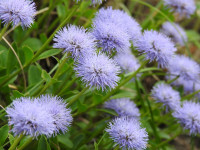
Perennial herbaceous plant of modest size, generally 3 to 12 cm tall, with a scapose habit and a woody, short, and creeping stem. The stem is able to withstand intense cold conditions typical of the mountainous environments where it lives, and presents small ascending herbaceous branches. The perennial buds are located at ground level, from which the elongated floral axis develops, often leafless.
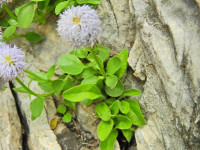
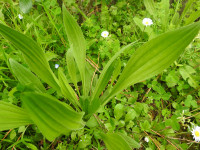
The basal leaves are leathery and glabrous, shiny green, with an obcordate, rounded, or bilobed blade at the apex, and are inserted on a petiole 3-4 cm long. The blade dimensions vary on average between 13-18 mm in length and 14-22 mm in width. They have 3 to 7 veins and are characterized by the presence of calcareous secretions in the form of tiny white punctiform crystals, visible with a lens, which are accumulated by the plant and released into the environment. The cauline leaves progressively reduce upwards, assuming ovate, elliptical, and finally lanceolate shapes.
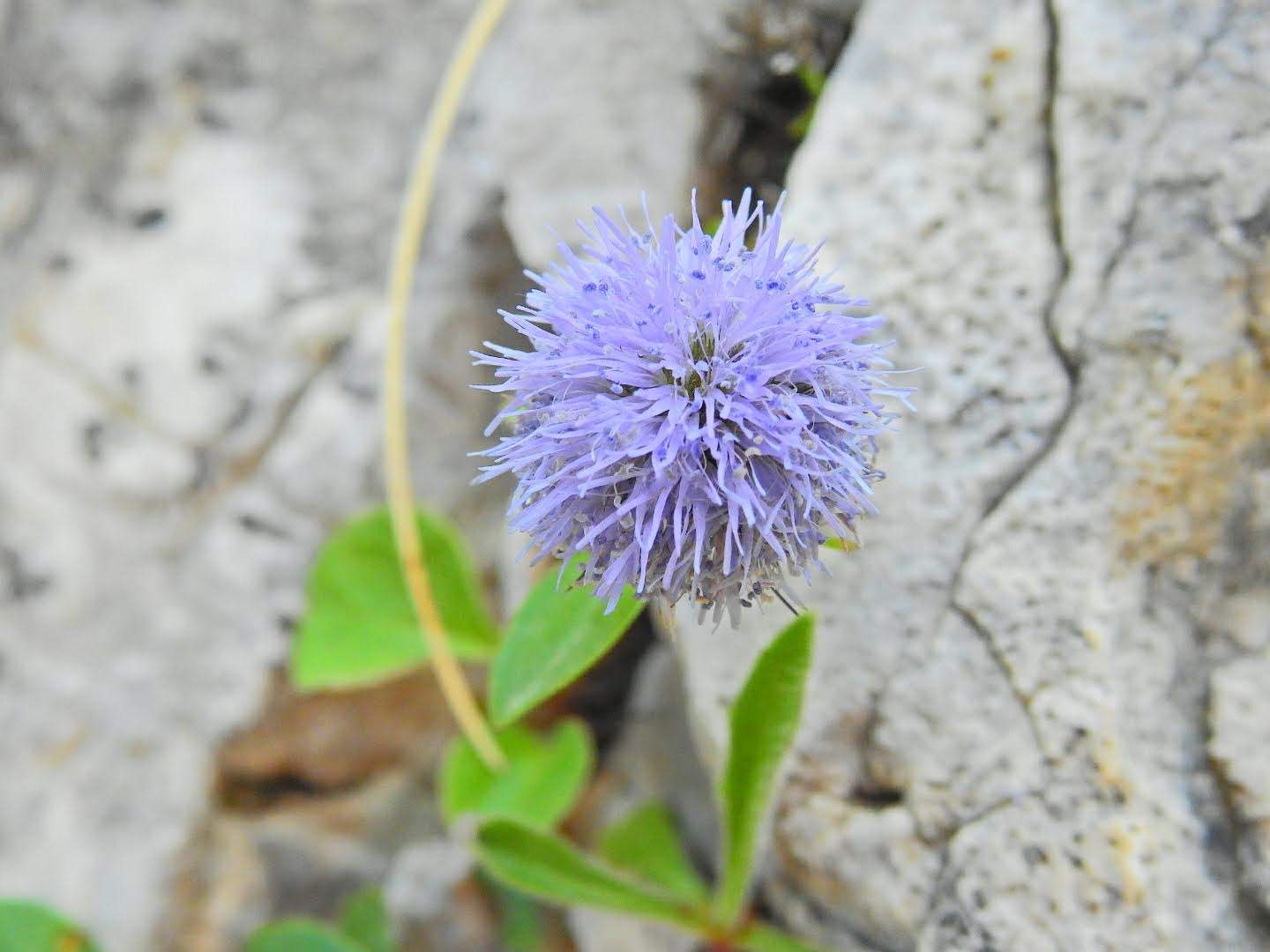
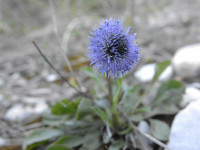
The flowers are gathered in spherical, compact capitula, about 1-1.2 cm in diameter, placed on a long leafy scape. The bracts composing the involucre are lanceolate, with variable sizes: the lower ones measure about 1.5 x 5 mm, while the upper ones are smaller, between 0.7 and 1 mm by 4-5.5 mm, and have lateral hairs 0.3-0.4 mm long. The calyx is campanulate and five-toothed. The corolla is sympetalous, bilabiate, with an entire upper lip and a trilobed lower lip, of blue-violet color that tends to lighten with age until becoming almost whitish, a phenomenon that reflects the specific name "incanescens" (becoming hoary). The flowers are pentamerous, hermaphroditic, and zygomorphic. The ovary is superior and unilocular, formed by two carpels, while the style has a capitate or slightly bilobed stigma.
The fruit is an achene, small and dry, typical of many species of the family Plantaginaceae.
Habitat and distribution
Endemic species of Italy, it is present exclusively in the Apuan Alps and the Tuscan-Emilian Apennines, from the Monte Orsaro area to Monte Libro Aperto, extending to the localities of Montemarcello and Portovenere along the Ligurian coast. Its presence is strictly linked to calcareous substrates, preferably on cliffs and calcareous rock outcrops, where it is distributed between 600 and 1300 meters of altitude, with some occurrences up to 1600 meters. In some stations, it also reaches sea level.
It prefers sunny exposures and mountainous environments characterized by hard substrates poor in organic matter, where the soil is dry and well-drained, a condition that favors the development of its particular leathery leaves and inflorescences.
Its limited distribution and habitat specificity make it a species of great conservation interest, protected by the Tuscan regional law.
Flowering period
Flowering mainly occurs in May and June, when the spherical capitula show their characteristic blue-violet color, which tends to lighten as the season progresses. No significant variations in the flowering period are known in the different distribution areas, but flowering is strictly linked to local mountain climatic conditions.
Ecology and pollination
The plant reproduces sexually through the production of achenes, but also vegetatively thanks to the woody creeping stem from which new shoots originate. The flowers, hermaphroditic and zygomorphic, are adapted for entomogamous pollination, mainly by pollinating insects that visit the capitula for pollination.
The specific details of pollinating insects have not been thoroughly documented, but the structure of the bilabiate flowers and the blue-violet coloration indicate attraction towards bees and other hymenopteran pollinators common in calcareous mountain ecosystems.
Seed dispersal occurs through the achenes, whose mode of dispersal has not been studied in detail, but is probably limited to falling near the mother plant, contributing to the limited expansion of the species' range.
Curiosities and traditional uses
No traditional food or medicinal uses are documented for this species, probably due to its very limited distribution and the inaccessible rocky habitat. However, the plant holds significant scientific and botanical interest for its evolutionary antiquity and peculiar morphological characteristics, clearly differentiated from other species of the genus.
It has been chosen as the symbol of the "Pietro Pellegrini" Botanical Garden of Massa, highlighting the cultural and naturalistic value that this species represents for the Apuan Alps and the surrounding territory.
Etymology
The genus name, Globularia, derives from the Latin globus, meaning "sphere" or "globe", referring to the spherical shape of the floral capitula. The specific epithet incanescens means "becoming hoary", recalling the characteristic color change of the inflorescences which, with age, shift from an intense blue-violet to lighter, almost whitish tones.
The Italian common name "Apennine Globularia" is linked to its exclusive geographic distribution in the Apuan Alps and probably refers to the delicacy and rarity of the plant, similar to what happens with other species with evocative popular names in the regional botanical context.
Sources
- Prof. S. Pignatti, Flora d'Italia, Edagricole, Bologna 1982
- Acta Plantarum - Flora delle regioni italiane (scheda di Giuliano Salvai)
Characteristics
Where I found it (6 sightings)
Classification
- Kingdom
- Plantae
- Family
- Plantaginaceae
- Full name
- Globularia incanescens Viv.
- Life form
- Emicriptofite scapose
Similar species
Search for species with similar characteristicsNoticed an error in the identification? Write to me
Other species of the same family
Plantaginaceae
Explore
Other species of Plantaginaceae