Botanical species
Kickxia commutata
(Bernh. ex Rchb.) Fritsch
Mediterranean Fluellen
Description
Morphological description
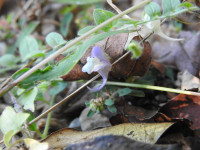
The Mediterranean Fluellen is a perennial herbaceous plant belonging to the Plantaginaceae family, characterized by a prostrate-ascending and branched habit. The stems, which range from 20 to 60 cm in length, are small, creeping and rooting at the nodes, covered with patent and glandular hairs about 1 mm long. These stems develop into numerous fan-shaped branches, giving the plant a branched appearance and widely covered with glandular hairs.
The leaves are heteromorphic: the lower ones are opposite, ovate-rounded, while the upper ones are alternate, ovate and hastate, with an obtuse apex. All leaves are petiolate and covered with stiff hairs, giving a herbaceous texture. Leaf size varies but they are generally ovate in shape, with entire margins.
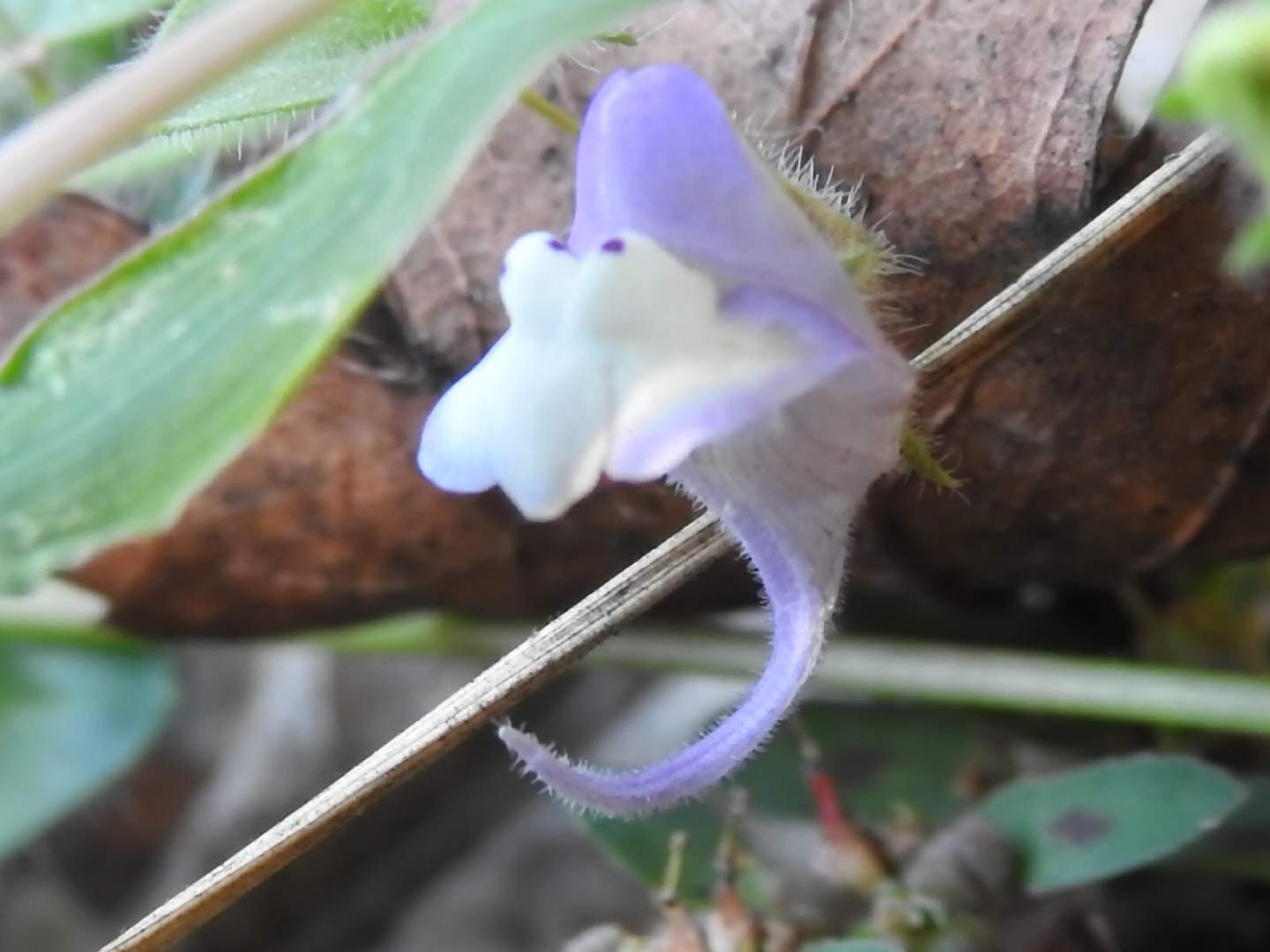
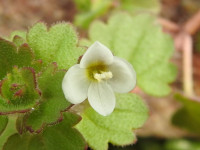
The flowers are solitary, positioned in the axil of the upper leaves and supported by glabrous and rigid peduncles, 6 to 30 mm long, often the same length or slightly longer than the leaves. The corolla, 11-15 mm long, is gamopetalous, bilabiate and zygomorphic: the upper lip is pale violet, while the lower lip is whitish with a yellowish palate spotted with violet. The calyx is pubescent, formed by lanceolate and linear sepals with lobes of 4-5 mm, which elongate up to 5 mm during fruiting. The spur, curved like a hook, is well developed and maintains its arched shape even at maturity. The throat is very wide and closed by a swelling of the lower lip.
The fruit is a globose capsule, 4-4.5 mm, poricidal with thick walls, containing numerous tuberculate seeds. The capsule is enveloped by the accrescent calyx, which protects its maturation. The seeds have a reticulated surface with alveolate areas delimited by ridges and covered by short tubercles or papillae.
The root system is typical of perennial plants with buds located at ground level, allowing the annual regeneration of the plant.
Habitat and distribution
The Mediterranean Fluellen is a typically Mediterranean species, with a range extending along the Mediterranean coasts, limited to the Olive area (narrow Mediterranean zone). In Italy it is mainly present in the central-southern regions and coastal areas, but it can also be found in mountainous environments up to about 1000 meters altitude.
It prefers dry and sunny habitats, such as edges of tracks, uncultivated lands, fallow fields and abandoned crops, often in association with species like Ecballium elaterium, Ajuga chamaepitys and Mercurialis annua. It grows on generally poor, well-drained soils with direct sun exposure, adapting to dry and calcareous soil conditions.
Flowering period
Flowering extends from April to July, with possible variations due to altitude and latitude. In warmer and low-altitude environments, the flowering period can start as early as April, while in mountainous or colder areas it lasts until July.
Ecology and pollination
The species employs a reproductive strategy mainly involving pollinating insects, attracted by the coloration of the corolla, which features a violet upper lip and a white-yellowish lower lip spotted with violet, typical visual signals for butterflies and bees. The curved spur contains nectar, which serves as a reward for pollinating insects.
Seed dispersal occurs through the poricidal capsule which, once mature, releases the tuberculate seeds onto the surrounding soil. The presence of glandular hairs on stems and leaves may have a protective function against excessive herbivory and dehydration.
Curiosities and traditional uses
No significant medicinal or food uses are documented for this species, nor known folkloric references. However, like many spontaneous Mediterranean plants, the Mediterranean Fluellen contributes to the biodiversity of dry habitats and represents an important component of plant communities developing in marginal and sunny environments.
Etymology
The genus name Kickxia is dedicated to Jean Kickx (1775-1831), Belgian botanist, pharmacist and mineralogist, author of the "Flora Bruxellensis". The specific name commutata derives from the Latin commutatus, meaning "changed" or "altered", probably referring to the variability or peculiar shape of the species' leaves.
The Italian common name "Mediterranean Fluellen" refers to the herbaceous and perennial consistency of the plant, with "cencio" often indicating a plant of little value or a plant residue in dialect, while "perennante" emphasizes its perennial nature compared to related annual or biennial species.
Sources
- Prof. S. Pignatti, "Flora d'Italia"
- Acta Plantarum - Flora delle regioni italiane (scheda di Mirna Medri)
Characteristics
Scheda botanica
| Famiglia | Plantaginaceae |
|---|---|
| Fioritura | aprile – luglio |
| Forma biologica | Creeping plants |
| Habitat | with white flowers, with lilac flowers, Perennial plant |
Domande frequenti
- Quando fiorisce Mediterranean Fluellen?
- Mediterranean Fluellen fiorisce aprile – luglio.
- Che tipo di pianta è Mediterranean Fluellen?
- Mediterranean Fluellen è una Hemicryptophytes (Creeping plants) secondo la classificazione di Raunkiaer.
- A quale famiglia appartiene Mediterranean Fluellen?
- Mediterranean Fluellen appartiene alla famiglia botanica Plantaginaceae.
Where I found it (6 sightings)
Classification
- Kingdom
- Plantae
- Family
- Plantaginaceae
- Full name
- Kickxia commutata (Bernh. ex Rchb.) Fritsch
- Synonyms
- Elatinoides commutata (Bernh. ex Rchb.) Wettst.; Linaria commutata Bernh. ex Rchb.
- Life form
- Hemicryptophytes creeping plants
Similar species
Search for species with similar characteristicsFurther reading
Noticed an error in the identification? Write to me
Other species of the same family
Plantaginaceae
Explore
Other species of Plantaginaceae