Botanical species
Anthemis arvensis
L.
Corn Chamomile
Description
Morphological description
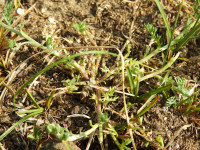
Annual or biennial herbaceous plant, with a variable habit from erect to prostrate or decumbent, often branched, with a height that can reach 50-80 cm. The stem is generally ascending, sometimes erect or diffusely prostrate, with a rough and sparsely hairy surface.
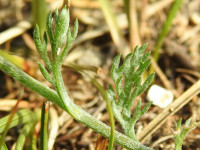
The leaves are ovate-oblong in shape, 1.5 to 5 cm long and 0.5 to 1.5 cm wide, sessile and bipinnatisect (i.e., divided two or three times into thin segments). The terminal lobes are linear-oblong or linear-lanceolate, acute and mucronate, with a herbaceous texture and a slightly hairy surface. The basal leaves sometimes clasp the stem.
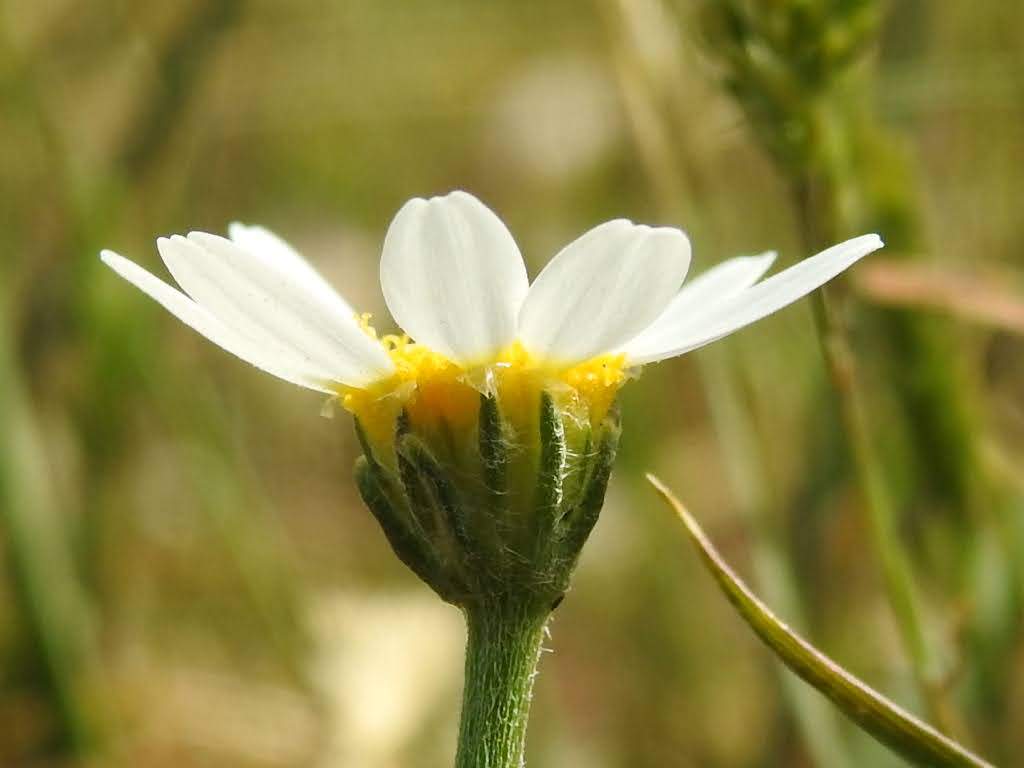
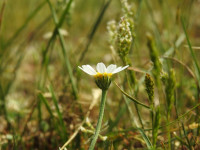
The inflorescences consist of single terminal capitula, 1.5 to 4 cm in diameter, supported by long, thin peduncles sometimes thickened towards the apex during fruiting. The involucral bracts are oblanceolate, villous on the back, with membranous and hyaline or brownish margins, rounded and often fringed at the apex.
The receptacle is hemispherical or conical, convex and elongated especially in fruit, 2-10 mm long and 2-3 mm wide, with keeled and acuminate chaff scales arranged among the tubular flowers.
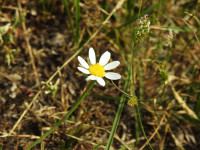
The flowers are of two types: peripheral ligulate, sterile or female, white in color with oblong-elliptical ligules 3.5-17 mm long, which fold downward at the end of anthesis; central tubular, hermaphroditic, yellow, 2.5-3.5 mm long, occasionally with purplish shades, glabrous and not or slightly swollen at the base.
The fruits are obconic achenes or cypselae, 1.5-3 mm long, square in cross-section with 5-10 rounded or marked ribs, smooth, without pappus or with pappus reduced to a semicorona. The apex presents a thickened, wavy ring or a small torn hyaline auricle.
The root system is not described in specific sources, but as with most Asteraceae it has a taproot.
Habitat and distribution
It is a species widely distributed throughout the Italian territory and the Mediterranean basin, also present in other temperate areas of the world. It commonly grows in anthropized and disturbed habitats such as cultivated fields, especially cereals, fallows, dry meadows, pastures, and abandoned lands. It prefers well-exposed, sunny soils of various types, often dry or semi-arid, without particular pedological requirements.
The growth altitude ranges from plains to mountainous and subalpine zones, adapting to different conditions thanks to its ecological plasticity. It is a typical species of hilly and mountainous environments but can also be found in lowland areas.
Flowering period
Flowering generally extends from March to October, with possible local variations linked to climate and latitude. In warmer and temperate climates, flowering can start early in spring and continue until autumn, while in cooler areas it may be more concentrated in the summer months.
Ecology and pollination
The plant produces radiate flowers with white ligules and yellow tubular flowers, which attract various pollinating insects, particularly bees, wasps, butterflies, and other pollinators. The prolonged flowering and the presence of numerous capitula favor good entomophilous pollination.
The species reproduces by seed; dispersal of achenes occurs mainly by gravity and wind action, although the pappus is very reduced or absent, so long-distance dispersal is not particularly effective. The ability to rapidly colonize disturbed soils is favored by abundant seed production.
Curiosities and traditional uses
Commonly known as "Corn Chamomile" or "bastard chamomile," this plant has historically been used in folk medicine for its medicinal properties. Traditionally it is employed as an antipyretic, antirheumatic, analgesic, antiseptic, and anti-inflammatory. It is used to relieve spasms, colic, and dizziness, especially during the menstrual period.
In natural cosmetics, extracts of this plant are appreciated for cleansing the skin and hair, improving shine and silkiness. It is also used as a facial mask to reduce inflammation, lighten, nourish, and regenerate skin cells.
An interesting bioeconomy project in Sardinia foresees the development of a line of male cosmetics based on extracts of Anthemis arvensis, exploiting its abundant local presence and functional properties.
Despite traditional uses, medicinal and food applications should be considered for informational purposes and adopted with caution.
Etymology
The genus name "Anthemis" derives from the Greek ἀνθεμίς (anthemís), meaning “flower,” a term used by Dioscorides to indicate chamomile, recalling the characteristic abundant flowering of the plant.
The specific name "arvensis" indicates its typical habitat, i.e., "plowed fields," highlighting its frequent presence in cultivated or disturbed soils.
The Italian common name "camomilla falsa" or "camomilla bastarda" highlights the resemblance to true chamomile (Matricaria chamomilla), while differing in morphological characteristics and aromatic properties.
Sources
- Prof. S. Pignatti, Flora d'Italia
- Acta Plantarum – Flora delle regioni italiane (scheda di Piera Pellizzer)
- World Flora Online (WFO)
Characteristics
Scheda botanica
| Famiglia | Asteraceae |
|---|---|
| Fioritura | marzo – ottobre |
| Forma biologica | Scapose |
| Habitat | with white flowers, annual plant |
Domande frequenti
- Quando fiorisce Corn Chamomile?
- Corn Chamomile fiorisce marzo – ottobre.
- Che tipo di pianta è Corn Chamomile?
- Corn Chamomile è una Therophytes (Scapose) secondo la classificazione di Raunkiaer.
- A quale famiglia appartiene Corn Chamomile?
- Corn Chamomile appartiene alla famiglia botanica Asteraceae.
Where I found it (9 sightings)
Classification
- Kingdom
- Plantae
- Family
- Asteraceae
- Full name
- Anthemis arvensis L.
- Life form
- Therophytes scapose
Similar species
Search for species with similar characteristicsFurther reading
Noticed an error in the identification? Write to me
Other species of the same family
Asteraceae
Explore
Other species of Asteraceae