Botanical species
Calendula arvensis
M.Bieb.
Field Marigold
Description
Morphological description
Calendula arvensis is an annual herbaceous plant, sometimes biennial, belonging to the family Asteraceae, with a scapose habit and variable height from 10 to 50 cm. The stem is erect or arcuate-ascending, branched and covered with a hairiness that can vary from sparse to dense, giving a more or less velvety or slightly rough appearance due to the presence of hooked hairs. The branches often end with corymbose inflorescences, giving the plant a fair density of flowers.
The leaves are alternate, light green in color, with shapes ranging from lanceolate-spatulate in the basal leaves (20-50 mm long and 6-15 mm wide) to narrower and sessile in the cauline leaves, which have a semi-amplexicaul base with irregularly dentate or entire margin and mucronate apex. The basal leaves are attenuated into a short petiole, while the upper ones are directly inserted on the stem.
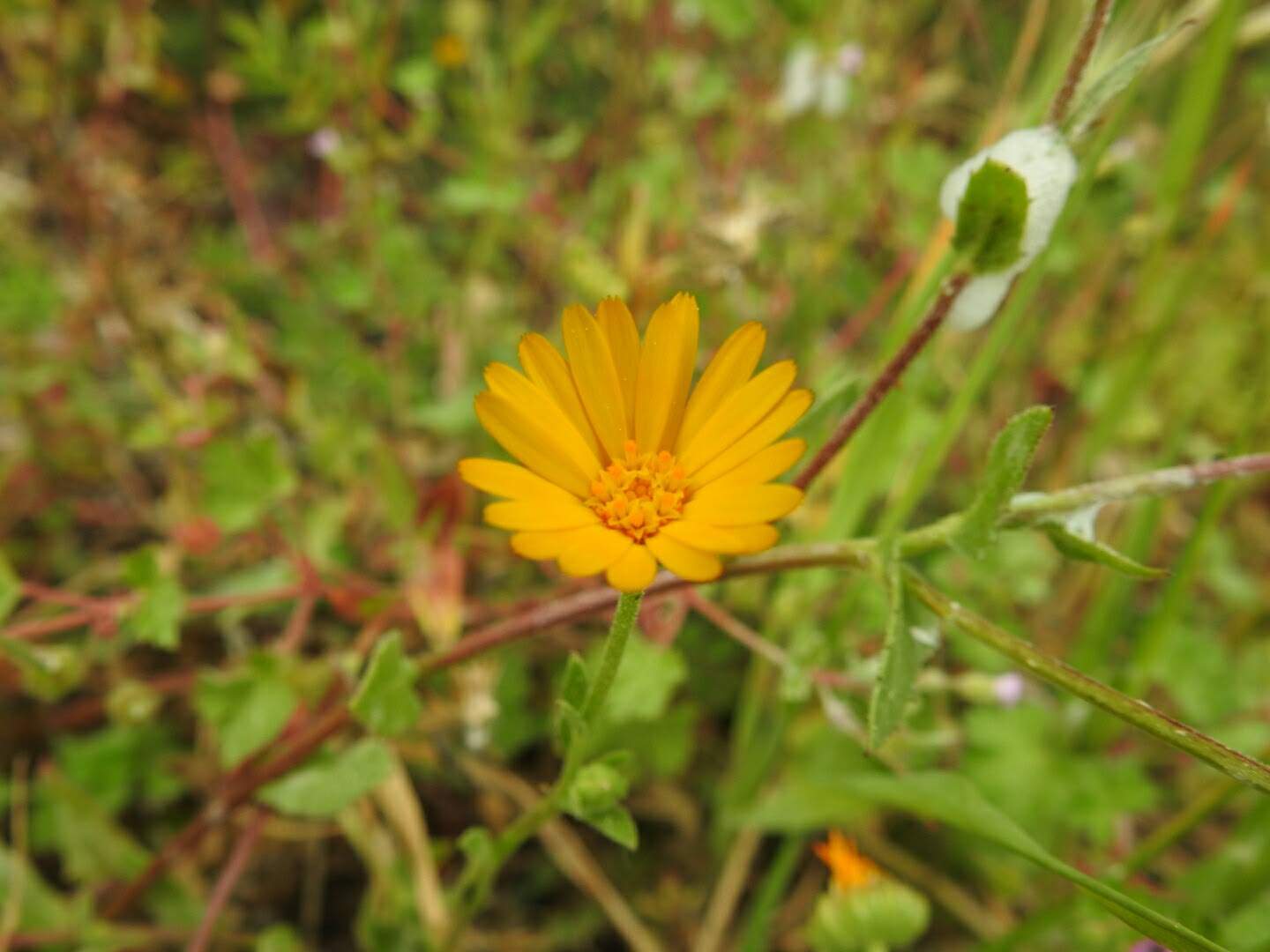
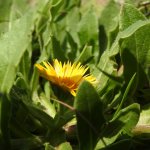
The flowers are gathered in solitary capitula, long-pedunculate and measuring between 2 and 3 cm in diameter. The capitulum is composed of two types of flowers: peripheral ligulate, bright yellow or sometimes orange, with ligules generally 7-15 mm long and a tridentate apex, and central tubular flowers, hermaphroditic and yellow in color. The involucre is campanulate, formed by scales arranged in two rows, with a thin, scarious margin and sometimes slightly purplish.
The fruit is a heterocarpic cypsela, lacking a pappus, whitish, with three distinct forms: the outer ones are falcate, spinulose and about 2 mm long; the median ones are laterally winged and concave; the inner ones are annular or falcate, wrinkled on the back. The seeds are falcate, hooked and about 2.3 mm long, facilitating dispersal through contact with animals or soil. The root system is not described in detail in the sources, but as an annual herbaceous species it is presumed to develop fibrous roots adapted to dry and calcareous soils.
Habitat and distribution
Calendula arvensis is a typical species of Mediterranean regions, with a distribution extending from southern and central Europe, through Asia Minor to North Africa. In Italy it is mainly present in coastal regions and inland areas up to about 600 meters of altitude. It is common in uncultivated soils, edges of paths and roads, vineyards and plowed fields, preferring calcareous and well-drained soils.
The species is thermophilic and gregarious, often forming scattered but locally abundant populations, especially in anthropized and disturbed environments. Its presence is frequent in Mediterranean climates, where the warm and dry season favors its annual or biennial life cycle.
Flowering period
Flowering extends from April to October, with some variability due to geographic area and local climatic conditions. In warmer and temperate climates flowering can begin as early as April and continue until late autumn, while in cooler environments or with harsher winters it tends to concentrate between April and July. The capitula, numerous and showy, are active for much of the growing season, contributing to the long visual presence of the species in agrarian and spontaneous landscapes.
Ecology and pollination
Calendula arvensis relies on pollinating insects, mainly bees, butterflies and other pollinators, attracted by the yellow-orange colors of the flowers and the production of nectar and pollen. The actinomorphic symmetry and the ligulate structure of the peripheral flowers facilitate insect access, while the presence of hermaphroditic tubular flowers in the center ensures fertilization and production of fertile seeds.
Seed dispersal mainly occurs through epizoochory mechanisms: the falcate and hooked seeds attach to animal fur or human clothing, favoring colonization of new habitats. The presence of three forms of achenes with different characteristics increases the probability of reproductive success in variable environments.
Curiosities and traditional uses
This species, also known as Wild Marigold or Field Calendula, has a long history of use in medicinal and food contexts, especially in the Mediterranean basin. Historically used until the Middle Ages, the plant has been rediscovered for its content of flavonoids, saponins, resins, essential oils, salicylic acid, beta carotene, lycopene, lutein and xanthines, substances that confer anti-inflammatory, antiseptic, antispasmodic and healing properties.
In popular use, calendula was used to treat skin inflammations, to soften the skin, as a diaphoretic and regulator of the menstrual cycle. The flowers were also used to dye hair and in infusions to relieve eye irritations. The leaves were consumed in mixed salads together with other wild herbs, while the dried petals were used to flavor wine, which after about ten days of sun exposure, turned into an aromatic vinegar.
From a cultural point of view, the plant is linked to ancient myths: in Greek mythology it is said that Aphrodite’s tears for the death of Adonis turned into calendulas. In the 19th century the flower was a symbol of lovesickness, jealousy and deceit. William Shakespeare also praised its beauty in sonnet XXV, comparing the opening of its petals to the favor of princes under the sun.
Etymology
The genus name "Calendula" derives from the Latin "calendae," which indicates the first day of the month in the Roman calendar, emphasizing the long flowering duration of the plant, which lasts for many months. The specific epithet "arvensis" means "of the plowed fields," recalling the typical habitat of this species, often present in cultivated fields and disturbed soils. The Italian common name "Fiorrancio selvaggio" refers to the orange color of the flowers and its spontaneous growth in natural and rural environments.
Sources
- Prof. S. Pignatti, "Flora d'Italia"
- Acta Plantarum - Flora delle regioni italiane (scheda di Antonino Messina)
- Tela Botanica / H. Coste, "Flore descriptive et illustrée de la France"
Characteristics
Where I found it (9 sightings)
Classification
- Kingdom
- Plantae
- Family
- Asteraceae
- Full name
- Calendula arvensis M.Bieb.
- Synonyms
- Calendula arvensis L. subsp. bicolor (Raf.) Nyman; Calendula arvensis L. subsp. hydruntina (Fiori) Lanza; Calendula bicolor Raf.; Calendula micrantha Tineo & Guss.; Calendula officinalis L. subsp. arvensis (Vaill.) Fiori; Calendula officinalisL. var. hydruntina Fiori; Caltha arvensis Vaill.
- Life form
- Terofite scapose
Similar species
Search for species with similar characteristicsFurther reading
Noticed an error in the identification? Write to me
Other species of the same family
Asteraceae
Explore
Other species of Asteraceae