Botanical species
Dittrichia graveolens
(L.) Greuter
Stinkwort


Description
Morphological description
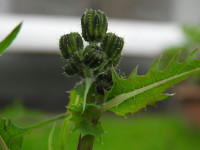
Annual herbaceous plant, generally 30 to 60 cm tall, characterized by an erect, very branched stem, often spreading, with a viscous, hairy, and glandular surface. The habit is scapose, with an elongated floral axis generally leafless. The cauline leaves are linear, 20-33 mm long and 1-2 mm wide, sessile, acute, with entire or weakly denticulate margins, covered with hairs and sticky glands, giving the plant a rough appearance. The basal leaves, broader and linear-spatulate (up to 1 cm wide and up to 75 mm long), are petiolate but tend to disappear at flowering time.
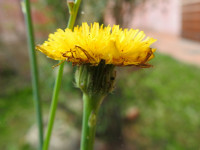
The capitula, numerous and small (6-15 mm in diameter), are arranged in more or less elongated racemes in the axils of bracts similar to the leaves. The involucre is conical-elongated, 4-7 mm long, with cartilaginous, glandular bracts and internal lesiniform scales 5-6 mm long. The marginal flowers are female, with very short yellow ligules that do not exceed the involucre, while the central flowers are hermaphroditic, tubular, and also yellow, sometimes with reddish shades. The corolla of the ligulate flowers measures between 2 and 5 mm in length, while that of the tubular flowers is about 3-4 mm.
The fruit is an ellipsoid cypsela, 1.5-2 mm long, whitish, rough and glandular, without ribs, with a slightly narrowed apex. The pappus is composed of barbellate capillary bristles, arranged in a single series, basally connected to form a small finely denticulate membranous cup.
The plant has a strongly unpleasant odor, hence the common name “Stinkwort” or “Inula fetida”, due to the presence of essential oils and aromatic substances characteristic of the species.
Habitat and distribution
A species of Mediterranean and Turanian origin, it is widespread throughout the Mediterranean basin and extends to Central Asia. In Italy it grows mainly in arid environments, uncultivated areas, ruins, roadside edges, also on subsaline soils, from the plains up to about 800 meters altitude. The species is thermophilic and heliophilous, preferring sunny exposures and poor soils, often disturbed and with low plant competition.
In some extra-European areas, such as California, it has been introduced and rapidly naturalized, becoming an invasive species.
Flowering period
Flowering mainly occurs between August and November (from late summer to late autumn), a period in which the species produces numerous yellow capitula that provide pollen resources when other blooms are scarce. No significant geographic variations in the flowering period are known within Italy.
Ecology and pollination
The plant is highly melliferous and produces a large amount of pollen, representing an important resource for pollinating insects especially in autumn. The flowers, with their radiate structure and female marginal flowers accompanied by hermaphroditic central ones, favor entomophilous pollination, mainly by bees and other pollinating insects.
Seed dispersal occurs thanks to the pappus composed of capillary bristles that facilitate anemochory (wind dispersal) of the cypselae, allowing the plant to rapidly colonize new habitats, especially in disturbed environments.
Curiosities and traditional uses
Historically, the species has been used for its medicinal properties: it contains essential oils and has been employed in folk medicine to treat viper bites. In Australia, where it has been introduced, it is used in the treatment of asthma.
Despite the strong unpleasant odor that characterizes it and makes it unappealing to herbivores, the plant plays an important ecological role as a source of pollen and nectar during periods of scarce flowering.
It should be emphasized that any medicinal or food use is for informational purposes only and does not replace professional medical advice.
Etymology
The genus name Dittrichia is dedicated to Dittrich, a specialist in Asteraceae and director of the Berlin Botanical Garden. The specific epithet graveolens derives from the Latin gravis (heavy, strong) and the present participle olens (smelling), referring to the characteristic intense and unpleasant odor of the plant.
The Italian common name “Enula dall’odore intenso” precisely recalls this aromatic and distinctive aspect, while other popular names in different languages also refer to the strong odor (for example the English “Stinkwort” or the French “Inule fétide”).
Sources
- Prof. S. Pignatti, "Flora d'Italia"
- Acta Plantarum - Flora delle regioni italiane (scheda di Anja Michelucci)
- World Flora Online (WFO)
Characteristics
Scheda botanica
| Famiglia | Asteraceae |
|---|---|
| Fioritura | agosto – novembre |
| Forma biologica | Scapose |
| Habitat | with yellow flowers, annual plant, plant with a scapose habit |
Domande frequenti
- Quando fiorisce Stinkwort?
- Stinkwort fiorisce agosto – novembre.
- Che tipo di pianta è Stinkwort?
- Stinkwort è una Therophytes (Scapose) secondo la classificazione di Raunkiaer.
- A quale famiglia appartiene Stinkwort?
- Stinkwort appartiene alla famiglia botanica Asteraceae.
Where I found it (11 sightings)
Classification
- Kingdom
- Plantae
- Family
- Asteraceae
- Full name
- Dittrichia graveolens (L.) Greuter
- Synonyms
- Cupularia graveolens (L.) Gren. & Godr.; Erigeron graveolens L.; Inula graveolens (L.) Desf.; Jacobaea graveolens (L.) Merino
- Life form
- Therophytes scapose
Similar species
Search for species with similar characteristicsNoticed an error in the identification? Write to me
Other species of the same family
Asteraceae
Explore
Other species of Asteraceae