Botanical species
Euphorbia paralias
L.
Sea Spurge
Description
Morphological description
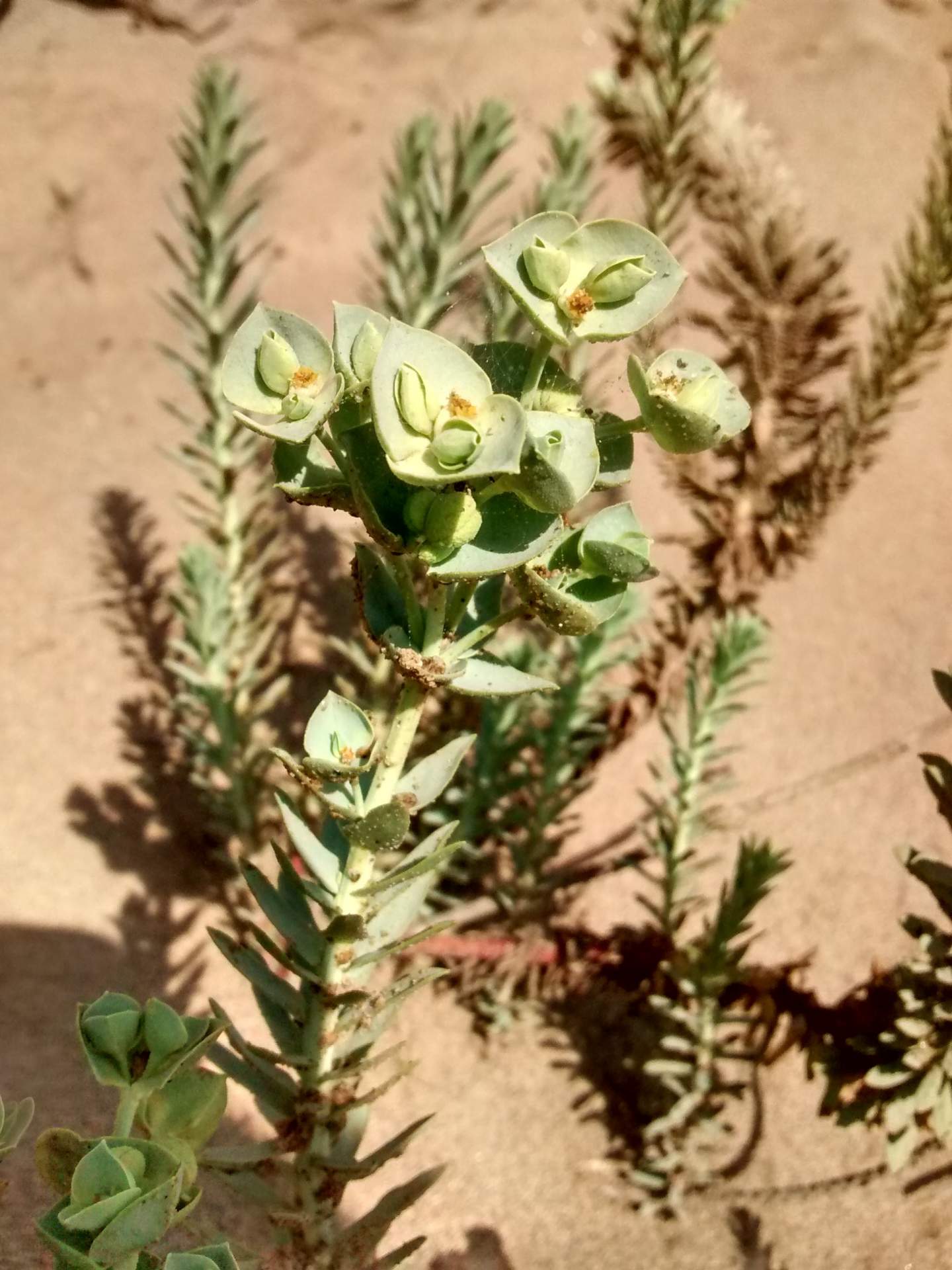
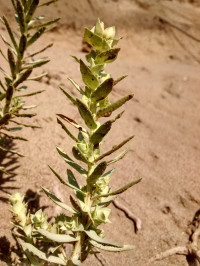
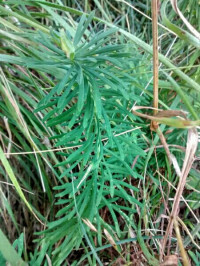
Perennial suffrutex plant generally 30 to 60 cm tall, with an erect and bushy habit. The stem is woody at the base, glabrous and glaucous in color, often with numerous sterile branches both basal and lateral. The stem surface is smooth and hairless.
The leaves are numerous, sessile, arranged imbricately and have a leathery and fleshy texture, adapted to reduce water loss. The shape varies from linear-lanceolate to oblong-elliptic, with dimensions around 0.5-3 cm in length and 0.3-1.5 cm in width. The leaves are entire, with a smooth margin and slightly concave on the upper side, green-blue tending to glaucous in color.
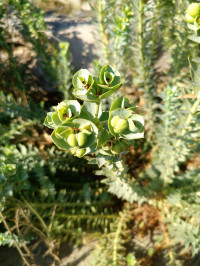
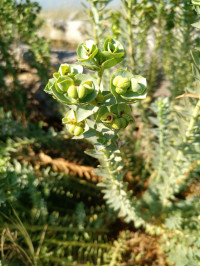
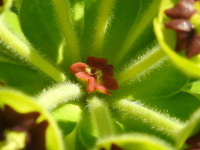
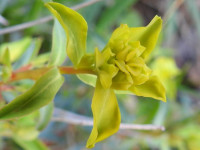
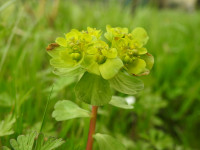
The inflorescence is a cyathium, typical of Euphorbiaceae, composed of unisexual flowers gathered in a structure that simulates a single flower. The umbel is terminal, formed by 3-6 rays often bifurcated and repeatedly dichotomous. The bracts surrounding the flowers are cordate-reniform, thick and acute, with a mucronulate margin. The female flowers are central and solitary, while the male flowers, numerous, are reduced to a single stamen each, placed in small cup-like structures resembling calyxes. On the upper edge of these cups there are four arcuate glands, yellow or brown in color, with short and divergent horns, which function to attract pollinating insects.
The flowers, lacking petals and sepals, have a greenish-yellowish color, with the yellow glands giving a brighter tone.
The fruit is a globose capsule, 3-5 mm in diameter, slightly depressed on top, trilobed and deeply grooved, with a dorsal granular surface. At maturity it opens to release smooth, ovoid-globose seeds, white-ashen or pearl gray in color, equipped with a very small caruncle.
The root system is deep and robust, with long and hard roots, contributing to the consolidation of the coastal sandy substrate.
Habitat and distribution
Strictly psammophilous and maritime species, it grows along the sandy coasts of the Mediterranean and Western Europe, including the Atlantic coasts and the Corsica region. In Italy it is mainly present along the maritime sandy shores, where it contributes to the formation and stabilization of coastal dunes, being part of the plant associations called ammophilous communities.
It prefers exposed coastal environments, with well-drained sandy substrates poor in organic matter, often subject to wind, salt spray and drought conditions. The species is adapted to arid and windy climates, typical of the Mediterranean coastal belt, and is generally found at low altitudes, up to sea level and in the immediate vicinity.
Flowering period
Flowering extends from April-May to July-September, with geographical variations that may slightly anticipate or prolong the period depending on local climatic conditions. In warmer Mediterranean climates flowering can begin as early as April, while in more temperate regions it can last until September.
Ecology and pollination
Sea Spurge is a plant adapted to harsh environmental conditions such as strong wind, salt spray and drought, thanks to its fleshy and imbricate leaves that reduce transpiration and protect photosynthetic structures.
The cyathium inflorescence, characteristic of Euphorbiaceae, is pollinated by insects attracted by the colored glands located on the upper edge of the floral cups. These glands, yellow-orange in color, secrete sugary substances that serve as a lure for pollinating insects, thus ensuring fertilization. Male and female flowers, although separate, are grouped to simulate a single flower, facilitating cross-pollination.
Seed dispersal occurs through explosive dehiscence of the capsule which, opening, ejects the seeds in the immediate vicinity of the mother plant, contributing to the colonization of sandy dunes. The main ecological role of the species is to stabilize the sandy substrate, thanks to the deep and robust root system that fixes coastal dunes.
Curiosities and traditional uses
Like many Euphorbiaceae, this species contains a white and viscous latex that is highly toxic to humans and animals. Traditionally, this latex has been used in folk medicine for local treatments, such as the removal of calluses, warts and papillomas, as well as to soothe rheumatic pains. The latex was applied directly to the affected areas, however its use has largely been abandoned due to its strong toxicity and the risk of severe skin and eye irritation.
In the past, the seeds and root powder were used as purgatives for the treatment of constipation, also in veterinary practice. Contact of the latex with the skin can cause blisters and dermatitis, while ingestion is dangerous, causing vomiting, bloody diarrhea and delirium.
A curious and specific use of the latex of this species concerns its application to soothe stingray stings, which cause intense pain, blisters and inflammation. The plant was used as a folk remedy to calm such painful effects.
Due to its high toxicity, medical and food use is discouraged and considered dangerous.
Etymology
The generic name Euphorbia derives from the Greek physician Euphorbos, physician to Juba II, king of Mauretania, who first used the properties of these plants. The specific name paralias comes from the Greek παράλιος (parálios), composed of παρά (pará, "near") and ἅλς (háls, "sea"), referring to its coastal habitat.
The Italian common name, "Sea Spurge", also recalls the typical growth environment of the species, namely the marine and sandy areas along the coasts.
Sources
- Prof. P.V. Arrigoni, "Flora analitica della Toscana", "Flora dell'Isola di Sardegna"
- Acta Plantarum - Flora delle regioni italiane (scheda di Mirna Medri)
- Tela Botanica / H. Coste, "Flore descriptive et illustrée de la France"
Characteristics
Scheda botanica
| Famiglia | Euphorbiaceae |
|---|---|
| Fioritura | aprile – luglio |
| Forma biologica | Fruticose |
| Habitat | with yellow flowers, toxic plant, psammophilous plant |
| Tossicità | Tossica — non consumare |
Domande frequenti
- Quando fiorisce Sea Spurge?
- Sea Spurge fiorisce aprile – luglio.
- È tossica Sea Spurge?
- Sea Spurge è una pianta tossica o velenosa. Non consumare nessuna sua parte senza aver consultato un esperto.
- Che tipo di pianta è Sea Spurge?
- Sea Spurge è una Chamaephyte (Fruticose) secondo la classificazione di Raunkiaer.
- A quale famiglia appartiene Sea Spurge?
- Sea Spurge appartiene alla famiglia botanica Euphorbiaceae.
Where I found it (4 sightings)
Classification
- Kingdom
- Plantae
- Family
- Euphorbiaceae
- Full name
- Euphorbia paralias L.
- Synonyms
- Tithymalus paralias (L.) Hill
- Life form
- Chamaephyte fruticose
Similar species
Search for species with similar characteristicsFurther reading
Noticed an error in the identification? Write to me
Other species of the same family
Euphorbiaceae
Explore
Other species of Euphorbiaceae