Botanical species
Euphorbia characias
L.
Mediterranean Spurge
Description
Morphological description
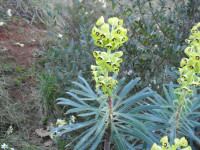
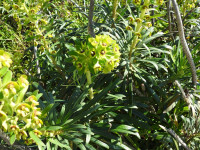
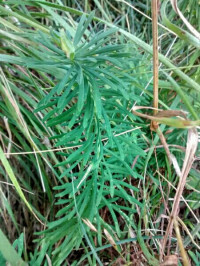
It is a suffrutex, perennial, milky and toxic, reaching a height between 30 and over 120 cm. It has a bushy habit with numerous erect branches, sometimes slightly curved in the upper part before straightening. The stem is woody at the base, reddish, bare below and green-pubescent higher up, with a tomentose or pubescent surface. The plants have a large underground rhizome from which the multi-stemmed shoots develop.
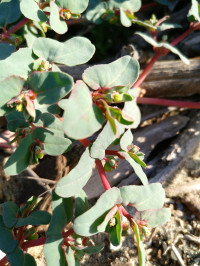
The leaves, sessile and arranged spirally, are alternate, oblong, linear or oblanceolate, with entire, leathery and persistent blades. They generally measure from 3 to 12 cm in length and 0.5-1.3 cm in width, with often revolute margins and a mucronate apex. The upper surface is bluish-green, the lower lighter, with a prominent central vein. The lower leaves are generally longer and directed downwards, while the upper ones are shorter and erect.
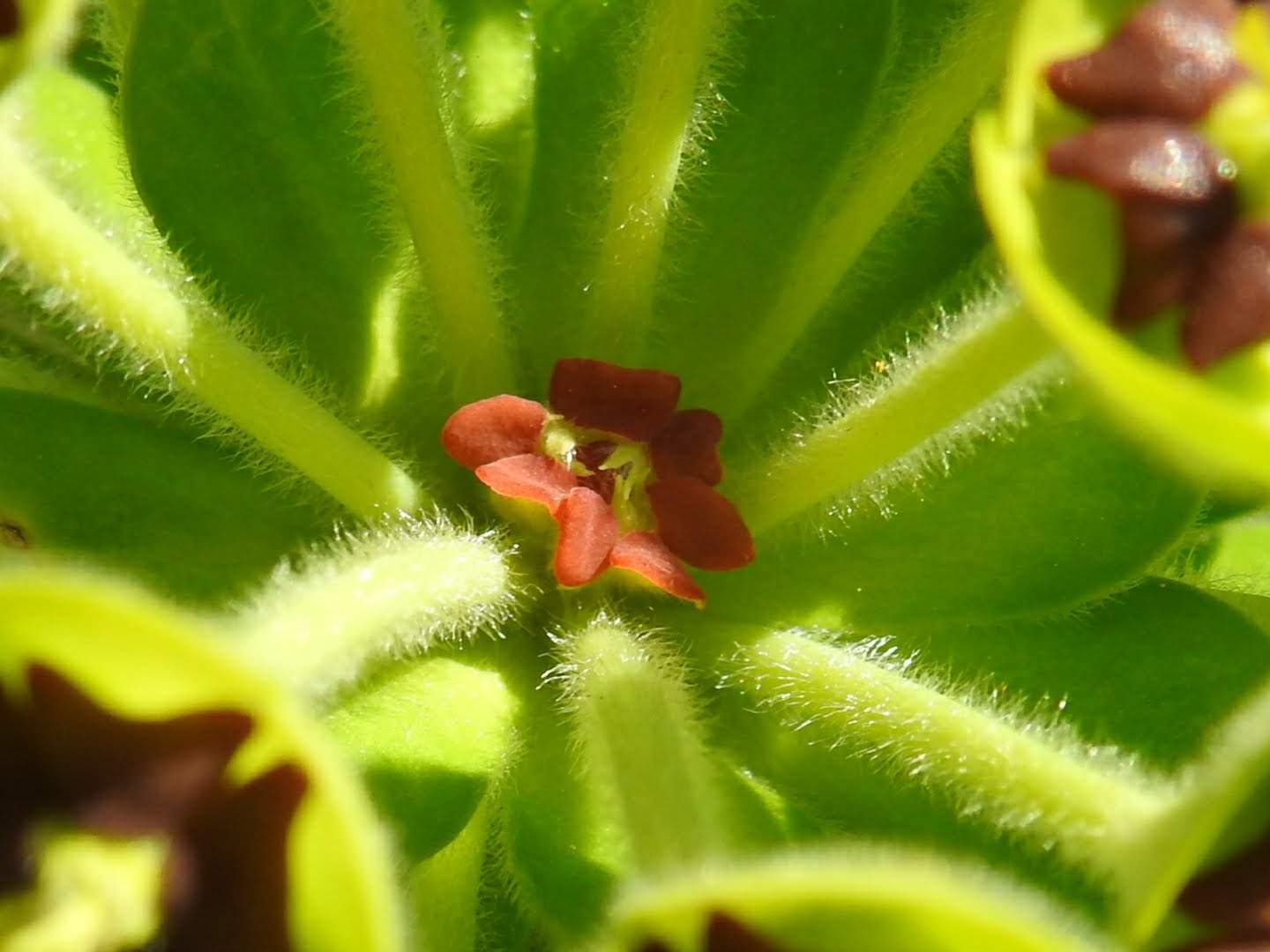
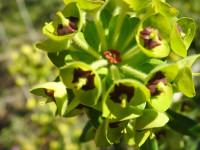
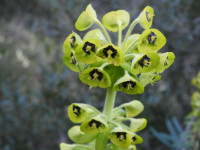
The flowers are unisexual and grouped in inflorescences called cyathia, which appear as a single flower. Each cyathium is formed by a concave cup-shaped receptacle, composed of partially fused bracts (up to halfway), of bislong or oval-bislong shape. The floral bracts are opposite and oval-rhombic. The umbel consists of numerous pubescent, erect and bifid rays, bearing from 10 to 20 cyathia. The nectar glands, arranged in a cross, are four per cyathium, dark red or brown-reddish in color, semilunar or subtrigonal in shape, with short and thick horns.
The female flower consists of a large superior ovary with three carpels and free bifid styles, yellow in color. The male flowers lack perianth and are reduced to stamens only.
The fruit is a tomentose and globose schizocarp 4-7 mm in size, formed by three deeply grooved cocci equipped with elongated styles. At maturity it divides into three mericarps containing smooth, ovoid, silvery-gray seeds about 2-3 mm long and equipped with a conical caruncle.
Habitat and distribution
This species is typical of the Mediterranean region, with a range that includes the Italian coasts, Sicily, Sardinia, Corsica, Spain, Portugal, the Balearic Islands, Greece, Crete and Morocco. In Italy it is widespread mainly along the coasts and in Mediterranean regions, up to about 1000 meters of altitude.
It prefers dry and sunny environments, such as scrublands, garrigues, uncultivated and open lands, often on calcareous or dry substrates, with well-lit exposure. It grows well in shallow, dry and well-drained soils.
Flowering period
Flowering extends from March to June, with some variations related to latitude and altitude. In the southernmost and coastal regions flowering can begin as early as March, while in more inland or higher altitude areas it can continue until July. The flowers, although lacking petals, are very showy thanks to the colored bracts and nectar glands.
Ecology and pollination
Pollination is mediated by pollinating insects attracted by the nectar produced by the glands of the cyathium. The insects visit both male and female flowers, facilitating fertilization. The species is able to reproduce both by seed and by vegetative propagation from the rhizome.
Seed dispersal occurs through a ballistic mechanism: mature fruits open explosively and project the seeds at distances greater than 3 meters from the mother plant. Moreover, a mutualistic mechanism is known with some ant species that collect the seeds attracted by the lipid caruncle (elaiosome), transporting them to the anthill and promoting dispersal at distances even greater than 70 meters. This system increases the chances of germination in suitable environments and contributes to territory colonization.
Curiosities and traditional uses
The plant is known for its toxicity: the white, milky and irritating latex is poisonous and can cause skin and mucous membrane irritations, especially to the eyes. The seeds are also toxic and have historically been used as purgatives. For this reason, all harvesting or handling operations must be done with caution.
Despite its toxicity, Euphorbia characias is widely cultivated in Mediterranean gardens for its ornamental habit and decorative inflorescences. In some Middle Eastern traditions, the plant is considered a protective symbol and is used to purify domestic environments, especially after childbirth.
Recent scientific studies have highlighted interesting pharmacological properties: a protein extracted from this species has shown the ability to significantly reduce the growth of protozoa responsible for leishmaniasis, a disease transmitted by blood-sucking insects such as sandflies.
Etymology
The genus name Euphorbia derives from Euphorbos, Greek physician of King Juba II of Mauretania (1st century BC), who according to Pliny the Elder discovered the properties of the latex of these plants and made medicinal use of it. The species name characias comes from the Greek charakías, from the term charax meaning "stake" or "reed", probably referring to the robustness and erect shape of the stem. This name was used by Dioscorides to indicate the first of the seven species of Tithymalus (a synonym of Euphorbia), defined as “male”.
The Italian common name "euforbia cespugliosa" describes the bushy habit of the plant and its belonging to the genus Euphorbia.
Sources
- Prof. P.V. Arrigoni, "Flora analitica della Toscana", "Flora dell'Isola di Sardegna"
- Acta Plantarum - Flora delle regioni italiane (sheet by Giuliano Salvai)
- Tela Botanica / H. Coste, "Flore descriptive et illustrée de la France"
Characteristics
Scheda botanica
| Famiglia | Euphorbiaceae |
|---|---|
| Fioritura | gennaio – aprile |
| Forma biologica | Nano-Phanerophytes |
| Habitat | toxic plant, flower without petals, plant with a spreading bushy habit |
| Tossicità | Tossica — non consumare |
Domande frequenti
- Quando fiorisce Mediterranean Spurge?
- Mediterranean Spurge fiorisce gennaio – aprile.
- È tossica Mediterranean Spurge?
- Mediterranean Spurge è una pianta tossica o velenosa. Non consumare nessuna sua parte senza aver consultato un esperto.
- Che tipo di pianta è Mediterranean Spurge?
- Mediterranean Spurge è una Phanerophytes (Nano-Phanerophytes) secondo la classificazione di Raunkiaer.
- A quale famiglia appartiene Mediterranean Spurge?
- Mediterranean Spurge appartiene alla famiglia botanica Euphorbiaceae.
Where I found it (5 sightings)
Classification
- Kingdom
- Plantae
- Family
- Euphorbiaceae
- Full name
- Euphorbia characias L.
- Synonyms
- Euphorbia characias L. subsp. wulfenii (Hoppe ex Koch) A.R.Sm.; Euphorbia eriocarpa Bertol.; Euphorbia melapetala Guss.; Euphorbia veneta Willd.; Euphorbia wulfenii Hoppe
- Life form
- Phanerophytes nano-phanerophytes
Similar species
Search for species with similar characteristicsFurther reading
Noticed an error in the identification? Write to me
Other species of the same family
Euphorbiaceae
Explore
Other species of Euphorbiaceae