Botanical species
Euphorbia spinosa
L.
Spiny Spurge
Description
Morphological description
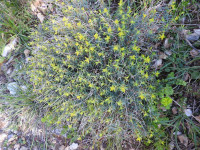
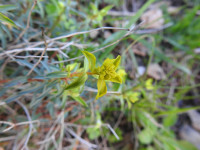
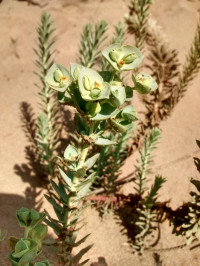
It is a highly branched suffrutex, small in size, generally between 20 and 30 cm tall, characterized by a pulvinate habit, that is cushion-shaped. The stem is woody only at the base, while the older branches from previous years become rigid, woody, and subspiny, with pointed tips resembling spines. These branches persist over time, giving the plant a very branched and protected appearance.
The leaves are small, between 3 and 12 mm long, ovate-lanceolate or ovate in shape, sessile (i.e., without petiole), glaucous (with a waxy coating of greenish-blue color), and have entire margins, that is smooth without serrations. They are generally rigid and sparsely arranged on the branches.
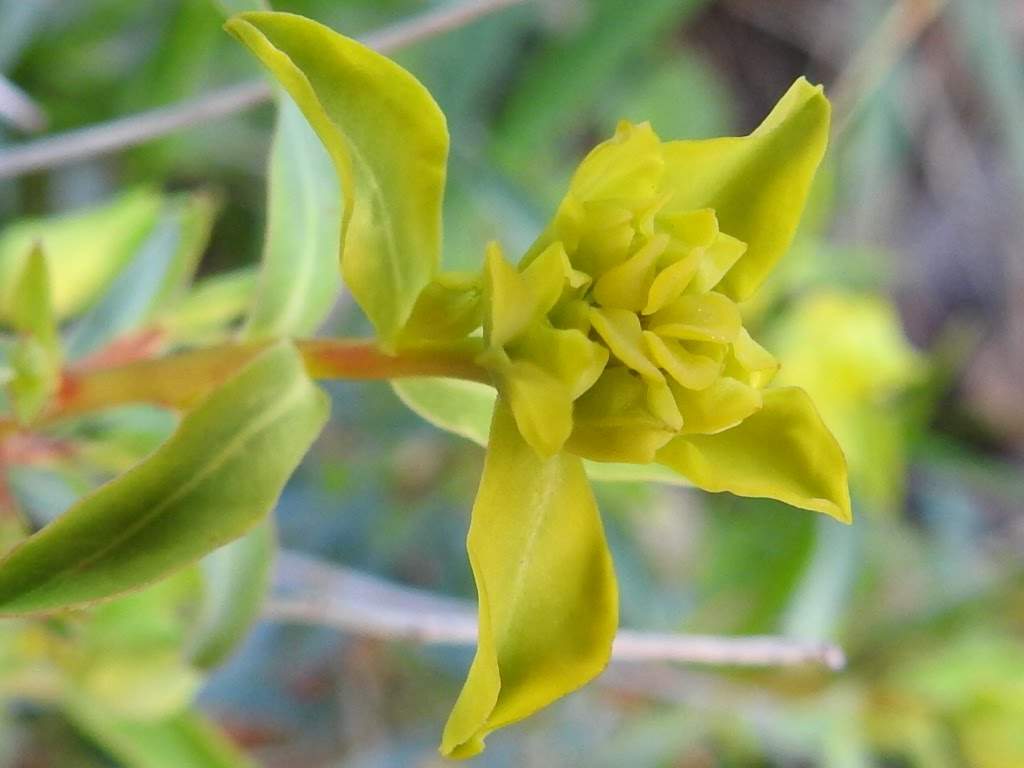
The inflorescences are typical of the genus Euphorbia, called cyathium: these are terminal umbels composed of 3-5 rays, each with a single flower without true petals. The bracts surrounding the flowers are ovate and yellow-green in color, while the glands present are oval and may vary in shape, sometimes with semicircular appendages in isolated populations. The flowers are yellow, petal-less, and have a whitish and irritating latex.
The fruit is a capsule about 3-4 mm in size, globose and verrucose (bearing protruding cylindrical tubercles), glabrous and with shallow grooves. Inside are compressed seeds, dark reddish in color, smooth and equipped with a caruncle (a structure that facilitates dispersal).
The root system is not described in detail in the available sources, but as a typical suffrutex of arid and rocky environments, it is presumably well adapted to anchoring the plant on stony and calcareous substrates.
Habitat and distribution
This species is typical of the northern Mediterranean basin, with a distribution ranging from Italy, particularly in mountainous and submontane areas, to regions such as Provence, Roussillon, and Corsica, with isolated populations also in Malta.
It grows mainly on dry and rocky slopes, limestone cliffs, and well-drained, sheltered soils, often exposed to full sun. The altitude ranges from about 100 up to 1400 meters above sea level, thus adapting to mountain and hilly environmental conditions.
The typical environment is that of dry and stony places, where competition with other herbaceous species is reduced by limited water availability and the nature of the soil.
Flowering period
Flowering extends from April to June, with possible geographic variations linked to altitude and local climate. In Italy, this time window coincides with spring and early summer, when climatic conditions are more favorable for the activity of pollinating insects.
Ecology and pollination
Reproduction occurs through small flowers gathered in cyathium inflorescences, typical of Euphorbiaceae, which attract pollinating insects. Although the flowers lack petals and are not particularly showy, the yellow-green bracts and whitish latex help defend the plant and signal the presence of nectar or pollen to insects.
The seeds, contained in the verrucose capsules, are mainly dispersed through fruit explosion mechanisms (dispersal by ballistic mechanism) typical of the genus Euphorbia, which project the seeds a short distance from the mother plant.
The plant is perennial and appears as a dwarf phanerophyte or suffrutescent chamaephyte, with perennial buds located between 20 cm and 2 m from the ground, adapted to conditions of high exposure and drought.
Curiosities and traditional uses
All parts of the plant contain a whitish latex that is very irritating to the skin and eyes, a toxic substance that acts as a deterrent against herbivorous animals and humans. For this reason, Euphorbia spinosa is not used as a food or medicinal plant in popular tradition, but its toxicity is well known.
The genus name Euphorbia derives from the Greek physician of the 1st century BC Euphorbos, who used some species of this genus for medicinal purposes, although spiny species like this one are less employed due to their toxicity.
The term "spinosa" refers to the rigid and spiny branches, a distinctive morphological characteristic of this species.
Etymology
The scientific name Euphorbia spinosa directly recalls the spiniform character of the woody and persistent branches. The genus Euphorbia is named after Euphorbos, a Greek physician known for having used plants of this genus for therapeutic purposes. The Italian common name “Spiny Spurge” simply reflects the scientific denomination.
Sources
- Prof. S. Pignatti, Flora d'Italia
- Acta Plantarum – Flora delle regioni italiane (scheda di Giuliano Campus)
- Tela Botanica / H. Coste, Flore descriptive et illustrée de la France
Characteristics
Where I found it (7 sightings)
Classification
- Kingdom
- Plantae
- Family
- Euphorbiaceae
- Full name
- Euphorbia spinosa L.
- Synonyms
- Euphorbia spinosa L. subsp. ligustica (Fiori) Pignatti
- Life form
- Camefite suffruticose
Similar species
Search for species with similar characteristicsFurther reading
Noticed an error in the identification? Write to me
Other species of the same family
Euphorbiaceae
Explore
Other species of Euphorbiaceae