Botanical species
Euphorbia peplus
L.
Petty Spurge
Description
Morphological description
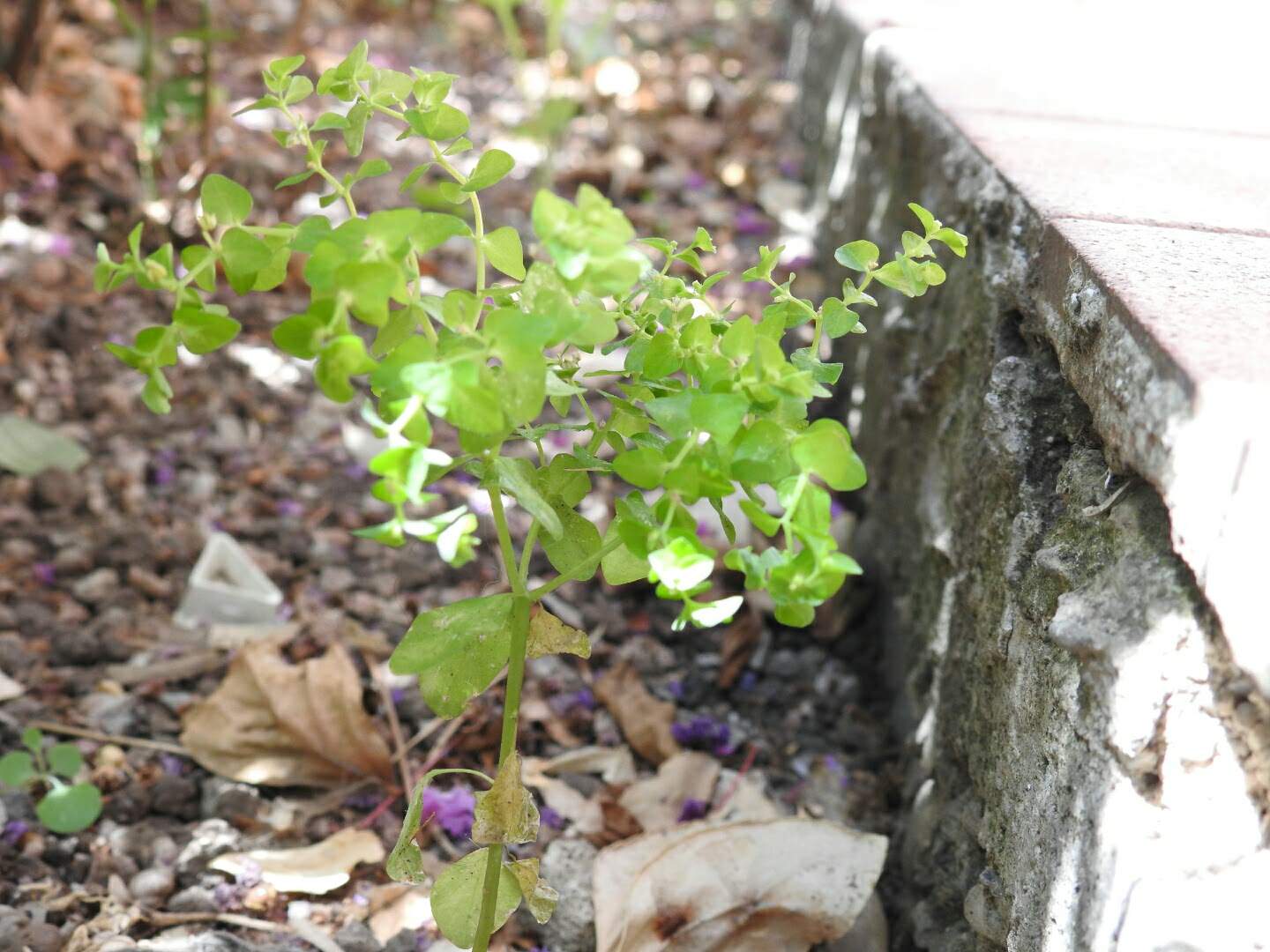
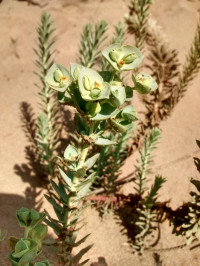
Annual herbaceous plant, latex-bearing and glabrous, with a height ranging between 10 and 40 cm. The stem is cylindrical, often ascending or prostrate, with a branched habit, especially at the base, from which secondary stems arise. The root system consists of a taproot.
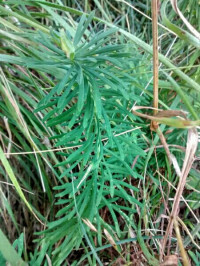
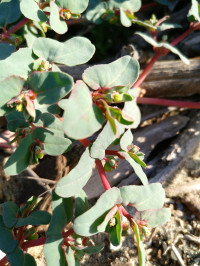
The leaves are alternate, soft and herbaceous in texture, with an obovate or elliptical blade, varying in size between 5 and 25 mm in length and 4-15 mm in width. They are entire, with a smooth margin, attenuate or cuneate base and obtuse or emarginate apex; the petiole measures about 1 cm and the lower surface shows a slight glaucousness. The lower leaves tend to fall early.
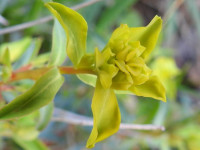
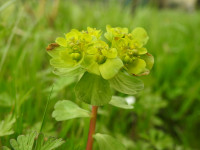
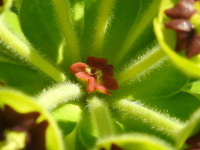
The inflorescence is a pseudoumbel (pleiocaulus), terminal and composed of 3-5 rays, frequently forked from 2 to 8 times, with bracts similar to the upper leaves but slightly larger and often mucronate. The cyathium, small (0.7-1.5 mm), is subsessile and has at the base two bracts that simulate a perianth. Inside the cup-shaped structure are the male flowers, reduced to a single stamen each, and a pedunculate female flower. There are four nectaries of green-yellowish color, sometimes with reddish shades, elliptical or subulate crescent-shaped, with two white appendages shaped like filiform horns.
The fruit is a subglobose schizocarp, measuring 1.3-2 × 1.5-2.2 mm, composed of three monospermous mericarps (cocci) smooth, longitudinally winged on the back by two keels and glabrous. The seeds are ovoid, gray-whitish in color, with a hexagonal cross-section and show longitudinal and round pits on the surface; the caruncle is rounded and deciduous. The capsule is pendulous, ovate-trigonous and two-winged along the back.
Habitat and distribution
It is a cosmopolitan species, widespread throughout the Mediterranean basin and in many other temperate areas of the world. In Italy it commonly grows in anthropized environments such as cultivated fields, vegetable gardens, pastures, gardens and nitrogen-rich places (nitrophilous environments), often in the presence of moist or moderately moist soils. It prefers sunny exposures and is found from the plains up to about 1700 meters of altitude.
Flowering period
The flowering is prolonged, extending from January to December, with local variations linked to climate and latitude. In milder Mediterranean climates it is possible to observe flowers for most of the year.
Ecology and pollination
The species is an annual herbaceous plant that reproduces through seeds produced by cyathium inflorescences, a particular inflorescence typical of Euphorbiaceae. Pollination is mainly entomogamous, favored by pollinating insects attracted by the nectars present in the glands of the cyathium. The cyathium structure, with male and female flowers gathered in a cup, facilitates cross-pollination.
The seeds are dispersed mainly through mechanisms of fall and local dispersion; the presence of caruncles, lipid-rich structures, suggests that ants and other small insects may also contribute to secondary dispersal (myrmecochory).
Curiosities and traditional uses
This species is known for its toxicity: it contains irritating latex and chemical compounds such as flavonoids, tannins, anthraquinones, sterols and triterpenes toxic to humans and animals. Historically it has been used in herbal medicine as a purgative, expectorant, anti-inflammatory and antipyretic. However, its use is strongly discouraged due to its high toxicity, with risks even from simple skin application or contact with eyes and mucous membranes.
Recently studies are underway to investigate the potential antitumor properties of its latex and its bioactive compounds, but such uses are still experimental and not official.
The common name “Petty Spurge” derives from its reduced size compared to other species of the genus Euphorbia. There are no particular folkloric references or documented food uses, precisely because of its toxicity.
Etymology
The genus name Euphorbia derives from the Greek “euphorbion”, a name given to a plant used by the physician of Mauretania Euphorbus, from which also derives the historical root of the scientific name. The specific name “peplus” seems to refer to the Greek term “πέπλος” (péplos), meaning “mantle” or “robe”, probably due to the resemblance of the bracts surrounding the inflorescence to a cloak.
The Italian name “Petty Spurge” refers to the relatively small size compared to other similar euphorbias.
Sources
- Prof. P.V. Arrigoni, "Flora analitica della Toscana", "Flora dell'Isola di Sardegna"
- Acta Plantarum - Flora delle regioni italiane (scheda di Giuliano Salvai)
- Tela Botanica / H. Coste, "Flore descriptive et illustrée de la France"
- World Flora Online (WFO)
Characteristics
Where I found it (3 sightings)
Classification
- Kingdom
- Plantae
- Family
- Euphorbiaceae
- Full name
- Euphorbia peplus L.
- Synonyms
- Euphorbia calabrica Huter; Euphorbia peploides Gouan; Euphorbia peplus L. var. peploides (Gouan) Vis.; Tithymalus peplus (L.) Hill
- Life form
- Terofite scapose
Similar species
Search for species with similar characteristicsFurther reading
Noticed an error in the identification? Write to me
Other species of the same family
Euphorbiaceae
Explore
Other species of Euphorbiaceae