Botanical species
Euphorbia cyparissias
L.
Cypress Spurge
Description
Morphological description
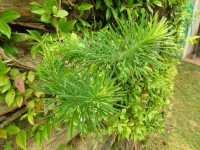
Perennial herbaceous plant, rhizomatous and glabrous, with erect stems reaching a variable height between 15 and 60 cm. The stem is generally simple or branched in the apical part, leafless at the base and often glaucescent green in color, sometimes with reddish hues. The base of the stem is woody in some specimens with numerous sterile shoots developing below the inflorescence.
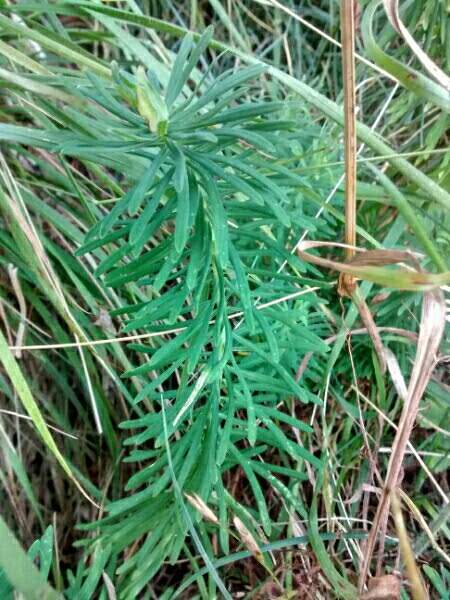
The leaves are alternate, linear or linear-setaceous, ranging from 5 to 40 mm long and 1-3 mm wide, with entire margins and obtuse or pointed apex. They are arranged in a patent or reflexed manner, with an overall narrow and filiform appearance, especially dense on the flowering branches. The leaf surface is glabrous and yellowish-green in color, less dense along the flowering stems.
The inflorescence is a cyathium, a particular type of flower typical of the genus Euphorbia, which simulates a single flower but is actually composed of multiple unisexual flowers. The cyathium is placed at the apex of the branches in pleiocasia with 12-15 rays, each bifid once or twice. The bracts surrounding the inflorescence are ovate-reniform, similar to the cauline leaves, yellow in color tending to turn red towards the end of flowering. The glands of the cyathium are four, sessile, semilunar in shape with short horns, yellow in color. The involucre shape is campanulate or slightly urceolate, about 1.5-2 mm long and 0.9-1.1 mm wide, also glabrous.
The fruits are trilocular capsules, subglobose, about 3 mm, slightly sulcate and finely granulose or verrucose on the surface. Inside they contain three ovoid seeds, smooth and shiny, gray or light brown in color, with a rounded or nipple-shaped caruncle.
The root system is rhizomatous, with stolons that allow rapid expansion and colonization of new spaces. This system enables the plant to spread easily and sometimes become invasive.
Habitat and distribution
A typical species of Mediterranean and European environments, it grows spontaneously in Italy especially in uncultivated areas, along roadsides, in dry meadows and anthropized areas. It prefers calcareous, well-drained soils, and normally develops from the plains up to about 1500 meters altitude, with reports also up to 2500 m a.s.l.
It is common in poor grasslands, pastures, abandoned lands, embankments and disturbed areas, showing good adaptability also to different pedoclimatic conditions, but always with preference for sunny exposures and semi-arid environments.
Its distribution covers almost all of Europe, with frequent presence in Mediterranean and temperate regions.
Flowering period
Flowering extends from March to October, with a higher concentration between April and September. The duration and intensity of flowering may vary slightly depending on local climatic conditions and altitude, with longer periods in mild climate areas.
Ecology and pollination
The cyathium inflorescence, although appearing as a single flower, is actually a complex of unisexual flowers, with a reproductive system that favors zoophilous pollination. The glands of the cyathium generally produce nectar, attracting pollinating insects that act as pollinators, although the plant can reproduce effectively through vegetative multiplication by stolons.
Seed dispersal occurs through capsules that open at maturity, releasing ovoid seeds that can be transported by natural elements such as wind or small animals.
The ability to multiply rapidly both vegetatively and generatively makes this species potentially invasive, capable of colonizing large areas in a short time.
Curiosities and traditional uses
The whole plant contains a white, bitter and sticky latex, highly toxic and caustic. The latex is known for its vesicant properties and can cause skin irritation and blisters if handled without protection. Historically, the plant has been used in folk medicine to remove calluses and warts.
The bark of the roots contains resins, gums, euphorbone, rubber and oils that confer emetic and purgative properties. In the past, an infusion of the plant in wine was used in the treatment of dropsy, although its therapeutic use is no longer recommended due to the plant's toxicity.
The species is especially toxic to livestock, which carefully avoids it; the presence of the plant in fodder can in fact cause serious disorders.
From a botanical point of view, the structure of the cyathium is so striking that it led Linnaeus and other botanists to interpret the inflorescence as a true single flower. The rapid spread and invasive character are mainly due to multiplication through stolons.
Etymology
The genus name derives from Euphorbos, physician to Juba II king of Numidia in the 1st century BC, who according to Pliny and Dioscorides discovered the properties of this plant. The specific name "cyparissias" refers to the resemblance of its linear and thin leaves to those of the cypress, from which also derives the Italian common name "Cypress Spurge" or "erba cipressina".
Sources
- Prof. P.V. Arrigoni, "Flora analitica della Toscana", "Flora dell'Isola di Sardegna"
- Acta Plantarum - Flora delle regioni italiane (scheda di Marinella Zepigi)
- Tela Botanica / H. Coste, "Flore descriptive et illustrée de la France"
- World Flora Online (WFO)
Characteristics
Where I found it (1 sightings)
Classification
- Kingdom
- Plantae
- Family
- Euphorbiaceae
- Full name
- Euphorbia cyparissias L.
- Life form
- Emicriptofite scapose
Similar species
Search for species with similar characteristicsFurther reading
Noticed an error in the identification? Write to me
Other species of the same family
Euphorbiaceae
Explore
Other species of Euphorbiaceae