Botanical species
Euphorbia prostrata
Aiton
Prostrate Sandmat
Description
Morphological description
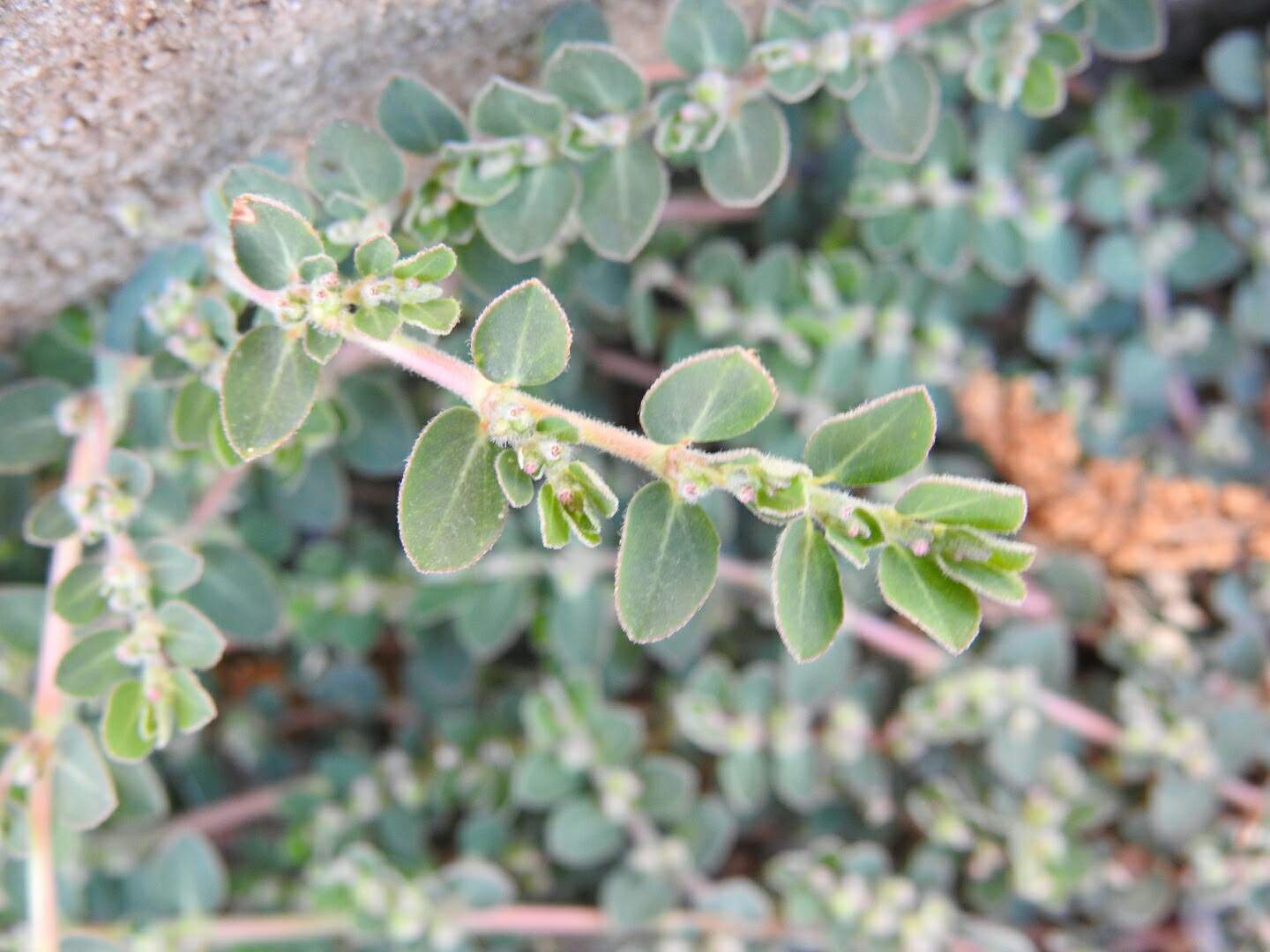
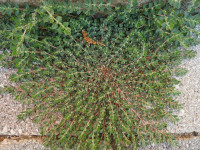
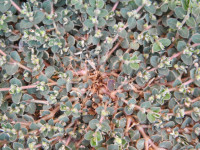
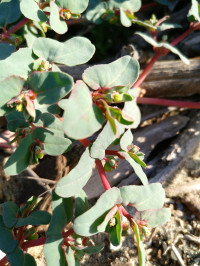
Annual herbaceous plant with a prostrate or prostrate-ascending habit, generally up to 15 cm tall, with thin, creeping stems branched at the base. The upper branches are often reddish and covered with a slight pubescence formed by erect hairs 0.1-0.2 mm long, while the lower part of the stem is more glabrous and green. Adventitious roots may appear along the stolons, contributing to its ability to rapidly spread over the ground.
The leaves are arranged oppositely on the branches, shortly petiolate (petiole about 0.5-1 mm long) and small-sized, averaging between 3.5 and 9 mm in length by 2-6 mm in width. The blade is oblong-elliptic or elliptic-obovate in shape, with an asymmetrical base: one side has a subcordate (almost heart-shaped) form, the other is rounded or cuneate. The leaf margin is entire or finely serrated especially in the upper half, with reddish dots. The upper surface (adaxial) is generally glabrous or slightly glabrescent, while the lower surface (abaxial) has pubescence mainly in the distal part. The stipules are triangular, fimbriate (with a fringed margin) and also hairy, located at the base of the petiole.
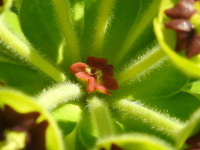
The inflorescence is a cyathium (inflorescence characteristic of Euphorbiaceae), turbinate trilobed in shape with hairy margins, often sessile or on very short peduncles (about 1 mm). Each cyathium includes a central female flower, surrounded by 4-5 male flowers reduced to bracteoles lacking perianth. The nectar glands are four, red in color, with pink or white petaloid appendages that enhance their visibility. The ovary is pubescent, with stigmas bifid for more than half their length.
The fruit is a trilobed capsule, about 1.1-1.5 mm long, slightly grooved and with reddish keels (lines of junction) bearing erect hairs. At maturity, the fruit peduncle bends backward. The seeds are small (about 0.9-1 mm), ovoid-tetrahedral in shape, gray-brown or yellow-reddish in color, with a granulose-striate surface transversely and lacking caruncle (nutritive appendage). Their structure shows 4-5 well-defined transverse grooves.
The plant is characterized by toxicity, common to many Euphorbiaceae, due to the presence of latex and irritating chemical compounds.
Habitat and distribution
Native to North America, this species is now widely naturalized and considered highly invasive throughout the Italian peninsula. It is present in every region, from the plains up to medium-low altitudes, preferring open and sunny environments.
Prostrate Sandmat is extremely versatile and easily colonizes anthropized and disturbed habitats: it is frequently found in gardens, cultivated lands, roadsides, uncultivated areas and even heavily degraded substrates. However, it seems to prefer sandy or well-drained soils, where it can rapidly develop thanks to its creeping habit.
In the Mediterranean area it is mainly widespread in warm temperate climates, adapting to variable soil and microclimate conditions, but with a preference for sunny exposures.
Flowering period
Flowering extends from June to November, with possible variability depending on the geographic area and local climatic conditions. The long flowering season allows the species to reproduce effectively and expand continuously during the warmer and milder months of the year.
Ecology and pollination
The cyathia of Prostrate Sandmat, although lacking true petals, are equipped with colored nectar glands and petaloid appendages that attract pollinating insects. Pollination is mainly entomophilous, favored by small insects that feed on the nectar produced by the red glands.
The reproductive strategy relies on reduced male flowers and single female flowers per cyathium, with subsequent production of capsules that open to release small, rough seeds. Seed dispersal mainly occurs over short distances, facilitated by contact with the ground and the plant’s creeping habit, but long-distance spread is aided by human activity and accidental transport via agricultural equipment or construction materials.
Curiosities and traditional uses
Despite the general toxicity of the plant, Prostrate Sandmat has been the subject of studies for its potential medicinal properties. Some extracts have shown hypoglycemic, antibacterial and antiviral effects experimentally, but there are currently no practical applications or established traditional uses exploiting these properties.
In folklore and popular culture there are no particular symbolic attributions or food uses reported, probably due to its toxicity and inconspicuous appearance.
Etymology
The generic name Euphorbia derives from the Greek “Εὔφορβος” (Euphorbos), the name of a Greek physician at the court of Juba II, king of Numidia, who is said to have discovered the medicinal properties of some species of the genus. The etymology emphasizes the idea of “nourishment” or “well-being,” from the Greek “εὐ” (good) and “φορβή” (fodder, nourishment).
The specific epithet prostrata clearly indicates the plant’s habit, “lying on the ground,” referring to the creeping stem and branches adhering to the substrate.
The Italian common name, “Prostrate Sandmat,” is a simple transposition of the scientific name, without widely used popular denominations.
Sources
- Prof. P.V. Arrigoni, "Flora analitica della Toscana", "Flora dell'Isola di Sardegna"
- Acta Plantarum - Flora delle regioni italiane (scheda di Quintino Giovanni)
- Tela Botanica / H. Coste, "Flore descriptive et illustrée de la France"
- World Flora Online (WFO)
Characteristics
Scheda botanica
| Famiglia | Euphorbiaceae |
|---|---|
| Fioritura | giugno – novembre |
| Forma biologica | Creeping plants |
| Habitat | creeping plant, toxic plant, flower without petals |
| Tossicità | Tossica — non consumare |
Domande frequenti
- Quando fiorisce Prostrate Sandmat?
- Prostrate Sandmat fiorisce giugno – novembre.
- È tossica Prostrate Sandmat?
- Prostrate Sandmat è una pianta tossica o velenosa. Non consumare nessuna sua parte senza aver consultato un esperto.
- Che tipo di pianta è Prostrate Sandmat?
- Prostrate Sandmat è una Therophytes (Creeping plants) secondo la classificazione di Raunkiaer.
- A quale famiglia appartiene Prostrate Sandmat?
- Prostrate Sandmat appartiene alla famiglia botanica Euphorbiaceae.
Where I found it (3 sightings)
Classification
- Kingdom
- Plantae
- Family
- Euphorbiaceae
- Full name
- Euphorbia prostrata Aiton
- Synonyms
- Anisophyllum prostratum (Aiton) Haw.; Chamaesyce prostrata (Aiton) Small; Tithymalus prostratus (Aiton) Samp.
- Life form
- Therophytes creeping plants
Similar species
Search for species with similar characteristicsFurther reading
Noticed an error in the identification? Write to me
Other species of the same family
Euphorbiaceae
Explore
Other species of Euphorbiaceae