Botanical species
Euphorbia peplis
L.
Purple Spurge
Description
Morphological description
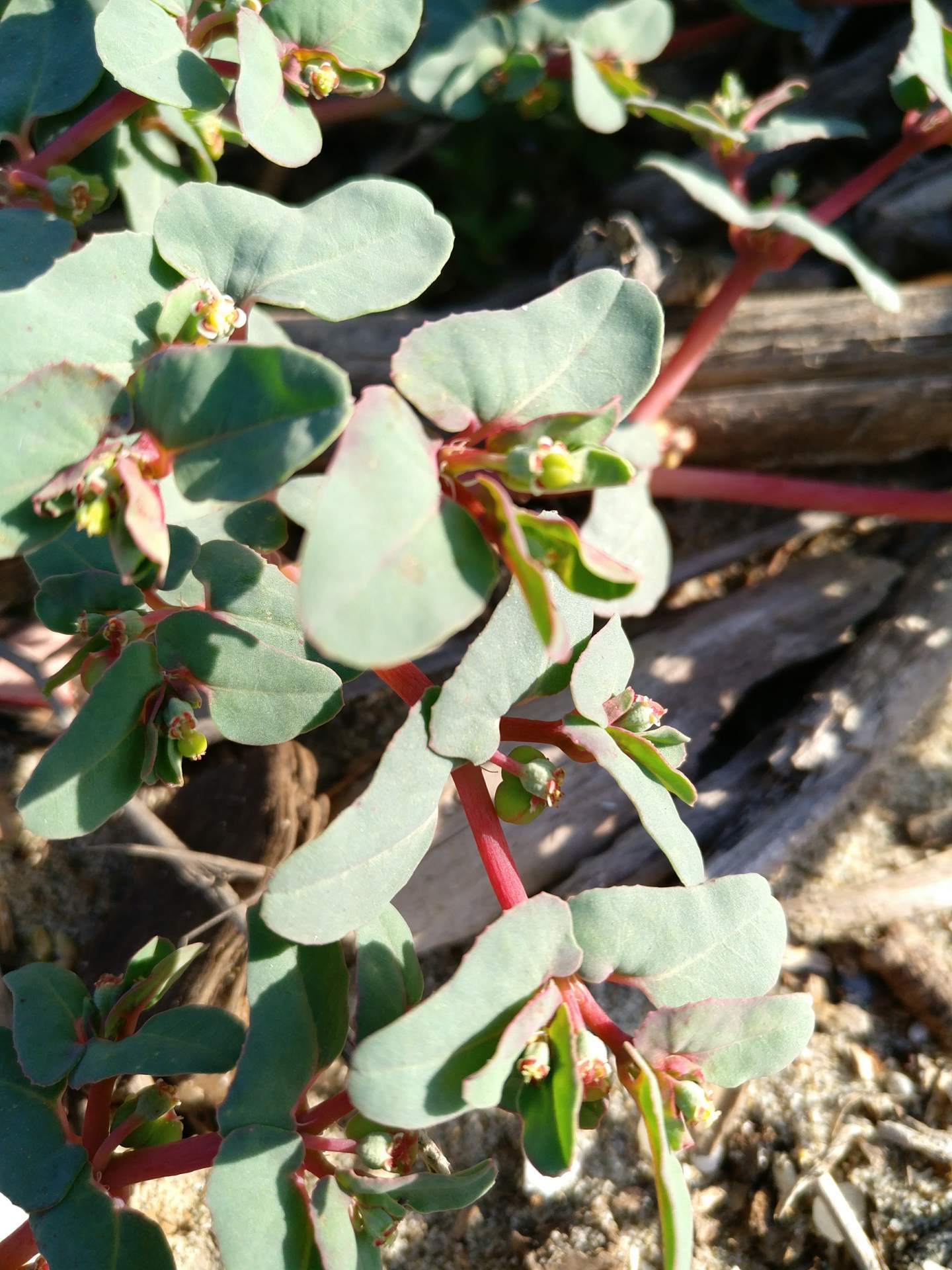
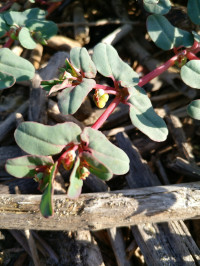
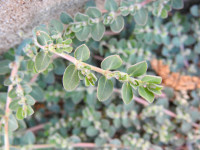
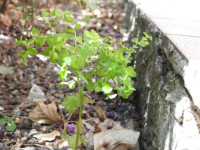
Annual herbaceous plant belonging to the family Euphorbiaceae, the species presents a creeping and flattened habit on the ground, typical of psammophilous plants adapted to sandy coastal environments. The stems, which can reach a length of about 40 cm, are robust, succulent, and often branched into four branches; they have a reddish coloration that becomes more evident at the branching points. The surface of the stems is glabrous and glaucous, with the presence of whitish latex typical of the genus.
The leaves are fleshy, slightly succulent, and leathery, oval or oblong-falcate in shape, with variable dimensions from 5-10 mm in width to 8-13 mm in length. They are opposite, petiolate (petiole length 2-3 mm), with an obtuse or emarginate base and often strongly asymmetric, characterized by a thick and glaucous texture. The upper surface may sometimes show a slight reddish pigmentation. The leaves are equipped with filiform stipules (shaped like small filamentous appendages).
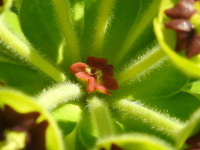
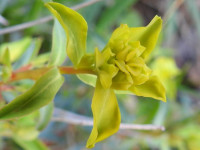
The flowers are unisexual, petal-less, and gathered in cyathium inflorescences located at the leaf axils. The nectar glands are brown-reddish in color, rounded in shape, and have a lighter appendage emerging from the surface. Flowering is characterized by brown flowers, very small and inconspicuous, in line with the reproductive strategy of psammophilous plants.
The fruit is a trigonal, pendulous capsule, smooth and glabrous, measuring between 4 and 5 mm. Inside are seeds of ovoid-pyriform shape, smooth, about 3 mm, gray or with brown spots. The root system consists of a long and well-developed taproot, which allows the plant to anchor firmly in coastal sandy substrates.
Habitat and distribution
This species is typical of sandy and gravelly coastal areas, especially marine shores characterized by dunes, beaches, and foredunes. It is a psammophilous plant that is part of the pioneer vegetation of the Mediterranean coasts, being well adapted to arid, brackish environments strongly exposed to wind and salt spray.
Its distribution extends throughout the Mediterranean basin and reaches the regions of Western Europe, up to the coasts of the Atlantic Ocean and the English Channel. In Italy it is mainly present in coastal regions, with a preference for low-altitude sandy beaches; it is also reported in Corsica. The growth altitude is generally low, confined to areas close to the sea.
The preferred substrate consists of fine sand or gravel, often under conditions of high salinity and low fertility. The plant prefers sunny exposures and open environments, where it can develop without excessive competition from more demanding species.
Flowering period
Flowering extends from May to September, with possible variability depending on local climatic conditions. In warmer climates, flowering can start early in May and continue until autumn, while in regions with milder temperatures it may be more concentrated in the central summer months.
Ecology and pollination
The plant produces unisexual flowers arranged in a cyathium, which are equipped with brown-reddish nectar glands that attract pollinating insects. Although there are no specific data on pollinator species, it is likely that small insects, such as wild bees, flies, or various dipterans, are involved in pollination, attracted by the nectar produced by the glands.
The reproductive strategy is based on a modest but effective seed production, which is presumably dispersed by gravity or by secondary means such as wind or water, given the coastal habitat. The trigonal, pendulous, and smooth capsule opens to release the ovoid seeds, which can then be transported by wind or waves to nearby beaches, facilitating the colonization of new sandy areas.
Curiosities and traditional uses
Like many other Euphorbia, this species contains a toxic latex, which has made the plant little used for food or medicinal purposes. Its common name, "Purple Spurge," recalls its typical presence in coastal environments and its affinity with sandy substrates.
Historically, the genus name is linked to Euphorbus, physician to King Juba II of Numidia, who according to tradition discovered the medicinal properties of some Euphorbia plants. However, no specific medical applications of this species are known, probably due to its toxicity and limited distribution.
There are no particular food uses or folklore associated with this plant, which is rather appreciated for its ecological role in dune stabilization and the conservation of coastal habitats.
Etymology
The scientific name of the genus derives from "Euphorbos" (Εὔφορβος), a Greek physician who served King Juba II, known for having discovered the therapeutic properties of some plants belonging to this group. The word "Euphorbus" derives from the ancient Greek "εὖ" (well) and "φορβή" (food, nourishment), literally meaning "well nourished."
The specific name "peplis" recalls the similarity of the leaves to those of Portulaca oleracea, commonly called "purslane" (from the Latin "peplis," which indicated a kind of garment or, by extension, a plant similar in shape). The Italian name "Purple Spurge" instead emphasizes the typical habitat of the species.
Sources
- Prof. S. Pignatti, Flora d'Italia, Edagricole, Bologna, 1982
- Acta Plantarum - Flora delle regioni italiane (scheda di Marinella Zepigi)
- Tela Botanica / H. Coste, Flore descriptive et illustrée de la France
Characteristics
Scheda botanica
| Famiglia | Euphorbiaceae |
|---|---|
| Fioritura | maggio – ottobre |
| Forma biologica | Creeping plants |
| Habitat | toxic plant, psammophilous plant, with brown flowers |
| Tossicità | Tossica — non consumare |
Domande frequenti
- Quando fiorisce Purple Spurge?
- Purple Spurge fiorisce maggio – ottobre.
- È tossica Purple Spurge?
- Purple Spurge è una pianta tossica o velenosa. Non consumare nessuna sua parte senza aver consultato un esperto.
- Che tipo di pianta è Purple Spurge?
- Purple Spurge è una Therophytes (Creeping plants) secondo la classificazione di Raunkiaer.
- A quale famiglia appartiene Purple Spurge?
- Purple Spurge appartiene alla famiglia botanica Euphorbiaceae.
Where I found it (2 sightings)
Classification
- Kingdom
- Plantae
- Family
- Euphorbiaceae
- Full name
- Euphorbia peplis L.
- Synonyms
- Anisophyllum peplis Haw.; Chamaesyce maritima Gray, nom. illeg.; Chamaesyce peplis (L.) Prokh.; Tithymalus peplis (L.) Scop.
- Life form
- Therophytes creeping plants
Similar species
Search for species with similar characteristicsFurther reading
Noticed an error in the identification? Write to me
Other species of the same family
Euphorbiaceae
Explore
Other species of Euphorbiaceae