Botanical species
Euphorbia helioscopia
L.
Sun Spurge
Description
Morphological description
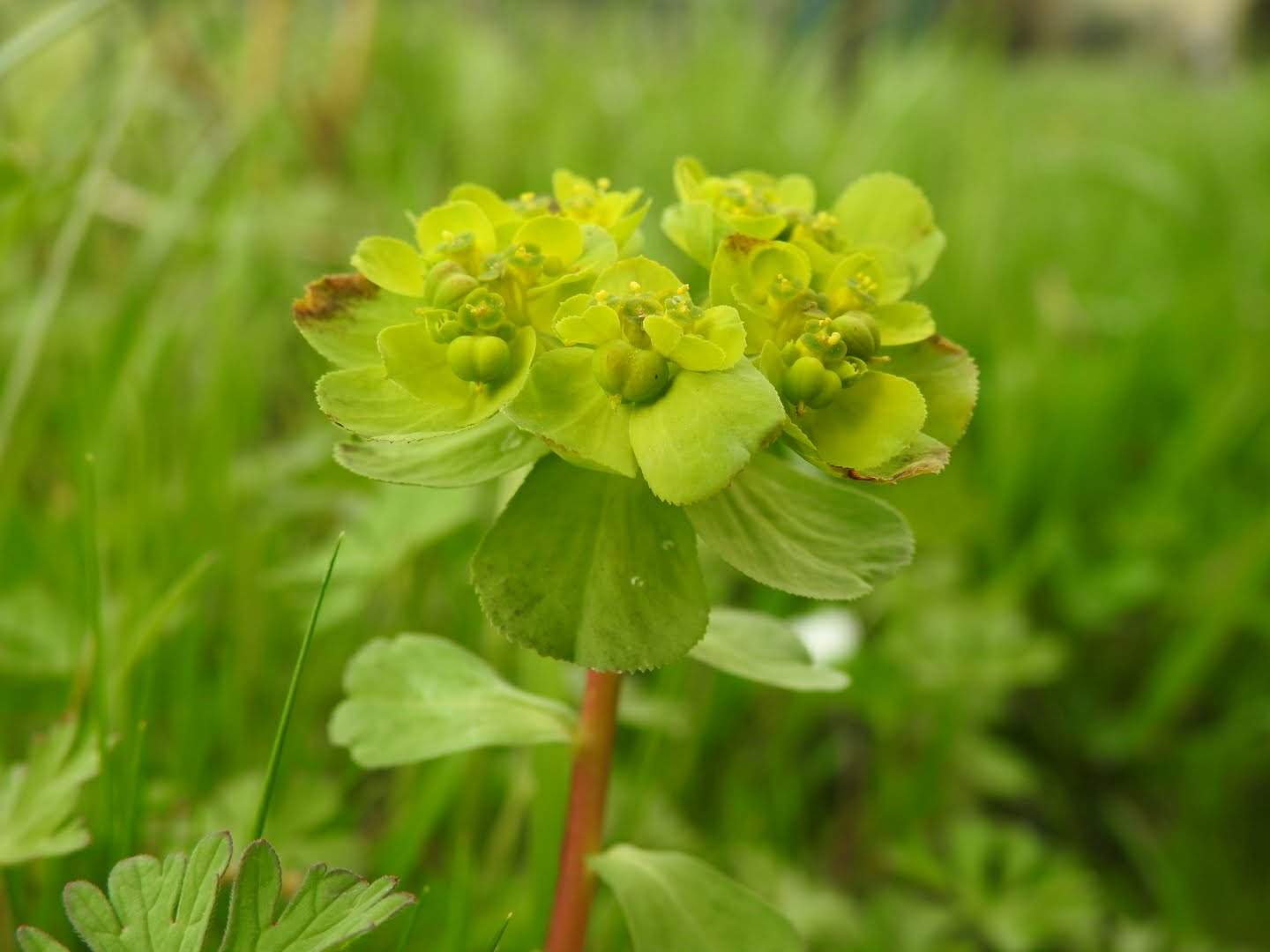
Annual herbaceous plant, with an erect or ascending habit, reaching a height varying between 10 and 50 cm, more commonly around 10-40 cm. The stem is relatively robust, cylindrical, generally simple, with a subglabrous surface or with patent hairs only on the upper part; in adult specimens the stem may show a reddish coloration and displays basal scars due to the falling of lower leaves.
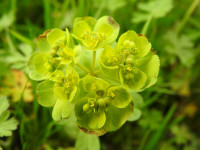
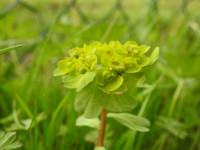
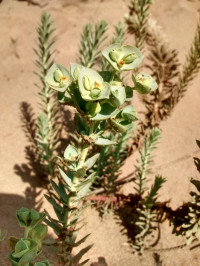
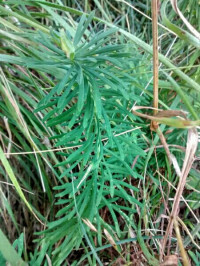
The leaves are alternate, glabrous, with a broadly obovate or ovate-spatulate blade, increasing in size from the bottom to the top of the plant. The lower leaves measure about 6-12 mm, while the upper ones are larger, up to over 8 cm in length, with a rounded or retuse apex and finely toothed or denticulate margin on the upper part. The latter can partially enclose the floral cymes. The bracts surrounding the inflorescences (cyathia) are similar to the upper leaves, obovate in shape and greenish-yellow in color.
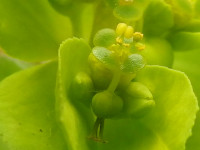
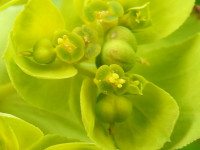
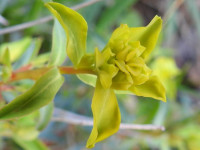
The inflorescence is a pseudumbel (cyathium) composed, typically with five rays, appearing as a single flower but consisting of an involucre with four lobes inside which there are five male flowers (each reduced to a single stamen) and one female flower (reduced to a pistil with three locules). The glands present on the involucre are oval, greenish-yellow in color, and often fragrant, contributing to attract pollinating insects.
The fruits are glabrous, smooth capsules, round in shape with three well-visible locules, about 3 mm long, yellowish in color and sometimes reddened on one side under unfavorable ecological conditions. The seeds are ovoid, dark brown, about 2 mm, with a strongly reticulate and verrucose surface, equipped with a transverse, flattened, and appressed caruncle.
The root system is taprooted, typical of annual herbaceous species.
The entire plant contains a white caustic and irritating latex, which makes the species toxic upon contact and ingestion.
Habitat and distribution
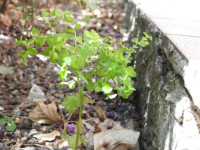
The species is cosmopolitan, present in Europe, Asia, and Africa, and has also been introduced in America. In Italy and the Mediterranean basin it is common and widespread in a wide range of environments, often anthropized or disturbed. It typically grows in uncultivated lands, cultivated soils, vineyards, road edges, degraded areas, and nitrophilous zones, i.e., rich in nitrogen.
It is found from the plains up to about 1200 m altitude, with reports also up to 1800 m a.s.l., preferring sunny exposures and well-drained but nutrient-rich soils, often calcareous or clayey. It is frequent in hilly and subalpine mountain environments, where it behaves as a scapose therophyte (with an elongated floral axis and almost leafless).
Flowering period
Flowering extends from April to November, with possible regional variations due to climate and altitude. In warmer regions flowering can begin already in early spring and continue until autumn, while in mountainous or cooler environments it is concentrated in the summer months.
Ecology and pollination
The flowers, although lacking true petals, are organized in cyathia that simulate a single flower and are characterized by the presence of oval and fragrant glands that attract pollinating insects, mainly small hymenopterans and dipterans. These insects are essential for pollination, facilitated by the accessible structure of the flowers and the presence of nectar.
The plant reproduces exclusively by seed; dispersal occurs mainly by falling near the mother plant, but seeds can be transported by external agents such as water, animals, or human activities, favoring colonization of new disturbed habitats.
Curiosities and traditional uses
This species has been known since ancient times for its toxic properties due to the caustic latex, which can cause skin and mucous membrane irritations. Despite this, in folk medicine it has been used, with caution, for the treatment of various ailments such as sciatica, arthritis, pleurisy, and warts.
A curious medieval traditional remedy attributed to Rinaldo da Villanova suggests the use of wine in which roots of Euphorbia helioscopia have been cooked to wash the mouth and prevent toothache and gum pain. However, such uses must be considered with extreme caution, given the plant's potential toxicity.
The common names "calenzuola" and "erba verdona" reflect local popular tradition, while the term "euphorbia" derives from the Greek physician Euphorbos.
Etymology
The genus name Euphorbia derives from the name of the Greek physician Euphorbos, who lived in the 1st century BC. The specific name "helioscopia" derives from the Greek "helios" (sun) and "skopein" (to look), alluding to the ancient, probably erroneous belief that the plant oriented itself following the sun during the day. This interpretation is also reported by Pliny the Elder, although it is not confirmed by modern observations.
The Italian name "calenzuola" is a traditional term identifying this species in various Italian regions, while "erba verdona" recalls the greenish-yellow color of the leaves and bracts.
Sources
- Prof. S. Pignatti, "Flora d'Italia"
- Acta Plantarum - Flora delle regioni italiane (sheet by Marinella Zepigi)
- Tela Botanica / H. Coste, "Flore descriptive et illustrée de la France"
- World Flora Online (WFO)
Characteristics
Where I found it (6 sightings)
Classification
- Kingdom
- Plantae
- Family
- Euphorbiaceae
- Full name
- Euphorbia helioscopia L.
- Synonyms
- Tithymalus helioscopius (L.) Hill
- Life form
- Terofite scapose
Similar species
Search for species with similar characteristicsFurther reading
Noticed an error in the identification? Write to me
Other species of the same family
Euphorbiaceae
Explore
Other species of Euphorbiaceae