Description
Botanical characteristics
The Euphorbiaceae are a family of dicotyledonous plants characterized by a wide variability of forms and sizes, including herbaceous plants, shrubs, small trees, trees, and lianas. Some species have a succulent or cactus-like habit and many are laticiferous, meaning they possess a milky latex, often irritating or toxic.
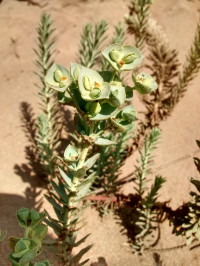
The leaves are generally simple, sometimes palmately compound, arranged alternately or more rarely oppositely, and may have stipules. The flowers are unisexual and radially symmetrical, often inconspicuous, arranged in inflorescences of various types. In particular, in the tribe Euphorbieae, present in Italy, the male and female flowers are grouped in a special structure called cyathium, which mimics a single flower but is actually a complex inflorescence. Cyathia can aggregate into larger inflorescences such as spikes or umbels.
Male flowers may consist of a single stamen, while female flowers have a superior tricarpellary and trilocular ovary. The family shows considerable variety in floral morphology, with the number of stamens ranging from 1 to 10. Plants can be monoecious (male and female flowers on the same plant) or dioecious (plants with flowers of only one sex).
The typical fruit is a two- or three-lobed capsule that opens at maturity to release the seeds.
Distribution and diversity
The Euphorbiaceae family is cosmopolitan, present in almost all climates worldwide except the arctic ones. Its distribution is mainly tropical, with the highest number of species in the Indomalayan regions (Southeast Asia and the Malay Archipelago) and the tropical Americas, followed by tropical Africa.
The family includes about 227 genera and over 6,500 species, with an extraordinary diversity of forms and environmental adaptations. This taxonomic richness makes Euphorbiaceae one of the largest and most complex families among dicotyledons.
Main genera and representative species
Among the best-known genera of the family are:
- Euphorbia: the type genus, highly diversified, including herbaceous, shrubby, and succulent species. In Italy, numerous species of Euphorbia are present, many recognizable by the typical cyathium inflorescence.
- Ricinus: includes the famous castor bean (Ricinus communis), an herbaceous plant known for its seeds from which castor oil is extracted, used in medicine and industry.
- Croton: genus of tropical shrubs and trees, some species used as ornamental plants.
- Jatropha: shrubs or trees often used for medicinal purposes or as energy plants.
- Hevea: includes the natural rubber plant (Hevea brasiliensis).
In Italy, besides numerous Euphorbia species, other representatives of the family are found, although less widespread.
Etymology
The family name derives from the type genus Euphorbia, dedicated to the physician of King Juba II of Numidia, Euphorbus, who used some species of this genus for medicinal purposes. The name was officially coined in 1789.
Curiosities and uses
Euphorbiaceae are of great ecological and cultural importance. Many species produce latex with toxic or irritating substances, which serve as a defense mechanism against herbivores.
From an economic point of view, this family includes plants used in very different fields:
- Food and industrial: such as castor oil extracted from Ricinus communis and natural rubber from Hevea brasiliensis.
- Medicinal: some species are used in traditional medicine for their pharmacological properties, although many contain toxic compounds.
- Ornamental: various genera and species, such as some succulent Euphorbias and Croton, are appreciated for their aesthetic value in gardens and greenhouses.
Sources
- Wikipedia (Italian)







Explore
Other botanical families