Botanical species
Eupatorium cannabinum
L.
Hemp Agrimony
Description
Morphological description
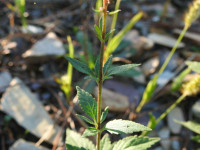
Perennial herbaceous plant, the species reaches a height between 60 and 150 cm, with occasional specimens exceeding 200 cm. The stem is erect, angular in cross-section and often reddish, covered with a pubescence of short, slightly curled hairs distributed also on the upper branches that form dense and flattened corymbs. The surface of the stem feels rough to the touch.
The root system consists of a fibrous, white-grayish, robust root that supports the plant in the moist substrates where it grows.
The leaves are arranged both oppositely and alternately along the stem, are shortly petiolate and have a herbaceous texture. The lower leaves are lanceolate, acuminate, while the upper ones are often divided into three lanceolate segments with acute apex. All leaves have irregularly serrated or toothed margins and show sparse pubescence, with evident glands especially on the lower surface. The venation is pinnate, with 5-6 pairs of lateral veins.
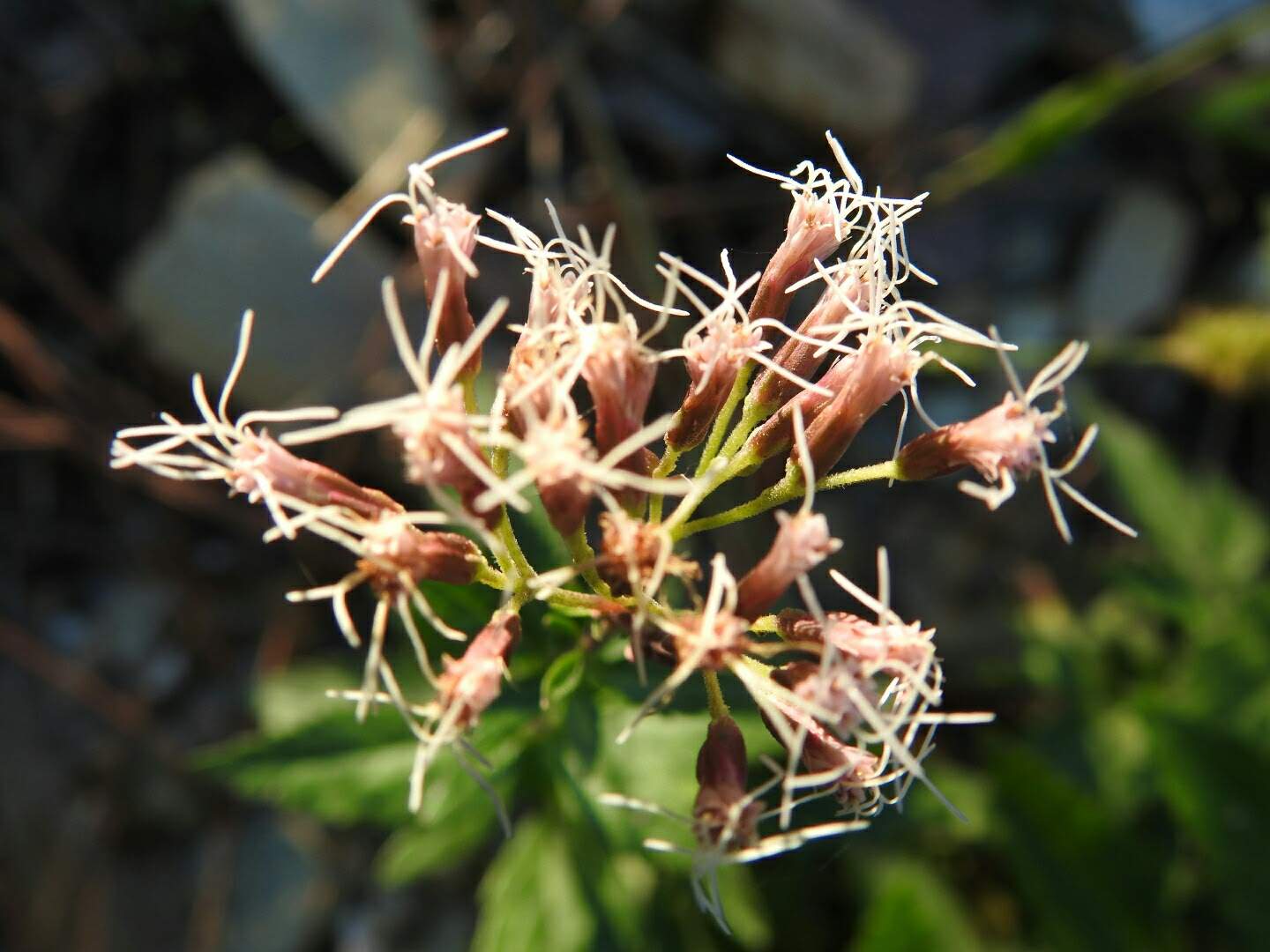
The flowers are gathered in small capitula, each composed of 4-6 tubular florets with five teeth, hermaphroditic and without ligules. The involucre of the capitula is cylindrical, 4-6 mm long, formed by imbricated scales with membranous margins and often purplish tips. The flower colors range from pale pink to purplish, sometimes tending to whitish. The average flower length is about 5-10 mm. The overall inflorescence is a dense and branched corymb, located at the apex of the main stems.
The fruits are angular-striated achenes about 2-3 mm long, black-brown in color, with five ribs and equipped with a pappus composed of a single row of stiff, white hairs 3-5 mm long, which facilitate wind dispersal.
Habitat and distribution
The plant is widespread throughout Italy and the Mediterranean area, with confirmed presence from sea level up to about 1400 meters altitude. It mainly grows in wet environments such as riverbanks, riverbeds, marshy areas, fresh woods and wet meadows, but is also found in ruderal and uncultivated soils. The common name "Hemp Agrimony" reflects precisely this preference for wet and aquatic habitats.
The preferred soil is generally moist or wet, with exposure ranging from partially shaded to sunny, in environments that ensure good water availability.
Flowering period
Flowering mainly occurs between July and October, with a higher concentration in the summer months (July-August). In some geographic areas, flowering may show slight temporal variations depending on altitude and local climatic conditions.
Ecology and pollination
The species reproduces mainly through seeds dispersed by wind thanks to the feathery pappus. The tubular and liguleless flowers are hermaphroditic and actinomorphic, have a slight fragrance and produce nectar, which attracts various pollinating insects, including bees, bumblebees and other hymenopterans, essential for fertilization. The structure of the inflorescence and the presence of numerous capitula facilitate entomophilous pollination.
The plant behaves as a scapose hemicryptophyte, i.e., perennial with buds at ground level and an elongated floral axis often leafless. It can become invasive under certain environmental conditions, especially in wet and disturbed habitats.
Curiosities and traditional uses
Hemp Agrimony is a medicinal species known since ancient times for its pharmacological properties, although it is also toxic due to the presence of hepatotoxic pyrrolizidine alkaloids. Among the active principles are eupatoriopicrin, with anticancer and cell growth inhibitory effects, immunostimulant polysaccharides and p-cymene, an essential oil with antiviral properties.
Traditionally, the plant has been used for its cholagogue and choleretic properties, useful in the treatment of liver disorders, as well as for its diuretic, depurative, laxative, expectorant and sudorific actions. Decoctions prepared with roots, leaves and flowering tops were also used to promote the healing of wounds, ulcers, eczema and other skin conditions.
Phytotherapeutic use is however discouraged without medical supervision due to its toxicity. No reliable alimentary uses are known, while in popular tradition the plant has been appreciated as a natural remedy against fevers and colds.
Etymology
The genus name Eupatorium derives from Greek and means "born of the noble father," a historical reference to Mithridates Eupator, king of Pontus in the 1st century BC, who according to tradition was the first to discover its medicinal properties.
The specific name cannabinum refers to the resemblance of the leaves to those of hemp (Cannabis sativa), with which it shares a palmate-lobed leaf appearance reminiscent of hemp.
The Italian common name "canapa acquatica" emphasizes both the leaf shape similar to hemp and the typical habitat of the species, linked to wet and aquatic environments.
Sources
- Acta Plantarum - Flora delle regioni italiane (actaplantarum.org)
- Acta Plantarum - Scheda di Mirna Medri
- Tela Botanica / H. Coste, Flore descriptive et illustrée de la France
- World Flora Online (WFO)
Characteristics
Scheda botanica
| Famiglia | Asteraceae |
|---|---|
| Fioritura | luglio – ottobre |
| Forma biologica | Scapose |
| Habitat | with white flowers, toxic plant, with pink flowers |
| Tossicità | Tossica — non consumare |
| Uso officinale | Pianta officinale |
Domande frequenti
- Quando fiorisce Hemp Agrimony?
- Hemp Agrimony fiorisce luglio – ottobre.
- È tossica Hemp Agrimony?
- Hemp Agrimony è una pianta tossica o velenosa. Non consumare nessuna sua parte senza aver consultato un esperto.
- Che tipo di pianta è Hemp Agrimony?
- Hemp Agrimony è una Hemicryptophytes (Scapose) secondo la classificazione di Raunkiaer.
- A quale famiglia appartiene Hemp Agrimony?
- Hemp Agrimony appartiene alla famiglia botanica Asteraceae.
Where I found it (6 sightings)
Classification
- Kingdom
- Plantae
- Family
- Asteraceae
- Full name
- Eupatorium cannabinum L.
- Life form
- Hemicryptophytes scapose
Similar species
Search for species with similar characteristicsFurther reading
Noticed an error in the identification? Write to me
Other species of the same family
Asteraceae
Explore
Other species of Asteraceae