Botanical species
Centaurea triumfettii
All.
Squarrose knapweed
Description
Morphological description
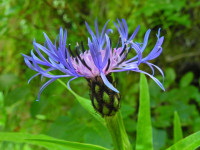
Squarrose knapweed is a perennial herbaceous plant belonging to the family Asteraceae, characterized by a scapose habit and a height generally ranging between 30 and 80 cm. The stem is erect, often simple, and has a sparsely pubescent surface with whitish felted hairs that give the plant a greenish-gray appearance, almost silvery in the young parts. At the base of the leaves, the stem has decurrent wings.
The root system consists of a short horizontal rhizome from which slender, tenacious, dark brown-black secondary roots arise.
The leaves are lanceolate, with entire margins, varying in size from 0.5 to 3 cm in length and 9 to 13 mm in width. The base can be narrowed or slightly clasping. The basal leaves are borne on a winged petiole, expanded at the base, while the cauline leaves are sessile, linear-lanceolate, and long-decurrent on the stem. The upper leaves, smaller, do not exceed the capitulum and are narrow and acute.
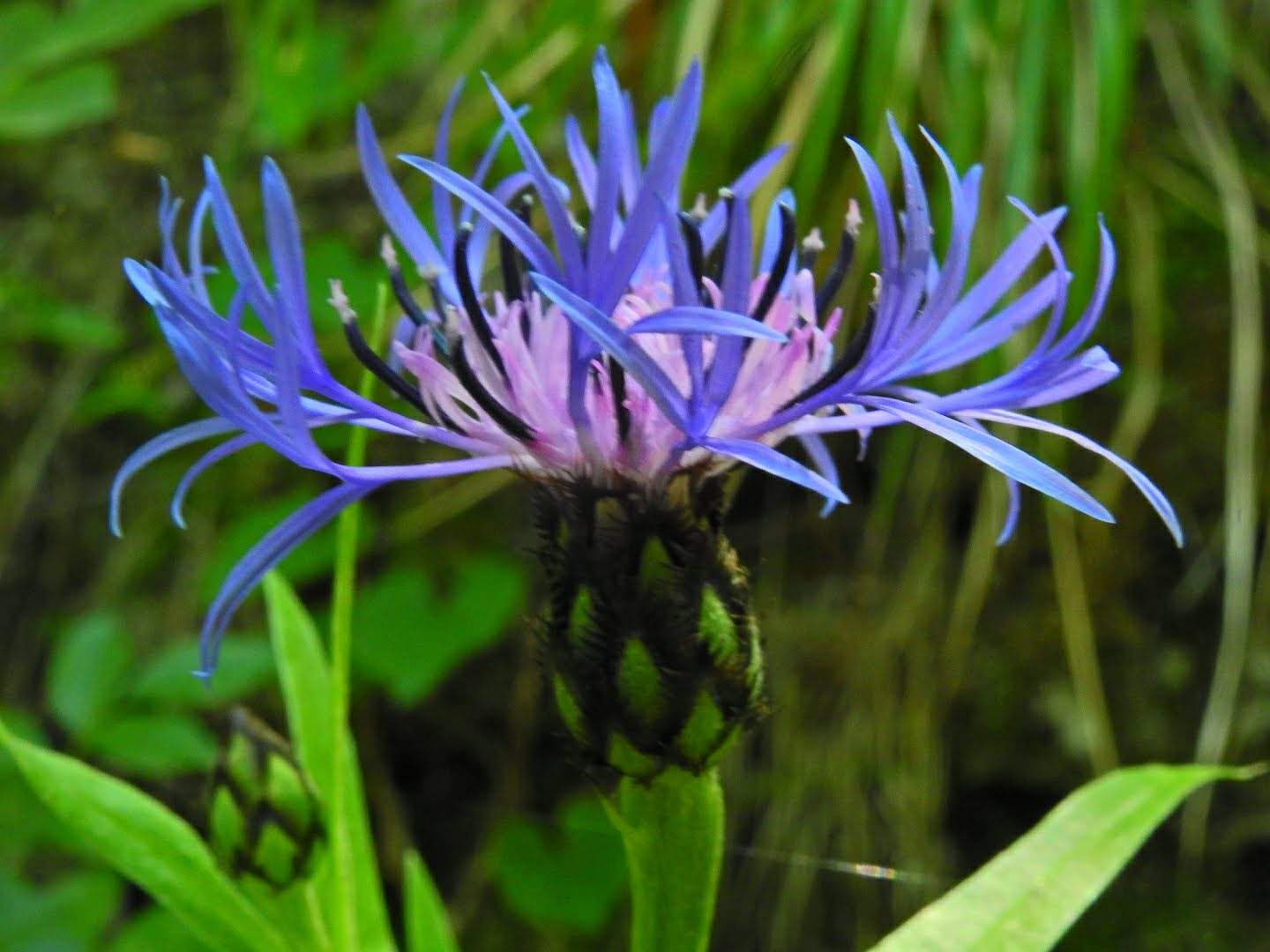
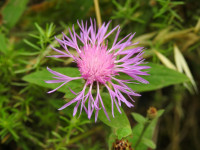
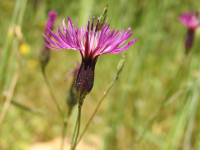
The flowers are grouped in one or two large capitula, up to 5 cm in diameter, solitary at the apex of the stem or branches. The involucre is cylindrical-ovate, 15 to 25 mm long, with involucral bracts having a lamina not clearly separated from the brown or black appendage. This appendage extends along the edges and bears on each side 9-15 pale brown cilia 1.5-2.5 mm long, longer than the underlying margin, an important distinctive characteristic in the determination of the species compared to similar species such as Centaurea montana.
The outer flowers are radiate, with a whitish tube that gradually fades to pink in the upper part and ligules of blue, violet, or lilac color. The central flowers are shorter, erect or erect-patent, purplish in color. The corolla is tubular and presents actinomorphic symmetry, with numerous petals arranged radially.
The fruit is a longitudinally striated achene, about 4-5 mm long, equipped with a pappus of hairs 1-2 mm long that facilitate dispersal.
Habitat and distribution
Squarrose knapweed is mainly distributed in the mountainous and hilly regions of southern and central Italy, with a prevalence in the southern European mountain ranges. It grows on dry meadows and scrublands, preferring sunny exposures and well-drained soils, often calcareous or rocky. The species adapts to varying altitudes, from sea level up to about 1400 meters, while in southern Italy and Sicily it can reach up to 1700 meters altitude.
In the Mediterranean, the species is considered a European orophyte, with a more marked presence in mountain and subalpine zones, where it develops in habitats of dry slopes and sparse forests.
Flowering period
The flowering period of Squarrose knapweed mainly extends from spring to summer, typically from May to August. No significant geographical variations in the flowering period are known, although at higher altitudes flowering may start slightly later due to climatic conditions.
Ecology and pollination
The plant has a reproductive strategy based on entomogamous pollination, attracting pollinating insects thanks to its colorful and highly visible flowers. The blue, lilac, or violet coloration of the radiate ligules is particularly effective in attracting bees, butterflies, and other pollinators, facilitating cross-fertilization.
Seed dispersal occurs mainly through the pappus of hairs which facilitates anemochory, allowing seeds to move even moderate distances from the mother plant.
Curiosities and traditional uses
Squarrose knapweed has a long history of use in European folk medicine, similar to other species of the genus Centaurea. The flowers are known for their medicinal properties: in the form of decoctions or infusions they were used to treat eye inflammations, rinses, and gargles in cases of irritated gums and mucous membranes. Furthermore, the plant was used as a mild diuretic and cough suppressant.
In cosmetic and phytotherapeutic fields, the plant was also used in baths for delicate and sensitive skin, thanks to its soothing properties.
From an ethnobotanical point of view, the flowers were used as a dye: combined with lime, they provided a durable green for plasters. Moreover, the flowers are still used today to extract natural dyes in pastry making, for coloring spoon desserts, and in artistic fields to obtain violet, light blue, or bright red pigments depending on treatment with alum or acids.
In the language of flowers, the knapweed symbolizes sweetness, happiness, and good wishes, and in some Eastern cultures it assumes symbolic values related to protection and sincerity.
Etymology
The genus name Centaurea derives from Latin "centaureum" and Greek "κενταυρίη", recalling the mythological figure of the centaur Chiron, known for his medical knowledge and for discovering the therapeutic virtues of many plants. This name reflects the ancient tradition attributed to these species of having healing properties.
The specific epithet triumfettii is dedicated to Giovanni Battista Trionfetti, an Italian physician and naturalist of the late 17th century, who was director of the Botanical Garden of Rome.
The Italian common name "Squarrose knapweed" refers precisely to this dedication, distinguishing the species from other related species commonly known as knapweeds.
Sources
- Acta Plantarum - Flora delle regioni italiane (scheda di Marinella Zepigi)
- World Flora Online (WFO)
Characteristics
Scheda botanica
| Famiglia | Asteraceae |
|---|---|
| Fioritura | maggio – agosto |
| Forma biologica | Scapose |
| Habitat | with lilac flowers, with purple flowers, with blue flowers |
Domande frequenti
- Quando fiorisce Squarrose knapweed?
- Squarrose knapweed fiorisce maggio – agosto.
- Che tipo di pianta è Squarrose knapweed?
- Squarrose knapweed è una Hemicryptophytes (Scapose) secondo la classificazione di Raunkiaer.
- A quale famiglia appartiene Squarrose knapweed?
- Squarrose knapweed appartiene alla famiglia botanica Asteraceae.
Classification
- Kingdom
- Plantae
- Family
- Asteraceae
- Full name
- Centaurea triumfettii All.
- Synonyms
- Cyanus triumfettii (All.) Dostál ex Á.Löve & D.Löve
- Life form
- Hemicryptophytes scapose
Similar species
Search for species with similar characteristicsNoticed an error in the identification? Write to me
Other species of the same family
Asteraceae
Explore
Other species of Asteraceae