Botanical species
Galactites tomentosus
Moench
Boar Thistle
Description
Morphological description
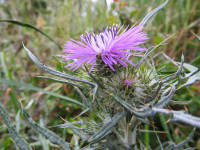
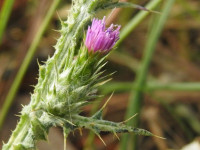
Biennial herbaceous plant generally up to 1 meter tall, with an erect habit and a branched stem especially in the upper part. The stem is characteristically white-tomentose, meaning covered with a dense woolly pubescence, and is provided with spiny lateral wings, features that distinguish it from related species. The surface of the stem also shows a slight cobwebby texture and hairiness, giving it a velvety and silky appearance.
The leaves are between 10 and 20 cm long, pinnatisect, meaning divided into several deeply incised segments, with a green blade variegated with white on the upper side and white-tomentose on the underside. The margins are robustly spiny and sharply pointed, giving the plant a defensive appearance. Rarely, the leaves may appear with an almost entire blade or, conversely, reduced to only the spiny ribs. The leaves are sessile and sometimes drooping along the stem.
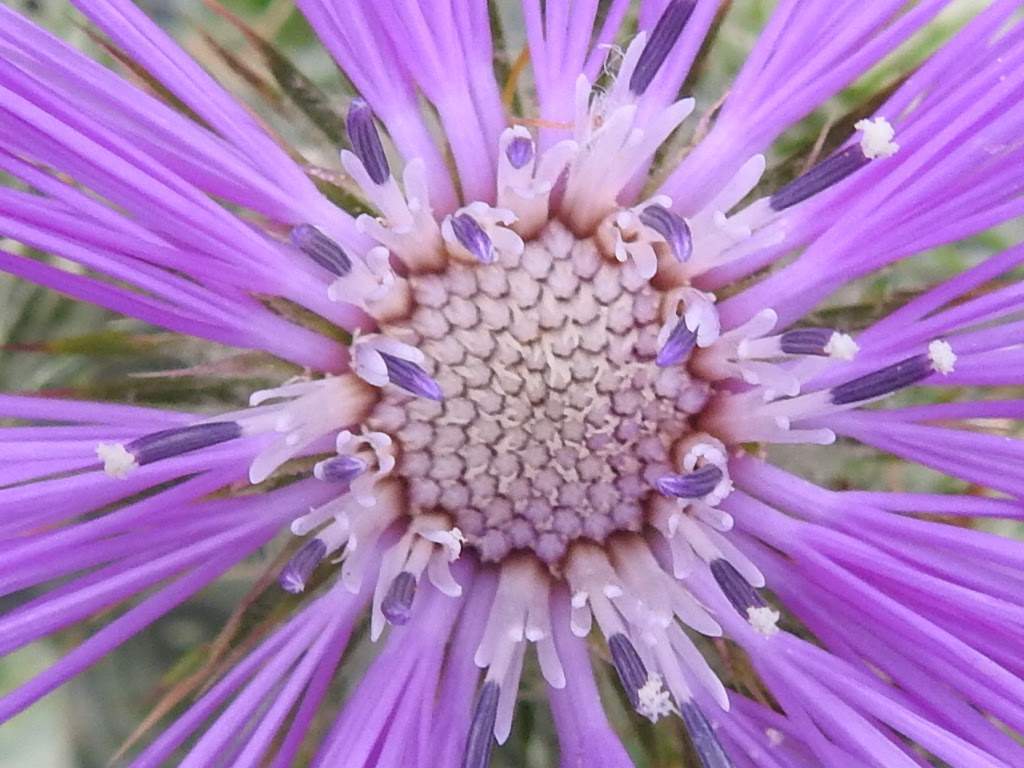
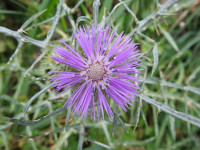
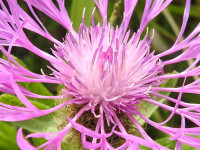
The flower heads, solitary or grouped in small clusters, are relatively large and bell-shaped. The involucre is composed of triangular scales, often cobwebby and with a long apical spine grooved on the upper surface. The flowers are exclusively tubular, with corollas varying in color from lilac, violet to purple, about 2 cm long. The central flowers are hermaphroditic, tetramerous and pentamerous, while the peripheral ones are sterile and longer, forming an outer ray. The stamens have fused filaments and anthers welded into a tube surrounding the single style, with a deeply bifid stigma.
The fruit is a compressed achene, brownish and shiny, equipped with a hemispherical crown of small persistent scales or bristles and a pappus consisting of whitish feathery bristles about 13 mm long, which facilitate anemochorous dispersal (wind transport).
The root system, as in most biennial Asteraceae, is taprooted, with a robust main root that allows anchorage and absorption in the dry areas where it grows.
Habitat and distribution
A typically Mediterranean species with a steno-Mediterranean distribution, Galactites tomentosus is present along the coasts of the Mediterranean basin, particularly in Italy, Greece, Spain, Portugal and North Africa. In Italy it is commonly found especially in coastal regions and the internal Mediterranean area, including Corsica. It grows spontaneously in uncultivated, dry, rocky or sandy soils, along roadsides and in ruderal environments, preferring poor, well-drained soils and sunny exposure.
The growth altitude ranges from sea level up to about 1300 meters. The species is well adapted to arid conditions and calcareous soils, typical of Mediterranean ecosystems, and is often associated with maquis and garrigue vegetation.
Flowering period
Flowering generally occurs between April and July, with possible variations related to altitude and latitude. In some Mediterranean areas, flowering can extend until August. During this period, the appearance of colorful flower heads that attract pollinating insects is observed.
Ecology and pollination
The species is entomogamous, meaning primarily pollinated by insects, which are attracted by the tubular flowers with bright colors (lilac, violet, purple) and the nectar offered. The structure of the flowers, with well-developed stamens and stigma, facilitates the transfer of pollen from one individual to another, promoting cross-fertilization and genetic variability.
Seed dispersal occurs mainly through the wind, thanks to the feathery pappus that allows the achenes to be transported even at considerable distances from the mother plant. This anemochorous dissemination mechanism facilitates colonization of new habitats, especially in open and disturbed environments.
Curiosities and traditional uses
This species, known by the common name Boar Thistle, has historically been recognized also as an edible plant. Already in antiquity figures such as Diodorus and Dioscorides suggested its food use. The young inflorescences and flowering stems can be eaten raw in salads, after careful cleaning, while leaves and stem, also rich in nutrients, are used for preparations in oil or vinegar, similarly to what is done with other species of thistles and wild artichokes.
The traditional food use also highlights its considerable resistance in arid and poor environments, making it an interesting local resource in contexts of biodiversity and Mediterranean cuisine.
Etymology
The genus name Galactites derives from the Greek “gála, gálaktos” meaning “milk”, referring to the white color of the dense woolly pubescence covering the stem and leaves of the plant. The specific epithet tomentosus precisely indicates the characteristic dense and soft pubescence (tomo = hair, tomentose = covered with hair). The Italian common name "scarlina tomentosa" recalls this hairy characteristic (tomentose) and the often violet color of the flowers (scarlina, from “scarlet” meaning bright red in English, referring to the purplish color).
Sources
- Prof. S. Pignatti, "Flora d'Italia"
- Acta Plantarum - Flora delle regioni italiane (sheet by Marinella Zepigi)
- Tela Botanica / H. Coste, "Flore descriptive et illustrée de la France"
Characteristics
Scheda botanica
| Famiglia | Asteraceae |
|---|---|
| Fioritura | aprile – luglio |
| Forma biologica | Biennials |
| Habitat | with lilac flowers, spiny plant, with purple flowers |
Domande frequenti
- Quando fiorisce Boar Thistle?
- Boar Thistle fiorisce aprile – luglio.
- Che tipo di pianta è Boar Thistle?
- Boar Thistle è una Hemicryptophytes (Biennials) secondo la classificazione di Raunkiaer.
- A quale famiglia appartiene Boar Thistle?
- Boar Thistle appartiene alla famiglia botanica Asteraceae.
Where I found it (3 sightings)
Classification
- Kingdom
- Plantae
- Family
- Asteraceae
- Full name
- Galactites tomentosus Moench
- Synonyms
- Centaurea galactites L.; Galactites elegans (All.) Soldano; Galactites pumila Porta; Lupsia galactites (L.) Kuntze
- Life form
- Hemicryptophytes biennials
Similar species
Search for species with similar characteristicsFurther reading
Noticed an error in the identification? Write to me
Other species of the same family
Asteraceae
Explore
Other species of Asteraceae