Botanical species
Erodium malacoides
(L.) L'Hér.
Soft Stork's-bill
Description
Morphological description
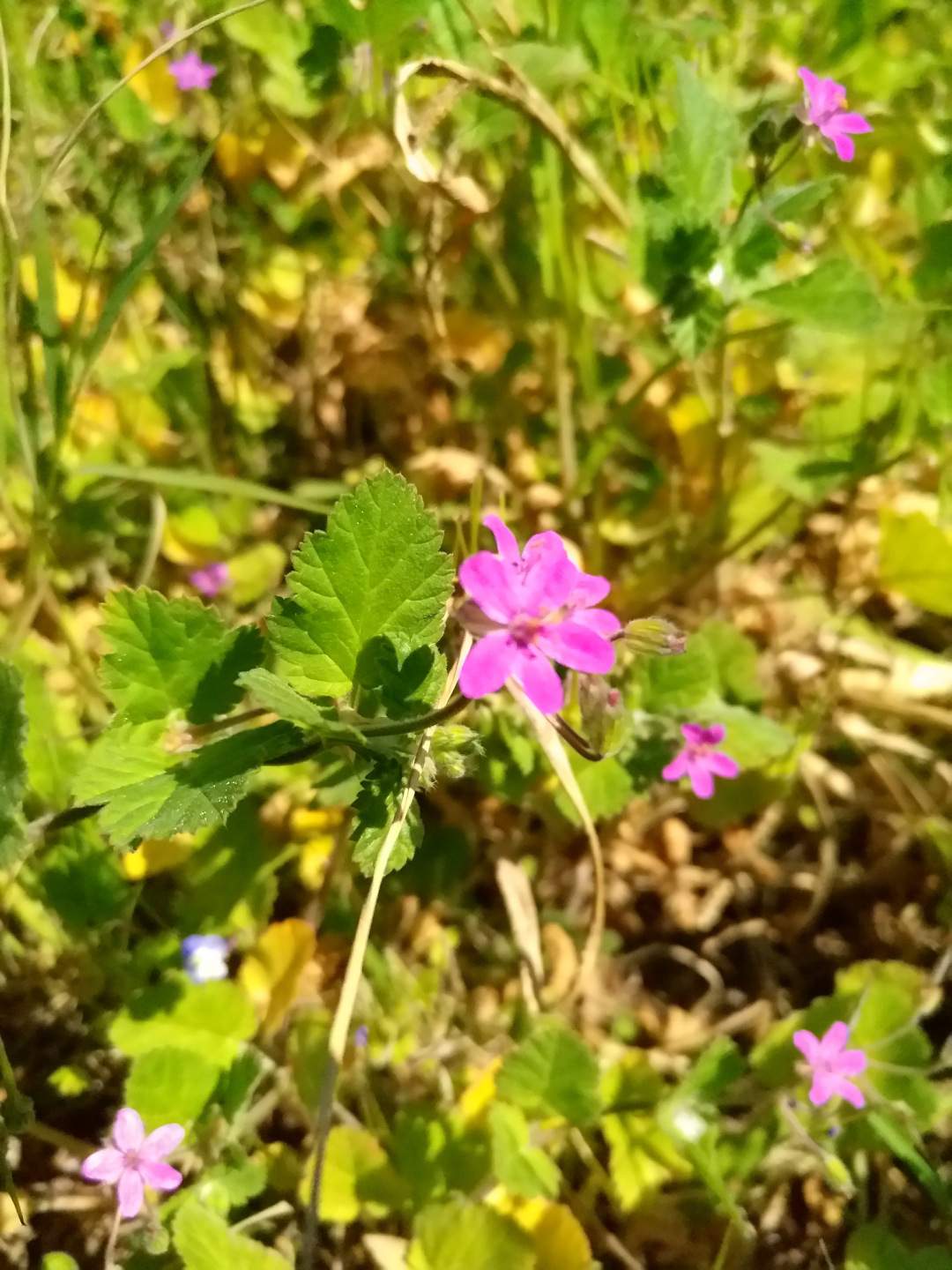
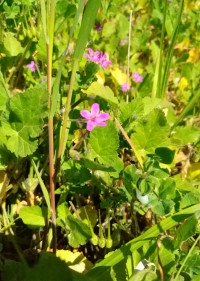
Annual or biennial herbaceous plant, typically 10 to 50 cm tall, with an erect to ascending or sometimes prostrate habit. The stem is grooved, branched-ascending, covered with dense pubescence consisting of downward-facing bristles and glandular hairs, giving it a rough and coarse surface. The root system is taproot type, with a well-developed main root.
The leaves are alternate, mainly concentrated at the base of the plant (basal leaves) and smaller and subsessile along the stem (cauline leaves). Basal leaves have a petiole 4-6 cm long and an oval blade, longer than wide, with variable dimensions around 2-3 cm wide by 3-6 cm long. The margin is coarsely dentate or crenulate and often slightly lobed or subpinnatifid; the texture is herbaceous, with a generally hairy surface and sometimes with sessile glands. Cauline leaves are similar but smaller and with a shorter or absent petiole.
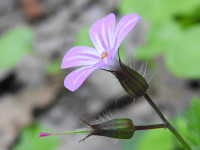
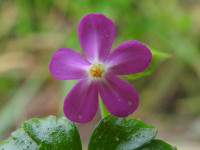
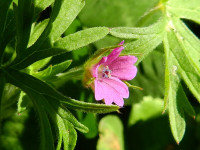
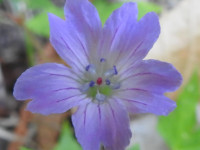
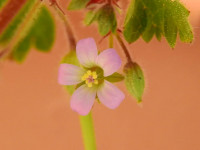
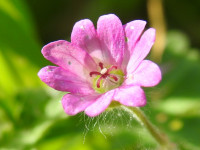
The inflorescence consists of umbels composed of 3-8 flowers on peduncles 3-7 cm long, generally longer than the leaves. At the base of the umbels are ovate, membranous bracts also covered with hairs. The flowers are hermaphroditic, actinomorphic, with five obovate petals, fuchsia or violet-lilac in color, 5-9 mm long, slightly longer than the sepals (5-6 mm). The calyx is formed by five free sepals, pointed and often ending with a small mucro, with 3-5 nerves. The androecium includes five fertile stamens, alternating with five scale-like staminodes, all fused at the base. The ovary is superior with styles fused into a long beak.
The fruit is a brownish achene 5-6 mm long, provided with two apical pits with concentric ridges, covered by erect-patent reddish bristles about 0.5 mm long. The fruit ends with a slender beak, 2-3 cm long, which bends at fruiting. This beak is formed by the fusion of the styles and plays a fundamental role in seed dispersal. The achene separates at maturity through a hygroscopic coiling mechanism of the spiral awns of the beak, which promotes anchoring to the soil and penetration into the ground.
Habitat and distribution
Species widely distributed in the Mediterranean area and Macaronesia, in Italy it is mainly present in southern regions, on the islands and along the coasts, but can reach up to 1300 meters altitude. It prefers mountainous and hilly environments, but also occurs at lower altitudes, from sea level up to medium-high elevations.
It favors anthropized and disturbed habitats such as uncultivated lands, road edges, dry pastures, vineyards, ruderal areas and gardens, showing excellent adaptability to sandy, dry or nutrient-poor soils. Its presence is also reported in coastal environments on sandy dunes and places with light, well-drained soil.
Flowering period
Flowering extends from February to November, with a spring peak between April and July. In some southern areas and Mediterranean islands, flowering can begin as early as late winter and continue until autumn. This long phenological window allows the species to exploit different climatic and environmental conditions.
Ecology and pollination
The flowers, hermaphroditic and actinomorphic, are adapted to entomophilous pollination, attracting various pollinating insects thanks to the bright color of the petals and the presence of nectar. The number and arrangement of stamens ensure good reproductive efficiency. The seed dispersal strategy is peculiar: the fruits, thanks to the spiral beak, coil and uncoil in response to humidity, allowing the seeds to penetrate the soil and also to be transported over distances by attaching to animal fur. This mechanism promotes effective and localized dispersal.
Curiosities and traditional uses
No specific traditional medicinal or food uses are reported for this species. However, the genus name and the characteristics of the fruit testify to a historical and botanical interest in the observation of seed morphology, used as a classic example of adaptation to dispersal. The common name “Soft Stork's-bill” refers both to the shape of the fruit and to the leaf similarities with the Malvaceae.
Etymology
The genus name Erodium derives from the Greek “erodios”, meaning “heron”, referring to the elongated and slender shape of the fruit, similar to the beak of a heron or a stork. The specific name malacoides refers to the similarity of the leaves with those of the Malvaceae (from the Greek “malache”, mallow). The Italian common name “becco di gru malvaceo” combines these two features: the shape of the fruit (stork's-bill) and the leaf similar to that of the mallow.
Sources
- Prof. S. Pignatti, "Flora d'Italia"
- Acta Plantarum - Flora delle regioni italiane (scheda di Daniela Longo)
- Tela Botanica / H. Coste, "Flore descriptive et illustrée de la France"
- World Flora Online (WFO)
Characteristics
Scheda botanica
| Famiglia | Geraniaceae |
|---|---|
| Fioritura | febbraio – novembre |
| Forma biologica | Scapose |
| Habitat | with fuchsia flowers, annual plant |
Domande frequenti
- Quando fiorisce Soft Stork's-bill?
- Soft Stork's-bill fiorisce febbraio – novembre.
- Che tipo di pianta è Soft Stork's-bill?
- Soft Stork's-bill è una Therophytes (Scapose) secondo la classificazione di Raunkiaer.
- A quale famiglia appartiene Soft Stork's-bill?
- Soft Stork's-bill appartiene alla famiglia botanica Geraniaceae.
Where I found it (2 sightings)
Classification
- Kingdom
- Plantae
- Family
- Geraniaceae
- Full name
- Erodium malacoides (L.) L'Hér.
- Life form
- Therophytes scapose
Similar species
Search for species with similar characteristicsFurther reading
Noticed an error in the identification? Write to me
Other species of the same family
Geraniaceae
Explore
Other species of Geraniaceae