Botanical species
Erodium moschatum
(L.) L'Hér.
Musk Stork's-Bill
Description
Morphological description
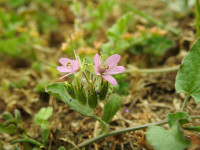
Annual or biennial plant, with a height ranging between 20 and 80 cm, characterized by a scapose habit with ascending or slightly prostrate stems. The stems are robust, branched, angular in section and have a densely hairy, striated, tomentose surface, with hirsute and cobwebby hairs. The leaves are alternate, pinnate, with ovate or elliptical segments, incised-toothed, slightly pubescent and equipped with a short petiole; the stipules are triangular and membranous, located at the insertion of the leaf rachis.
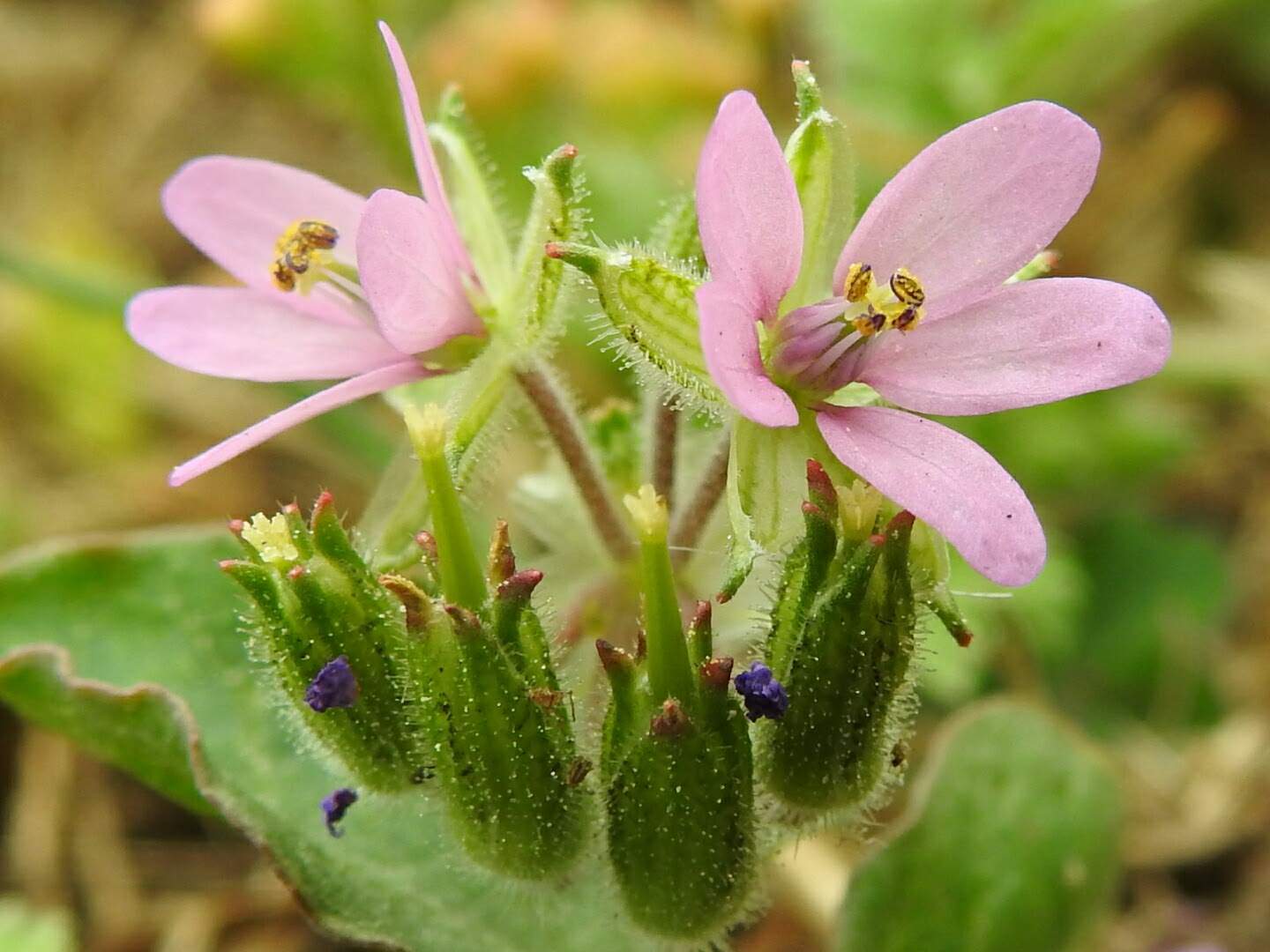
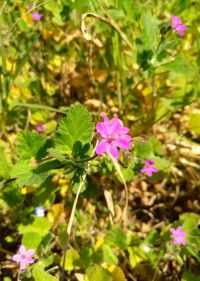
The inflorescences appear in racemes or umbels of 3-12 flowers, borne on long thin peduncles that often bend at the apex. The flowers have five entire petals, pinkish violet or lilac in color, slightly longer than the sepals, which are oblong-lanceolate and acuminate, about 6-8 mm long. The filaments of the fertile stamens are glabrous and have two teeth at the base.
The fruit is a schizocarp composed of five hirsute mericarps, each equipped with a long beak of 3-4.5 cm, characteristic and similar in shape to the beak of a heron, with an annular constriction below the beak. The root system, although little documented in sources, is typical of annual or biennial plants of ruderal environments, thus presumably well developed for rapid anchorage and absorption.
The plant emits a characteristic musk aroma, due to the presence of essential oils and resins on the surface.
Habitat and distribution
This species is typical of Mediterranean regions, with a eurymediterranean distribution extending north and east to central European areas. In Italy it is mainly widespread along the coasts and hilly areas, from sea level up to 1300 meters altitude. It grows predominantly in ruderal environments such as rubble, uncultivated places, sandy or clay soils, road and railway edges, preferring sunny or semi-shaded exposures.
Its presence is also documented in other areas of the Mediterranean basin, in central and southern Europe, up to western Asia and North Africa.
Flowering period
Flowering extends from April to September, with possible local variation depending on altitude and climatic conditions. In the warmer Mediterranean climates the plant can begin flowering already in early spring, while at higher altitudes or more northern regions flowering is concentrated mainly in the summer months.
Ecology and pollination
The plant reproduces sexually through hermaphroditic flowers, attractive to a variety of pollinating insects, although no specific relationships with particular pollinators are documented. The flower structure and nectar production favor entomogamous pollination.
The fruits, equipped with a long beak, are schizocarps that open into five mericarps, each equipped with a mechanical device that favors seed dispersal. The seeds are probably dispersed both by auto-dispersal mechanisms and by external agents such as wind or animals, although no specific dispersal strategies are known.
Curiosities and traditional uses
This species is known for its medicinal and edible properties. The entire plant contains tannins, essential oils and resins that make it useful in the preparation of infusions with diaphoretic action and slightly stimulating for digestive functions.
Historically it has been used in popular phytotherapy to promote sweating and improve digestion. Nevertheless, medicinal and alimentary uses should be considered with caution and for informational purposes only, without replacing medical advice or professional indications.
Etymology
The genus name Erodium derives from the Greek “erodios”, meaning heron, referring to the elongated and pointed shape of the fruit, similar to the beak of this bird. The specific epithet moschatum indicates the characteristic musk aroma emitted by the plant.
The Italian common name “becco di gru aromatico” also refers to the particular shape of the fruit (similar to the beak of a crane or heron) and the musky odor that distinguishes it.
Sources
- Acta Plantarum - Flora delle regioni italiane (actaplantarum.org)
- Acta Plantarum - Scheda di Marinella Zepigi
- Tela Botanica / H. Coste, "Flore descriptive et illustrée de la France"
- World Flora Online (WFO)
Characteristics
Scheda botanica
| Famiglia | Geraniaceae |
|---|---|
| Fioritura | gennaio – maggio |
| Forma biologica | Scapose |
| Habitat | with pink flowers, annual plant, plant with leaves with irregularly toothed margin |
| Uso officinale | Pianta officinale |
Domande frequenti
- Quando fiorisce Musk Stork's-Bill?
- Musk Stork's-Bill fiorisce gennaio – maggio.
- Che tipo di pianta è Musk Stork's-Bill?
- Musk Stork's-Bill è una Therophytes (Scapose) secondo la classificazione di Raunkiaer.
- A quale famiglia appartiene Musk Stork's-Bill?
- Musk Stork's-Bill appartiene alla famiglia botanica Geraniaceae.
Where I found it (2 sightings)
Classification
- Kingdom
- Plantae
- Family
- Geraniaceae
- Full name
- Erodium moschatum (L.) L'Hér.
- Synonyms
- Geranium cicutarium L. var. moschatum L.; Geranium moschatum (L.) L.
- Life form
- Therophytes scapose
Similar species
Search for species with similar characteristicsFurther reading
Noticed an error in the identification? Write to me
Other species of the same family
Geraniaceae
Explore
Other species of Geraniaceae