Botanical species
Geranium nodosum
L.
Knotted Crane's-Bill
Description
Morphological description
Perennial herbaceous plant of modest size, generally 20 to 50 cm tall, with an erect or ascending habit. The stem is slender, sparsely branched, angular in cross-section and characteristically swollen at the nodes, from which the common name “Knotted Crane's-Bill” derives. The stem surface is pubescent, covered with sparse non-glandular hairs, giving a slight fuzziness.
The leaves are arranged both at the base and along the stem. The basal leaves, with petioles 6-12 cm long, have a blade 7-9 cm long and 5-7 cm wide, polygonal and deeply divided into 5 ovate-oblong segments, with crenate-dentate margins. The upper leaf surface is dark green, while the lower surface is lighter and pubescent. The cauline leaves are smaller, with shorter petioles, and show a tripartite division with two basal lobes. The stipules are lanceolate, hairy on the lower surface and generally glabrous on the upper surface.
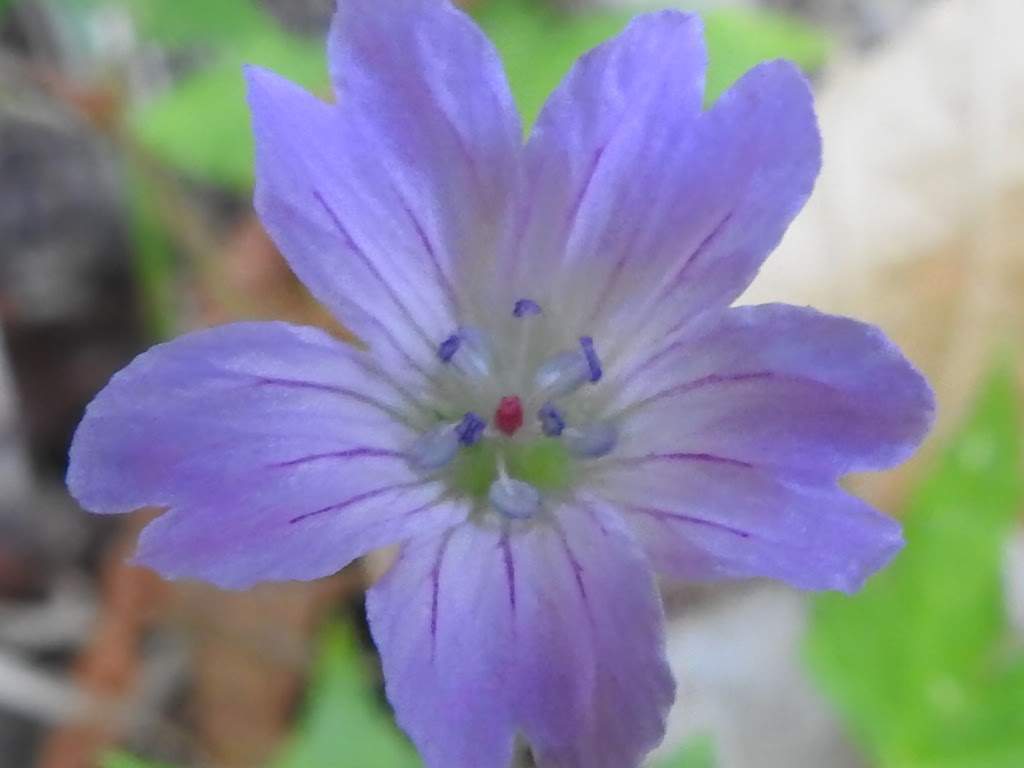
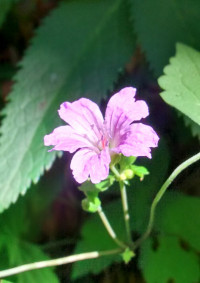
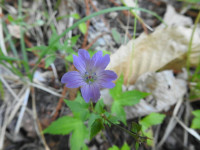
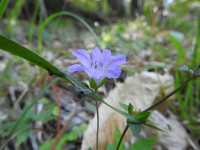
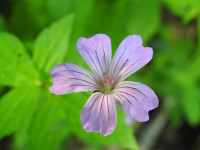
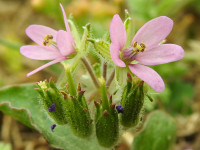
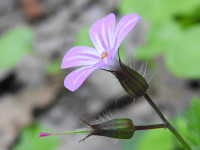
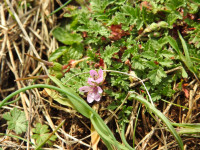
The flowers, borne on pubescent peduncles, are usually grouped in two-flowered cymes. Each flower is pentamerous, with five sepals about 9 mm long, equipped with a short apical point (mucro) and covered with fine hairs. The petals, 12-18 mm long and longer than the sepals, vary in color from pale lilac to violet, passing through pink shades with pearly reflections; they show evident darker veins and are notched at the tip, with a slightly heart-shaped incision. Ten stamens with ciliate filaments and bluish anthers surround a purplish stigma.
The fruit is a characteristic schizocarp, called "stork's beak," with five pubescent achenes equipped with a transverse crest at the apex. At maturity, the achenes curl upwards, facilitating the dispersal of brown-reddish seeds.
The root system develops from an elongated and thin underground rhizome, which each year produces new stems and roots, giving the plant the ability to survive and regenerate over time.
Habitat and distribution
This species is typical of broadleaf woods, especially favoring beech, oak, and chestnut forests. It frequently occupies shady environments, often more at the forest edge than inside denser woodland formations. It adapts well to well-drained soils but can also grow in relatively dry conditions.
In Italy, its distribution is mainly montane and submontane. It is especially present on the peripheral chains of the Alps (from the Julian Alps to the Grappa group, Lessini, Bondone, Giudicarie up to the Bergamasque Prealps and Grigne), in the Piedmont valleys up to Ivrea, and along the northern and central Apennines up to the imaginary line connecting Monte Amiata, Senese, Pratomagno, Casentino, Monte Nerone, Monte Catria. The species does not extend continuously further south, where it is replaced by Geranium versicolor, with which it shares a limited contact area in the Marche region. In the Mediterranean basin, besides Italy, it is found in some regions of Spain, Switzerland, Dalmatia, Montenegro, and Corsica.
The growth altitude generally ranges from 200 to 1600 meters, adapting to hilly and mountainous conditions, often along watercourses and in cool but not excessively humid forested areas.
Flowering period
Flowering extends from June to July, with a possible extension up to September in more southern regions or under particular climatic conditions. In its mountainous areas, flowering is mainly concentrated in the summer months, when temperatures are milder and pollinating insects are more active.
Ecology and pollination
The plant mainly relies on pollinating insects for pollination, including bees and other pollinators attracted by the vivid color and veins of the petals, which act as guides to the nectar. The flower structure, with well-exposed stamens and pistils, facilitates contact with pollinators.
Seed dispersal occurs thanks to the characteristic schizocarp mechanism, which, once mature, curls and launches the achenes away from the mother plant, favoring colonization of new areas. The presence of an underground rhizome also allows local vegetative expansion, giving the plant a good capacity for persistence and regeneration in forest habitats.
Curiosities and traditional uses
The genus name, Geranium, derives from the Greek “géranos” meaning crane, referring to the shape of the fruit that resembles the beak of this bird. The specific name “nodosum” refers to the swollen nodes of the stem, a distinctive characteristic of the species.
Traditionally, the aerial part of this plant has been used in phytotherapy for its astringent, anti-inflammatory, and vulnerary properties, i.e., to promote wound healing. These medicinal uses are documented but should be considered with caution, as they do not replace modern medical therapies.
From a dietary and folkloric point of view, no significant or particular uses related to this species are reported, which remains predominantly a wild plant of botanical and naturalistic interest.
Etymology
The scientific name is based on two Latin/Greek terms: “Geranium” from the Greek “géranos” (crane), due to the shape of the fruit resembling the beak of a crane, and “nodosum,” from the Latin adjective “nodosus,” referring to the swollen and visible nodes along the stem. The Italian common name “geranio nodoso” derives directly from this morphological characteristic.
Sources
- Prof. S. Pignatti, Flora d'Italia
- Acta Plantarum – Flora delle regioni italiane (scheda di Giuliano Salvai)
- Tela Botanica / H. Coste, Flore descriptive et illustrée de la France
- World Flora Online (WFO)
Characteristics
Scheda botanica
| Famiglia | Geraniaceae |
|---|---|
| Fioritura | giugno – luglio |
| Forma biologica | Rhizomatous |
| Habitat | with lilac flowers, with purple flowers, with pink flowers |
Domande frequenti
- Quando fiorisce Knotted Crane's-Bill?
- Knotted Crane's-Bill fiorisce giugno – luglio.
- Che tipo di pianta è Knotted Crane's-Bill?
- Knotted Crane's-Bill è una Geophytes (Rhizomatous) secondo la classificazione di Raunkiaer.
- A quale famiglia appartiene Knotted Crane's-Bill?
- Knotted Crane's-Bill appartiene alla famiglia botanica Geraniaceae.
Where I found it (15 sightings)
Classification
- Kingdom
- Plantae
- Family
- Geraniaceae
- Full name
- Geranium nodosum L.
- Life form
- Geophytes rhizomatous
Similar species
Search for species with similar characteristicsFurther reading
Noticed an error in the identification? Write to me
Other species of the same family
Geraniaceae
Explore
Other species of Geraniaceae