Botanical species
Geranium dissectum
L.
Cut-leaved Crane's-bill
Description
Morphological description
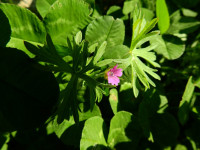
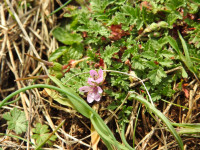
Annual herbaceous plant, with a prostrate-ascending habit, very branched, with stems generally between 10 and 50 cm long. The stem is covered with scattered, stiff, backward-facing and rough hairs especially at the base, giving a rough texture. The root system is fibrous with a well-developed main root.
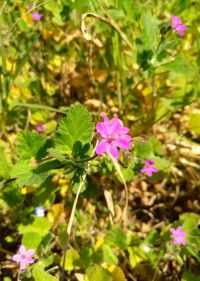
The leaves, orbicular in shape and with petioles about 15 cm long, are palmately lobed and deeply divided into 5-7 narrow segments which in the upper half further subdivide into linear lobes. The leaf surface is herbaceous, both adaxial and abaxial, with appressed eglandular and glandular trichomes. The cauline leaves are generally opposite, with lanceolate stipules sometimes lobed. Young leaves show less marked divisions and can be confused with those of Geranium molle; however, the different hairiness of the petioles allows distinction: G. dissectum presents short hairs mixed with long, stiff and reflexed hairs, while G. molle has long, soft and wavy hairs.
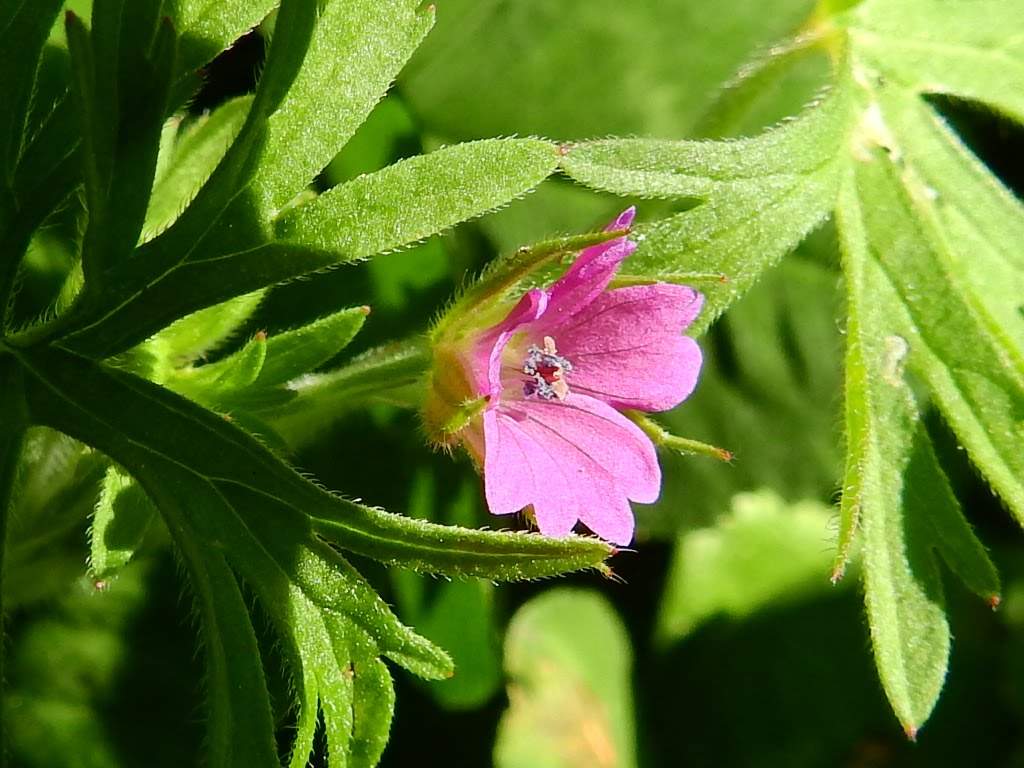
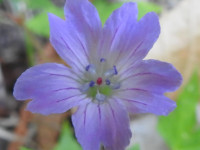
The inflorescence consists of two-flowered cymes with hairy peduncles that elongate during fruiting up to 1-2 cm; the bracts are lanceolate. The flowers are hermaphroditic, paired, with peduncles shorter than the leaves from which they arise and pedicels slightly longer than the sepals. The calyx has 5 lanceolate, three-nerved, mucronate sepals with scarious margins, generally longer than the petals. The corolla is composed of 5 simple petals, varying in size between 2.9 and 5.9 mm in length and 1.7-2.8 mm in width, pink or light red-purple in color. The upper edge of the petals is slightly notched and emarginate, generally heart-shaped; the petals have cilia only on the basal margin. The fertile stamens are 10, erect, with ciliate filaments pinkish at the apex, shorter than the sepals. The stigma is purple. The ovary is superior, simple and pubescent, with 5 carpels that blacken during fruiting.
The fruit is a schizocarp with a beak about 15 mm long, formed by 5 pubescent, smooth mericarps without a basal callus or swelling, each containing a brown-reddish, elliptical seed, 1-2 mm in diameter, characterized by a strongly reticulate-pitted surface.
Habitat and distribution
This species is present throughout much of Italy and the Mediterranean basin, where it preferentially grows in ruderal environments, grasslands, hedges, uncultivated areas, dumps and roadside margins. It is frequently considered a weed in cultivated fields, especially in hoed soils. It prefers dry, stony but nutrient-rich soils. The altitudinal range extends from sea level up to about 1300 meters.
Flowering period
Flowering extends from April to September, with marginal variations depending on local climatic conditions.
Ecology and pollination
The hermaphroditic flowers are pollinated by pollinating insects attracted by the pink-purple color and floral structure. The presence of emarginate petals and ciliate stamens facilitates access and pollen deposition on insects. The plant reproduces mainly by seed; dispersal is favored by the elongated beak of the schizocarp, which functions as a catapult mechanism for seed dissemination. The seeds, equipped with a reticulate surface, can adhere to substrates or be transported by wind or animals.
Curiosities and traditional uses
Cut-leaved Crane's-bill has a long history of use in phytotherapy. It is known for its antiseptic, astringent, styptic and tonic properties. The underground parts were traditionally used in the treatment of disorders such as angina, nephritis, hemorrhages and bruises. Tannins and natural dyes are obtained from the plant, evidence of its value in popular culture and craftsmanship.
No food uses or particular folkloric references are documented in the consulted literature.
Etymology
The generic name Geranium derives from the Greek "géranos", meaning crane, referring to the elongated and articulated shape of the fruits which resemble the beak of this bird. The specific epithet dissectum indicates the characteristic of the deeply divided (dissected) leaves. The Italian common name "geranio sbrandellato" refers precisely to the jagged and finely lobed appearance of the leaves.
Sources
- Acta Plantarum - Flora delle regioni italiane (actaplantarum.org)
- Acta Plantarum - Flora delle regioni italiane (scheda di Giuliano Salvai)
- World Flora Online (WFO)
Characteristics
Scheda botanica
| Famiglia | Geraniaceae |
|---|---|
| Fioritura | aprile – settembre |
| Forma biologica | Scapose |
| Habitat | with pink flowers, annual plant, plant with a prostrate-ascending habit |
Domande frequenti
- Quando fiorisce Cut-leaved Crane's-bill?
- Cut-leaved Crane's-bill fiorisce aprile – settembre.
- Che tipo di pianta è Cut-leaved Crane's-bill?
- Cut-leaved Crane's-bill è una Therophytes (Scapose) secondo la classificazione di Raunkiaer.
- A quale famiglia appartiene Cut-leaved Crane's-bill?
- Cut-leaved Crane's-bill appartiene alla famiglia botanica Geraniaceae.
Where I found it (11 sightings)
Classification
- Kingdom
- Plantae
- Family
- Geraniaceae
- Full name
- Geranium dissectum L.
- Life form
- Therophytes scapose
Similar species
Search for species with similar characteristicsFurther reading
Noticed an error in the identification? Write to me
Other species of the same family
Geraniaceae
Explore
Other species of Geraniaceae